
Where the Myth Comes From
Ask around and you'll likely hear it: "You should carry a small balance on your card so the credit bureaus can see you're using credit." It sounds plausible, and it's been repeated so often that many people treat it as fact. It isn't.
This misconception appears to stem from a misunderstanding of how credit utilization works. Utilization - the share of your available credit that you're using - is a real and meaningful factor in your credit score. But the scoring models that calculate your score look at your reported balance, not whether you paid interest on it. Those are two very different things. You can have a reported balance and still pay it off completely by the due date.
For a fuller look at other widespread credit score misunderstandings, see Things People Get Wrong About How Credit Scores Work.
What Carrying a Balance Actually Costs
Credit card interest rates in the U.S. are typically expressed as an Annual Percentage Rate (APR), but interest accrues daily on most cards. When you carry a balance, that daily interest is added to what you owe - and you'll pay interest on that interest if the balance continues to grow.
~22%
Average credit card APR in the U.S.
The Federal Reserve tracks average credit card interest rates; rates have risen considerably in recent years and vary by card and creditworthiness.
~55%
Cardholders who carry a balance monthly
According to Federal Reserve consumer credit survey data, roughly half of credit card users carry a balance from month to month rather than paying in full.
Consider a straightforward example: a $500 balance on a card with a 22% APR. If you only make minimum payments, you could pay well over $150 in interest before the balance is gone - and that's on a relatively small amount. On larger balances, the numbers grow proportionally. For a deeper look at how minimum payments extend debt, see Why Paying Only the Minimum Costs So Much More.
None of that interest spending translates into a better credit score. You're paying more money for no credit benefit whatsoever.
The Score Impact: A Side-by-Side Look
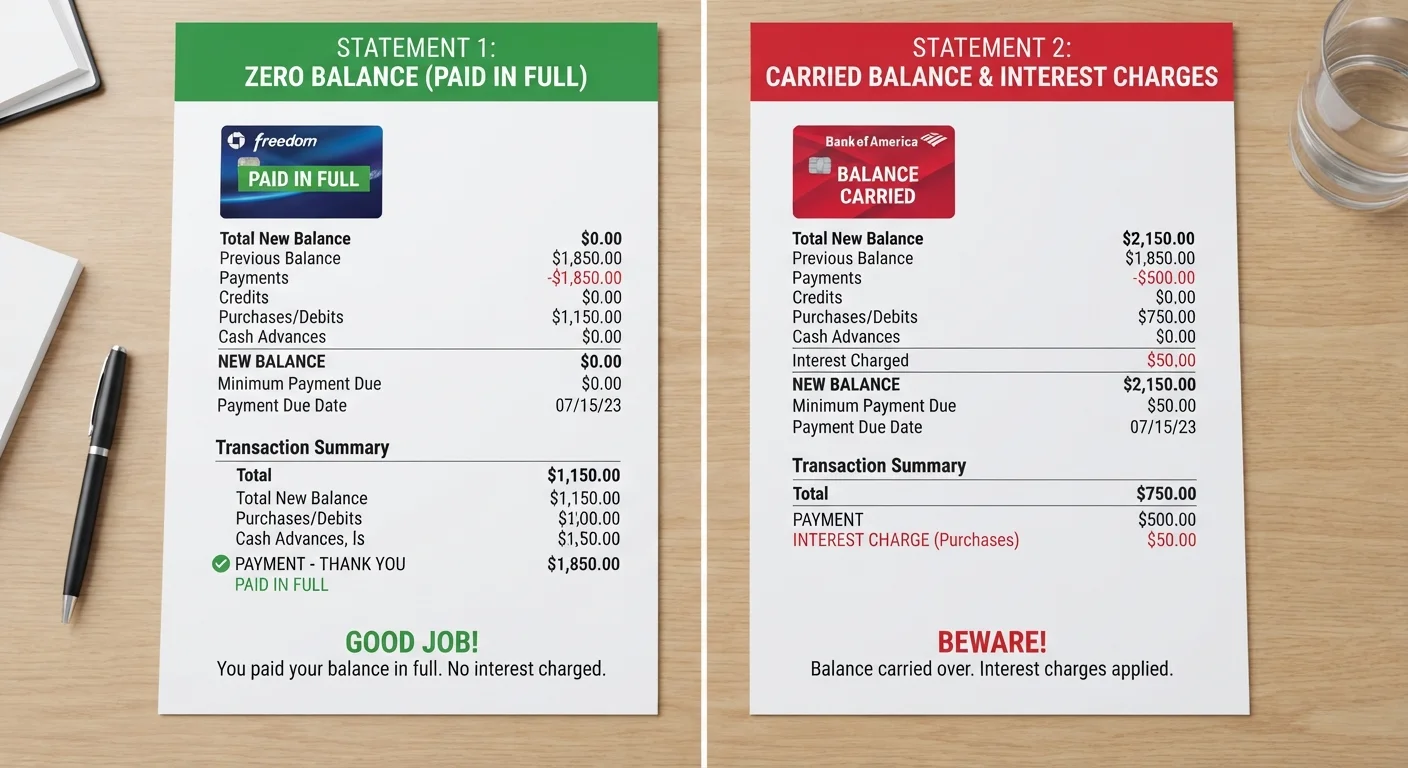
Both approaches - carrying a balance and paying in full - can produce similar credit utilization readings if the balance reported to the bureaus is similar at statement closing. The key distinction is what happens after that report is made.
| Carrying a Balance | Paying in Full Each Month | |
|---|---|---|
| Monthly interest charges | Yes - compounds daily | None |
| Credit score benefit | No additional benefit | No disadvantage either |
| Utilization ratio impact | Depends on reported balance | Depends on reported balance |
| On-time payment history | Built if minimum is paid | Built when full balance paid |
| Total cost over time | Higher - interest accumulates | Lower - no interest paid |
| Financial flexibility | Reduced - cash tied to debt | Maintained - no recurring debt |
Paying in full preserves your cash and eliminates interest. Carrying a balance costs money every billing cycle. From a pure credit-score standpoint, neither approach gives you an automatic edge over the other - but only one costs you nothing extra.
Moves That Can Quietly Hurt Your Credit Score covers other behaviors that affect your score in ways that often catch people off guard.
Building Good Credit Without Paying Interest
You can use a credit card regularly, maintain a healthy utilization ratio, and build a strong payment history - all without ever paying a dollar of interest. The approach is straightforward:
- Use your card for everyday purchases you'd make anyway, like groceries or gas.
- Pay the full statement balance by the due date each month, not just the minimum.
- Keep your utilization below 30% of your available credit, ideally lower. This is what matters - not whether you're carrying a balance month to month.
This method generates the on-time payment history and utilization data that scoring models reward, without any of the interest costs. For more on the habits that support long-term credit health, see Credit Habits That Support a Healthy Score Over Time.
If you're also working to manage existing debt alongside building credit, Snowball vs. Avalanche: Two Debt Payoff Strategies outlines two structured approaches worth understanding.
This article is for general informational and educational purposes only and does not constitute personalized financial or credit advice. For guidance specific to your situation, consult a licensed financial professional.