
What Each One Actually Is
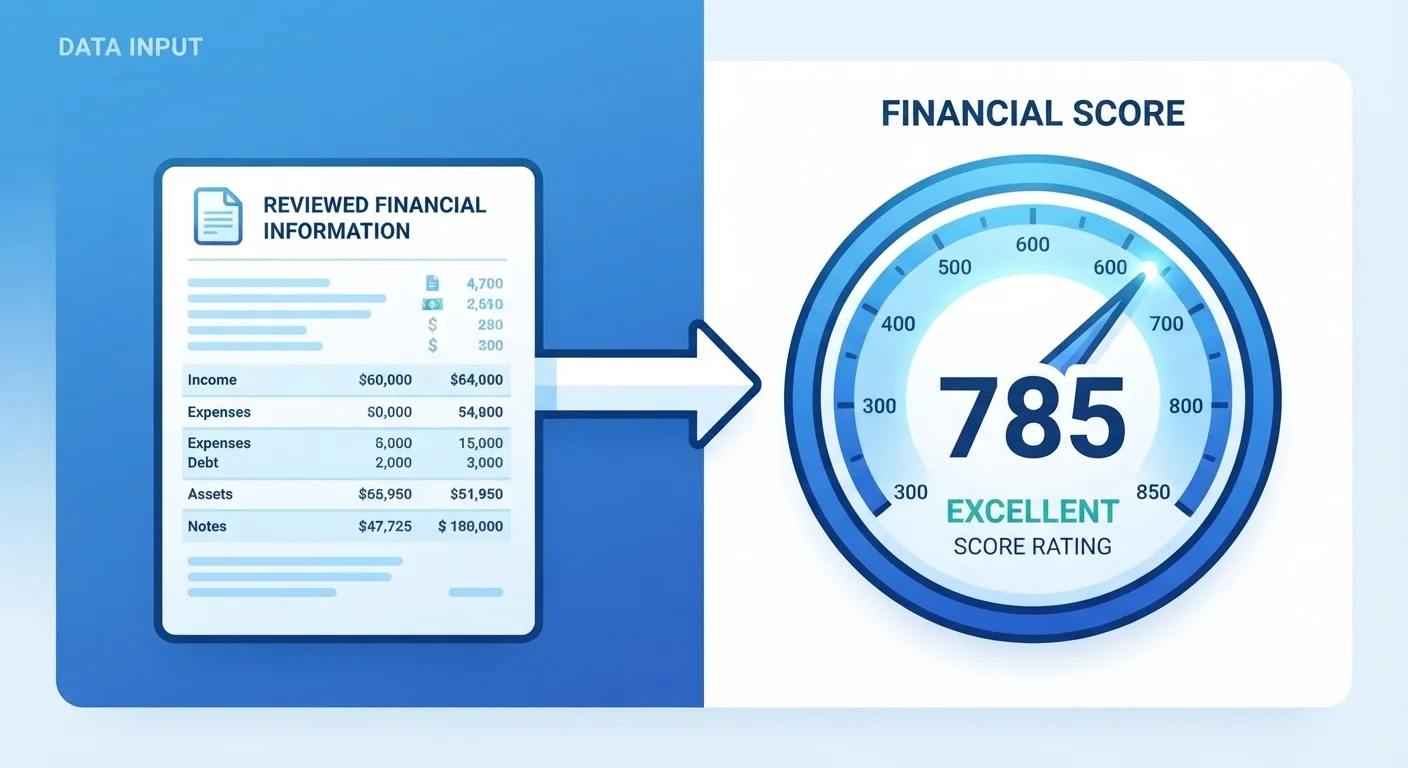
The confusion between credit reports and credit scores is understandable - they're closely linked, and the terms get used interchangeably all the time. But they are distinct tools that serve different purposes.
Your credit report is a detailed record compiled by each of the three major credit bureaus: Equifax, Experian, and TransUnion. It lists your open and closed accounts, payment history, credit inquiries, balances, and any public records such as bankruptcies. Think of it as a financial transcript - raw data, line by line.
Your credit score is a number - typically between 300 and 850 - calculated by applying a scoring model (like FICO or VantageScore) to the data in your credit report. It converts all that detail into a single figure lenders can evaluate quickly. To learn more about how that calculation works, see our guide to how credit scores are calculated.
In short: the report is the source material; the score is the summary.
| Criterion | Credit Report | Credit Score |
|---|---|---|
| What it is | Detailed history of your credit accounts | Three-digit number derived from your report |
| Who creates it | Equifax, Experian, TransUnion (3 reports) | Scoring companies (FICO, VantageScore, etc.) |
| How often it updates | As creditors report new activity | Each time a score is calculated from current data |
| Free access | Yes - federally mandated via AnnualCreditReport.com | Often free through banks, cards, or monitoring tools |
| Best used for | Spotting errors, fraud, account details | Gauging creditworthiness quickly |
| Can you dispute it? | Yes - disputes filed directly with bureaus | Not directly; improve it by fixing report data |
How Each One Is Generated and Who Controls It
Credit bureaus collect data from lenders, credit card companies, and other creditors who voluntarily report your account activity. That data becomes your credit report. Because each bureau collects independently, your three reports may not be identical - a creditor might report to all three, or only one or two.
Credit scores are then generated by scoring companies using proprietary formulas applied to whichever bureau's report they're reading. This is why your score can vary depending on the platform or lender checking it. Our article on why your credit score differs across platforms explains this in more detail.
You have a legal right to one free credit report per year from each bureau through AnnualCreditReport.com - the federally mandated site. Scores are not legally required to be provided free, but many banks and credit card issuers now offer free access as a benefit.
1 in 5
Consumers with a credit report error
The FTC has reported that approximately one in five consumers had an error on at least one of their three credit reports.
3
Separate credit reports each consumer has
Equifax, Experian, and TransUnion each maintain an independent report, which means your data - and potential errors - may differ across all three.
Why Both Matter - and How They Work Together
Neither document tells the full story on its own. Your score tells you where you stand; your report tells you why.
If your score drops unexpectedly, the report is where you investigate. A missed payment, a maxed-out card, a hard inquiry you don't recognize, or even an outright error could be the cause. You can learn more about the difference between those inquiry types in our explainer on hard vs. soft credit inquiries.
Errors on credit reports are more common than many people expect. The Federal Trade Commission has studied this and found a meaningful share of consumers have at least one inaccuracy. You can dispute errors directly with the bureau that reported them - a process that's free and legally protected under the Fair Credit Reporting Act (FCRA).
For a detailed walkthrough of what every section of your report means, see our guide to reading your credit report line by line.
The practical takeaway: monitor your score regularly as a quick signal, and pull your full reports periodically to audit the underlying data. Together, they give you a complete picture of where your credit stands and what to do next.
This article is for general informational purposes only and does not constitute financial or legal advice. Consult a qualified financial professional for guidance specific to your situation.