
Why Pulling Feels Impossible to Fix
Leash pulling tops the list of frustrations reported by dog owners — and for good reason. Unlike many other behavior problems, pulling is reinforced on every single walk, dozens of times a day. By the time most owners decide to address it, the habit is already deeply practiced.
The mechanics are straightforward: dogs are opportunistic learners. If pulling forward leads to sniffing a fire hydrant, greeting another dog, or simply covering more ground, the behavior gets stronger. The problem isn't your dog's breed, temperament, or stubbornness — it's that the environment has been teaching pulling for months or years.
This is also why traditional corrections often don't stick. Leash jerks and verbal reprimands tell the dog what not to do in a given moment but don't build the skill of walking calmly beside you. As noted in research on animal behavior, punishment-based training often backfires by creating anxiety without providing a clear alternative behavior.
The good news: because pulling is a learned behavior, it can be unlearned — with the right approach and enough repetition.
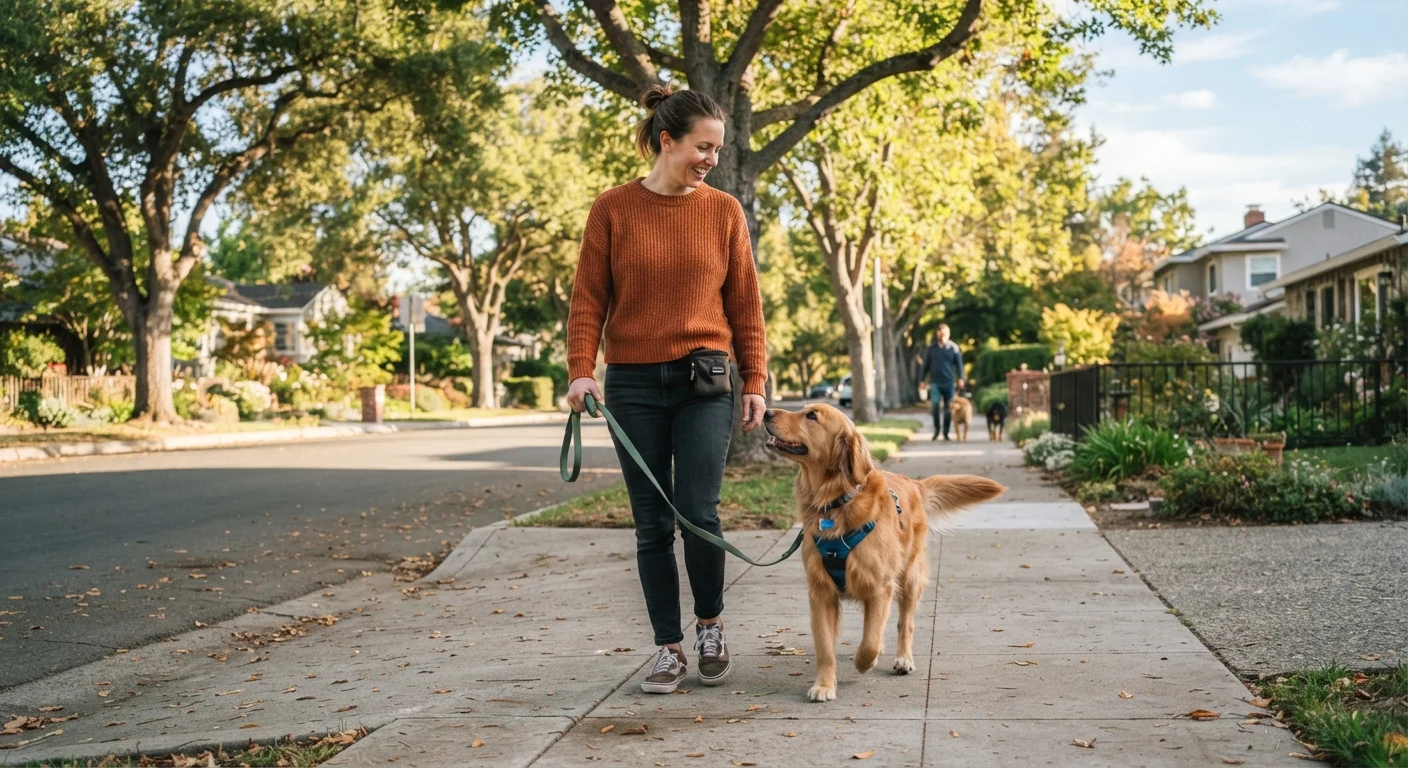
Front-clip harness
Redirects a dog's momentum toward you when they pull forward, making it easier to regain their attention without discomfort.
Standard 4–6 foot leash
Gives you enough control and feedback to feel leash tension while allowing natural movement.
High-value training treats
Used to reward the dog for returning to your side or maintaining a loose leash.
Treat pouch
Keeps rewards accessible so you can mark and reward good behavior within one to two seconds.
What to Expect During the Training Process
Loose-leash walking is one of the more time-intensive skills to train because you're competing with the environment — and the environment is endlessly interesting to your dog. Most owners see meaningful improvement within two to four weeks of consistent daily practice, but "consistent" is the operative word.
Keep Sessions Short and Frequent
Five to ten minutes of focused loose-leash practice, repeated two or three times a day, produces better results than a single long session. Dogs learn through repetition in small doses. Ending each session before your dog loses focus keeps the experience positive and leaves them ready to try again.
Expect an extinction burst early on — a temporary increase in pulling as your dog tries harder to get what used to work. This is a normal part of the process and a sign the training is registering. Push through it calmly.
Also expect progress to look uneven. Your dog may walk beautifully in the backyard and pull relentlessly the moment you hit the sidewalk. Distractions reset learning in new environments. Build back up systematically rather than assuming the training didn't take.
Don't Skip the Foundation Work
Jumping straight to outdoor walks without practicing in a low-distraction environment first is one of the most common reasons progress stalls. Dogs can't generalize new skills quickly — they need to succeed indoors or in the yard before the challenge level goes up. Skipping this step often leads owners to conclude that training 'isn't working' when the environment is simply too hard too soon.
Throughout the process, keep sessions positive and end them before your dog is mentally exhausted. A frustrated dog — or a frustrated owner — won't make progress. If you notice the sessions creating conflict or your dog shutting down, scale back the difficulty and reassess your approach.
Avoid Gear That Suppresses Rather Than Teaches
Prong collars, choke chains, and shock collars may reduce pulling in the moment, but they don't teach a dog what to do instead. Research in animal behavior suggests aversive tools can increase anxiety and reactivity over time. For most healthy adult dogs, a well-fitted flat collar or front-clip harness is sufficient when paired with consistent training.