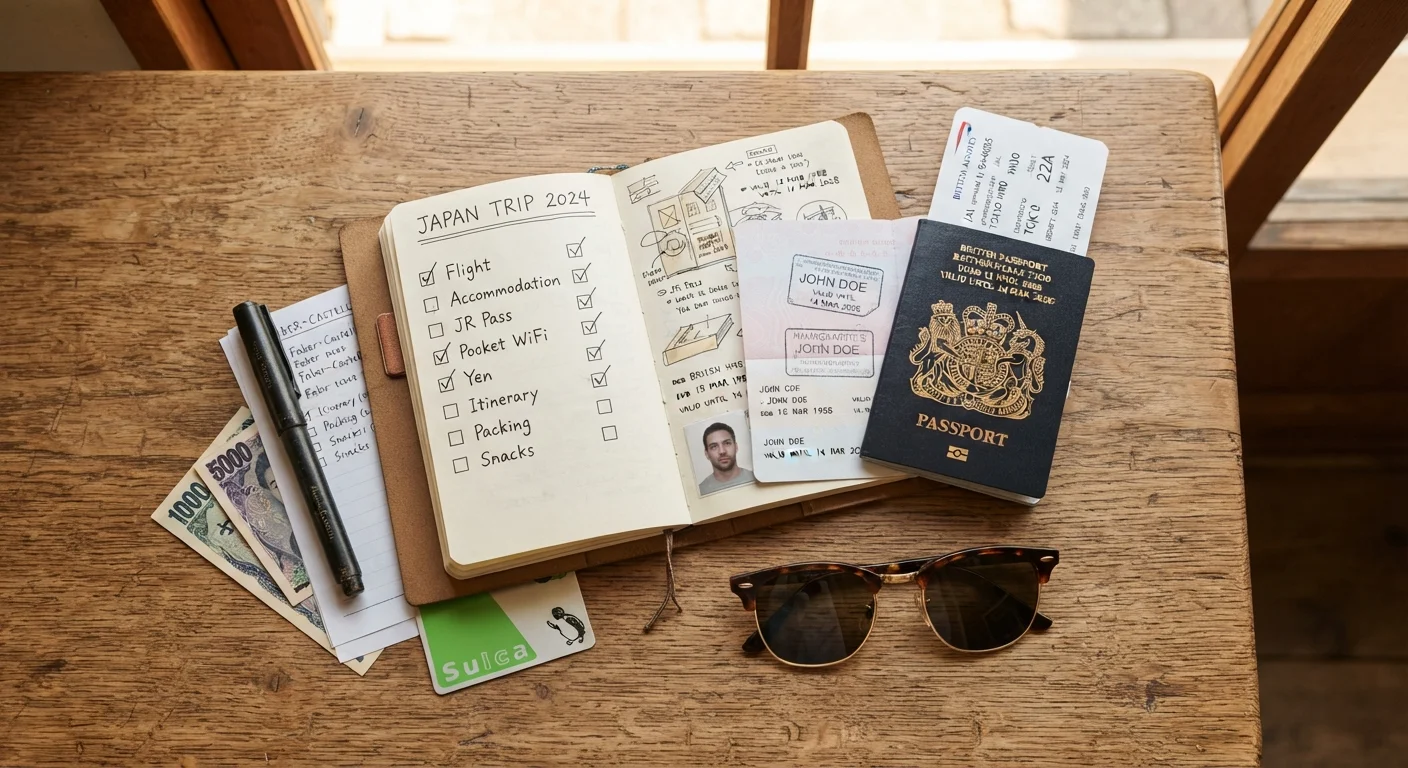

Entry Requirements and Visa Basics
For most American passport holders, entering Japan is refreshingly straightforward. Under Japan's visa exemption program, U.S. citizens can typically stay up to 90 days for tourism without applying for a visa in advance. That said, entry rules can change, so always confirm current requirements through the U.S. Embassy in Tokyo or the official Japan Ministry of Foreign Affairs website before you book anything.
You'll need a valid passport (check the expiration date — many countries want at least six months of validity beyond your travel dates), a return or onward ticket, and proof that you can support yourself financially during the stay. Immigration officers at Japanese airports are efficient; lines move quickly, and the process is generally smooth for first-timers.
Before you even think about packing, work through a solid planning checklist. Our pre-trip planning checklist walks you through every document and decision to nail down before departure.
Check Entry Rules Directly with Official Sources
Visa exemption policies and entry requirements for Japan can change with little notice. Always verify current rules through the U.S. Department of State's Japan travel page or Japan's Ministry of Foreign Affairs website — not just third-party travel blogs — well before your departure date.
Getting Around: Trains, IC Cards, and City Transit
Japan's public transit system is one of the most reliable in the world — trains run on time to the minute, signage in major cities includes English, and the network connects virtually everywhere tourists want to go. The learning curve is real, but it flattens fast.
Your first priority upon landing should be picking up an IC card — a rechargeable transit card (Suica and Pasmo are the most common) available at airport kiosks. Load it with yen, tap in and out at train and subway gates, and you're set for buses and even convenience store purchases in many areas.
For travel between cities — Tokyo to Kyoto, for example — the Shinkansen (bullet train) is fast, comfortable, and iconic. A Japan Rail Pass can offer savings if you plan multiple long-distance journeys; calculate your routes before buying one, since it doesn't always pay off for shorter itineraries.
~29,000
Train stations in Japan's rail network
Japan's railway network is among the densest in the world, connecting urban centers and rural towns with consistent punctuality.
99%
On-time rate for Shinkansen arrivals
Japan Railways reports the Shinkansen bullet train achieves near-perfect punctuality, with average delays measured in seconds annually.
~3 million
American tourists visiting Japan annually
Japan Tourism Agency data shows the U.S. consistently ranks among the top source countries for inbound international visitors.
Money, Cash, and Paying for Things
Japan surprises many visitors from the U.S.: despite being a technologically advanced country, it remains heavily cash-dependent. Many restaurants, small shops, temples, and rural businesses accept yen only. Arriving with some cash already exchanged — or withdrawing from a 7-Eleven or Japan Post ATM, both reliably accepting foreign cards — is a practical must.
Budget roughly ¥1,000–¥3,000 per day for incidental cash spending on top of bigger planned expenses. That's approximately $7–$20 USD at common exchange rates, though rates fluctuate — check a reliable currency tool before you travel and again upon arrival.
Credit cards are accepted at most hotels, department stores, and chain restaurants in cities, but don't count on them at izakayas (casual Japanese pubs), street food stalls, or local shops. Tipping is not practiced in Japan — in fact, offering a tip can cause confusion or even embarrassment. Simply paying the stated price is the respectful norm.
Language and Communication
Japanese is the official language, and while English proficiency has grown — especially in Tokyo, Osaka, and Kyoto — you shouldn't expect to coast on English alone everywhere. Key strategies that actually help:
- Download Google Translate with the Japanese language pack offline. The camera translation feature reads menus, signs, and labels in real time.
- Learn a handful of phrases: sumimasen (excuse me), arigatou gozaimasu (thank you very much), and eigo ga hanasemasu ka? (do you speak English?) open doors and earn genuine goodwill.
- Carry a map screenshot of your accommodation's address in Japanese characters — showing this to a taxi driver or local removes all ambiguity.
Train and airport signage in major hubs uses Roman characters alongside Japanese script, so navigation is manageable even without reading kanji. Smaller towns offer less English signage, which is part of the adventure.
Screenshot your hotel's address in Japanese characters before you leave home — not just the English transliteration. Taxi drivers and locals respond to the Japanese script far more reliably.
Address romanizations can be ambiguous or unfamiliar to locals, while the Japanese character version is unambiguous and universally understood.
Set your Google Maps to offline mode for your destination cities before your flight lands, so you have navigation even if your data connection is slow or delayed at the airport.
Airport SIM or Wi-Fi setup can take 20–30 minutes, and having offline maps means you're oriented the moment you step outside arrivals.
Etiquette Essentials Every Visitor Should Know
Japanese social customs aren't complicated once you know them, and locals genuinely appreciate visitors who make the effort. A few norms that stand out for Americans:
- Quiet on transit: Talking loudly on trains or phone calls is considered inconsiderate. Keep conversations low or skip them entirely.
- No eating while walking: Street food is typically enjoyed standing near the stall, not while strolling. Sit-down eating is the default.
- Shoes off indoors: Many traditional restaurants, ryokans (Japanese inns), and some homes require removing shoes at the entrance. Slip-on footwear makes this easy.
- Two hands for everything: Handing money, business cards, or gifts with both hands signals respect.
- Chopstick rules matter: Never stick chopsticks upright in rice (a funeral custom) or pass food chopstick-to-chopstick.
These aren't strict legal rules — locals are forgiving of unintentional missteps — but showing awareness creates noticeably warmer interactions throughout your trip.
Staying Connected and Practical Logistics
Staying connected in Japan is easy to arrange in advance. The two most popular options for American travelers are a pocket Wi-Fi rental (a portable device that creates a hotspot for multiple devices) or a local data SIM card. Both can be reserved online and picked up at the airport on arrival. Either option beats international roaming charges from a U.S. carrier for most trips lasting a week or more.
A few more logistics worth knowing:
- Luggage forwarding (takkyubin): Japan has a remarkable service where you can ship your suitcase from your hotel to the next destination overnight for a modest fee. This makes train travel between cities far more comfortable.
- Convenience stores (konbini): 7-Eleven, Lawson, and FamilyMart locations are everywhere and sell prepared food, snacks, toiletries, medications, phone chargers, and ATM access. They're genuinely useful anchors throughout your trip.
- Pharmacies: For minor health needs, pharmacy chains carry a wide range of over-the-counter products. Note that some medications common in the U.S. are regulated differently in Japan — check the Japanese Ministry of Health guidelines before packing prescription or OTC drugs.
If you're comparing this kind of urban-transit, cash-and-logistics complexity to a domestic trip, our first-timer's guide to New York City offers a useful contrast — similar density, very different systems.
Japan is one of the most rewarding destinations an American can visit. The infrastructure is excellent, safety is generally very high, and the cultural depth on offer is remarkable. Go prepared, stay curious, and you'll find the experience more than lives up to the anticipation. For a broader foundation before any international trip, explore the Trip Planning hub for checklists and orientation guides that help everything click into place.