What R-Value Means and Why It Matters
Before comparing insulation types, it helps to understand R-value - the measure of how well a material resists heat moving through it. The higher the R-value, the more effective the insulation. Every region of the United States has recommended R-values set by the U.S. Department of Energy based on climate zone. An attic in Minnesota generally needs a much higher R-value than one in Florida.
R-value depends on both the material and its thickness. Adding more inches of the same material increases R-value proportionally for most types, though spray foam is an exception. Compressing batt insulation, on the other hand, reduces its effective R-value - a common mistake during DIY installation.
11%
Typical heating/cooling energy lost through the roof
The U.S. Department of Energy estimates that inadequate attic insulation is one of the leading causes of residential energy loss.
R-38 to R-60
Recommended attic R-value for cold U.S. climates
The DOE's climate zone recommendations call for significantly higher attic R-values in northern states than in warmer southern regions.
Batt Insulation: The DIY Standard
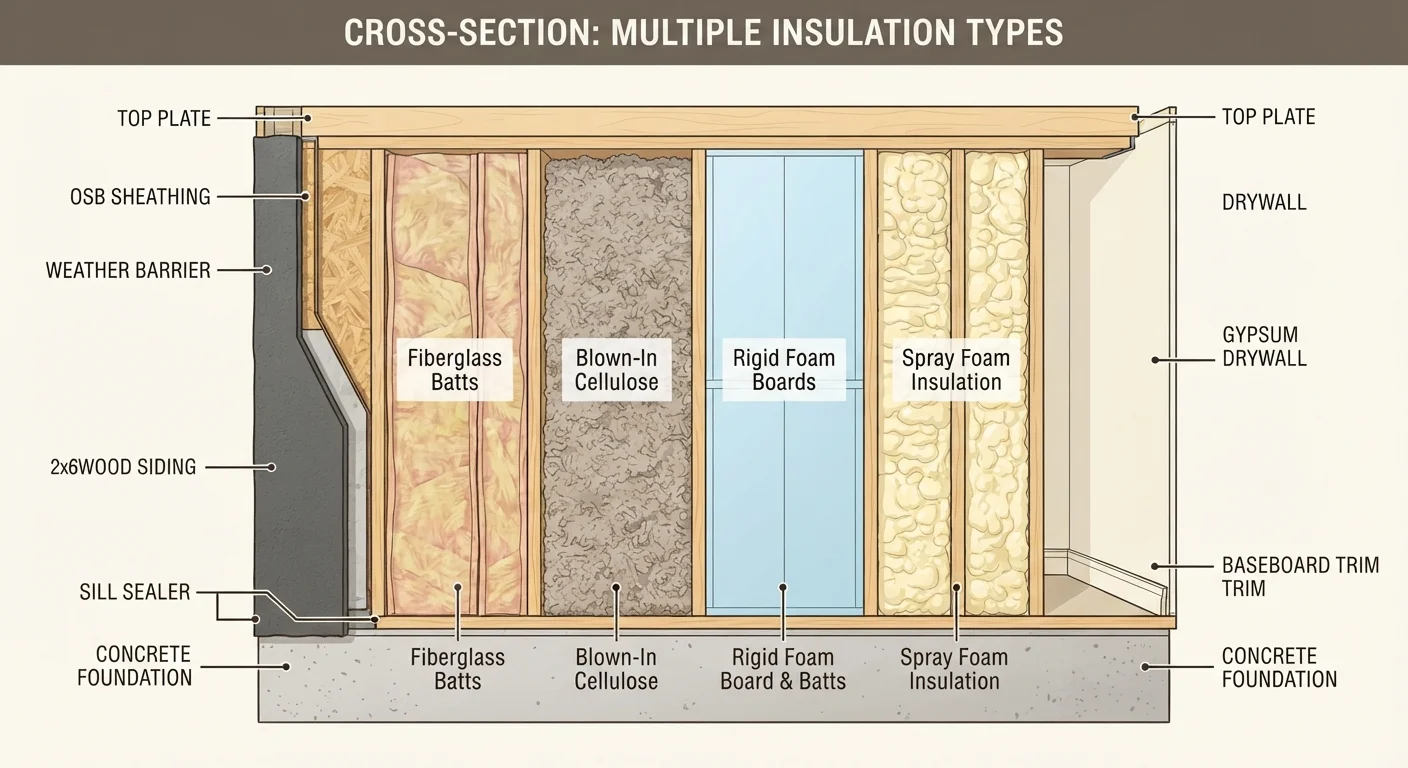
Batt insulation - most commonly made from fiberglass or mineral wool - comes in pre-cut panels sized to fit between standard wall studs and ceiling joists. It is the most widely available type and the most practical choice for homeowners tackling open wall cavities during a remodel or new construction.
Fiberglass batts are inexpensive and easy to cut with a utility knife. Mineral wool batts cost somewhat more but offer better fire resistance, soundproofing, and moisture resistance. Both types require careful installation: gaps, voids, or compression significantly reduce performance.
Wear Protective Gear When Installing Batts
Fiberglass particles can irritate skin, eyes, and lungs during installation. Always wear long sleeves, gloves, safety glasses, and an N95 respirator when handling fiberglass batt insulation. Mineral wool requires similar precautions. Work in a well-ventilated area and wash exposed skin promptly after finishing.
Where it works best: Exterior walls with open 2×4 or 2×6 framing, floors above unconditioned spaces, and attic ceilings with accessible joists. Batt insulation is not ideal for irregularly shaped cavities or spaces with lots of obstructions like wiring and pipes.
Blown-In Insulation: Filling the Gaps
Blown-in insulation - typically made from cellulose (recycled paper) or loose-fill fiberglass - is installed using a blower machine that pushes material into place through a hose. It conforms naturally to irregular shapes and fills around obstructions, making it a strong choice for attics and enclosed existing cavities where batts cannot be easily inserted.
Cellulose is treated with fire retardants and is considered a more environmentally friendly option due to its recycled content. Loose-fill fiberglass is lighter and doesn't settle as much over time. Both can be rented as DIY projects for attic floors, though filling enclosed wall cavities - which requires drilling holes and patching - is more challenging and often best left to an experienced installer.
| Batt | Blown-In | Rigid Foam | Spray Foam | |
|---|---|---|---|---|
| Typical R-value per inch | R-3 to R-4 | R-2.5 to R-3.8 | R-3.8 to R-6.5 | R-3.7 to R-7 |
| DIY-friendly | Yes - open cavities | Attics yes, walls harder | Yes, with precautions | No - professional required |
| Moisture resistance | Low to moderate | Low (cellulose absorbs moisture) | High (XPS, polyiso) | High (closed-cell) |
| Air sealing ability | Poor - gaps remain | Moderate | Moderate with tape/sealant | Excellent |
| Best application | Open wall cavities | Attics, enclosed walls | Basements, sheathing | Crawlspaces, rim joists |
| Fire resistance | Moderate (mineral wool: high) | Moderate (treated) | Low - must be covered | Low - must be covered |
Rigid Foam: When Space Is Limited
Rigid foam boards - available in three main types: expanded polystyrene (EPS), extruded polystyrene (XPS), and polyisocyanurate (polyiso) - offer a relatively high R-value per inch compared to batts or blown-in. This makes them especially useful where wall depth is limited, such as in basement walls, exterior sheathing, or under slab floors.
XPS and polyiso generally have higher R-values per inch than EPS, but EPS is more vapor-permeable, which can be an advantage in certain moisture situations. Rigid foam is cut with a utility knife or saw and can be glued or mechanically fastened - manageable for a determined DIYer. One important note: in most jurisdictions, rigid foam installed in living spaces must be covered with a fire-rated material like drywall, because foam boards are flammable. Always verify local building code requirements before installation.
Spray Foam: Maximum Air Sealing
Spray polyurethane foam (SPF) expands on contact to fill cavities, gaps, and crevices completely. It comes in two forms: open-cell foam, which is softer and more vapor-permeable, and closed-cell foam, which is denser, has a higher R-value per inch, and acts as a vapor retarder.
Closed-cell spray foam has the highest R-value per inch of any common insulation type - roughly R-6 to R-7 per inch. It is frequently used in crawl spaces, rim joists, and roof decks where air sealing and moisture control are critical. Open-cell foam is often used in interior walls for soundproofing and air sealing at a lower cost.
Important: Two-component spray foam systems involve chemical components that require proper protective equipment and training. While small aerosol cans are available for sealing gaps around pipes and windows, full-scale spray foam insulation for walls or large areas should be installed by a licensed professional. Improper mixing or application can result in incomplete curing, off-gassing, and poor performance.
Always consult local building codes and, for electrical, structural, or gas-adjacent work, engage a licensed contractor. This article is for general informational purposes only and is not a substitute for professional guidance.