
Why Garage Organization Advice So Often Backfires
The garage is the room most American homeowners intend to organize and least often succeed with. Part of the problem is that common advice - buy more bins, sort by category, do a big clean-out weekend - sounds reasonable but frequently produces only short-term results before the space reverts to chaos.
The myths below are widespread precisely because they feel intuitive. Correcting them doesn't require an expensive renovation or a professional organizer. It requires a clearer picture of how garages actually get used, and a system built around that reality rather than around tidy-looking magazine photos.
Myth
Buying more storage bins and shelving units will finally get the garage under control.
Fact
Adding storage without first purging and sorting typically buries the clutter one layer deeper rather than resolving it.
Storage products are tools, not solutions. When new bins arrive before any sorting has happened, people often pack them with whatever is closest - mixing seasonal decorations with automotive supplies and sporting equipment. The result is labeled containers nobody opens because nobody remembers what's inside.
The effective sequence is always: remove everything, decide what stays, then choose storage sized to what remains. This process usually reveals that less storage hardware is needed than initially assumed.
Myth
The garage floor is the natural place to store most things since it's easy to access.
Fact
Floor storage is the least efficient use of garage space and the fastest path to a space that feels permanently cluttered.
Floor clutter compounds quickly. Items placed temporarily become permanent fixtures, pathways narrow, and the garage stops functioning as a workspace or parking area. Floor storage also exposes items to moisture, pests, and accidental damage from vehicles.
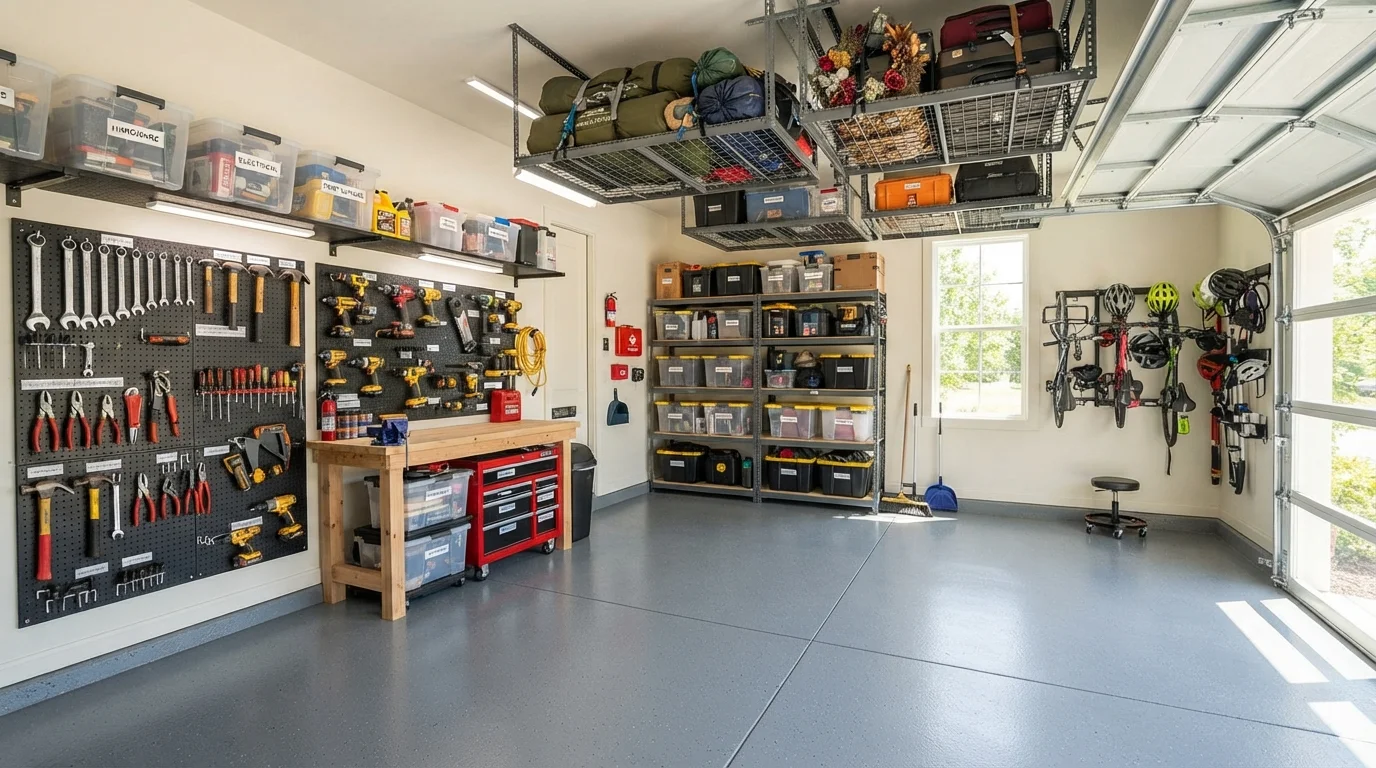
Wall-mounted pegboards, slatwall panels, and ceiling-hung racks reclaim the vertical cubic footage that most garages have in abundance. Frequently used items - hand tools, garden gloves, extension cords - belong at eye level on walls. Bulky, rarely used items like holiday inflatables or camping gear suit overhead ceiling racks well. See how the same thinking applies indoors in our guide to maximizing vertical storage in tight spaces.
Myth
Organizing the garage is a one-weekend project - once it's done, it's done.
Fact
Garage organization is an ongoing maintenance habit, not a single event.
Even a beautifully organized garage will drift back toward chaos without a regular reset. Seasons change, hobbies shift, and items get pulled out and not returned. A quarterly review - roughly four times a year - is far more effective than one massive annual overhaul.
Each review only needs to cover three questions: Does everything still have a designated spot? Has anything arrived that doesn't belong? Are any zones no longer matching how the space gets used? If you've struggled with organization reverting elsewhere in your home, the same underlying patterns are usually at play - our article on why decluttering efforts don't stick explores those dynamics in depth.
Myth
Grouping similar items together - all tools in one area, all sports gear in another - is the best organizational approach.
Fact
Organizing by activity zone rather than item category produces a more usable, intuitive layout.
Category-based grouping sounds logical but often creates inefficient workflows. A Saturday morning yard project requires the lawn mower, fuel, safety glasses, gloves, and a hose - all of which may live in four separate zones under a category system.
Activity zones cluster everything needed for one task in one area: a gardening station holds trowels, gloves, seed packets, and small containers together. A car-care station keeps wash supplies, tire inflator, and fluids within arm's reach of where a vehicle parks. This approach mirrors the zone logic used in well-organized kitchens - something our kitchen organization guide covers in practical detail.
Myth
Any shelving unit rated for heavy loads will hold garage items safely indefinitely.
Fact
Shelving systems require correct installation, proper weight distribution, and periodic inspection to remain safe.
A shelf rated for 500 pounds distributed evenly across its surface behaves very differently from one loaded with the same weight concentrated in the center. Anchoring to wall studs (not just drywall) is critical for wall-mounted systems. Overhead ceiling racks must be secured to ceiling joists, and weight limits should never be exceeded - especially in garages where vibration from vehicles or temperature swings can gradually loosen fasteners.
Inspect mounting hardware at least once a year. Replace any shelving unit showing rust, warping, or loose connections before continuing to load it.
Building a System That Holds Up Year-Round
Once the myths are out of the way, a practical garage system comes down to three principles: purge before you purchase, use walls and ceilings before the floor, and design around activities rather than categories.
Don't Store Everything 'Just in Case'
One of the most common reasons garages stay chaotic is the habit of keeping items that 'might be useful someday.' Broken tools, duplicate equipment, and outdated supplies consume prime real estate. If you haven't used an item in two or more years and it has no clear future purpose, it's likely taking up space another system could occupy. Donate, recycle, or dispose of items responsibly before buying any new storage hardware.
Start by mapping out how the garage gets used across all four seasons. Winter may mean storing holiday items and accessing snowblowers; summer may prioritize lawn equipment and bikes. Those seasonal shifts should be baked into your layout from the start, with frequently rotated items in accessible mid-wall zones and deep-storage items overhead or in back corners.
Labels matter more than container aesthetics. A clearly labeled open-front bin consistently outperforms an unlabeled decorative basket. The same principle applies throughout the home - our closet organization guide walks through labeling and zoning strategies that translate directly to garage contexts.
25%
Homeowners who can't fit their car in garage
According to a U.S. Department of Energy survey, roughly one in four American homeowners with a garage cannot park a vehicle inside it due to stored belongings.
3x
More usable storage via vertical wall systems
Home organization experts generally estimate that floor-to-ceiling wall-mounted systems can triple accessible storage capacity compared to floor-only shelving arrangements.
The goal isn't a garage that looks staged - it's one where any member of the household can find what they need in under a minute and return it to the same spot without thinking. That standard, maintained through brief quarterly check-ins, is what separates genuinely functional garages from ones that look organized only in photographs.
Safety First in Garage Storage
Garages often store flammable liquids, power tools, and heavy items on overhead racks. Always follow manufacturer weight limits for shelving and wall systems. Store hazardous chemicals - including pesticides, solvents, and fuels - in locked, ventilated cabinets away from heat sources and out of reach of children and pets. When in doubt about structural mounting or overhead storage, consult a licensed contractor.