
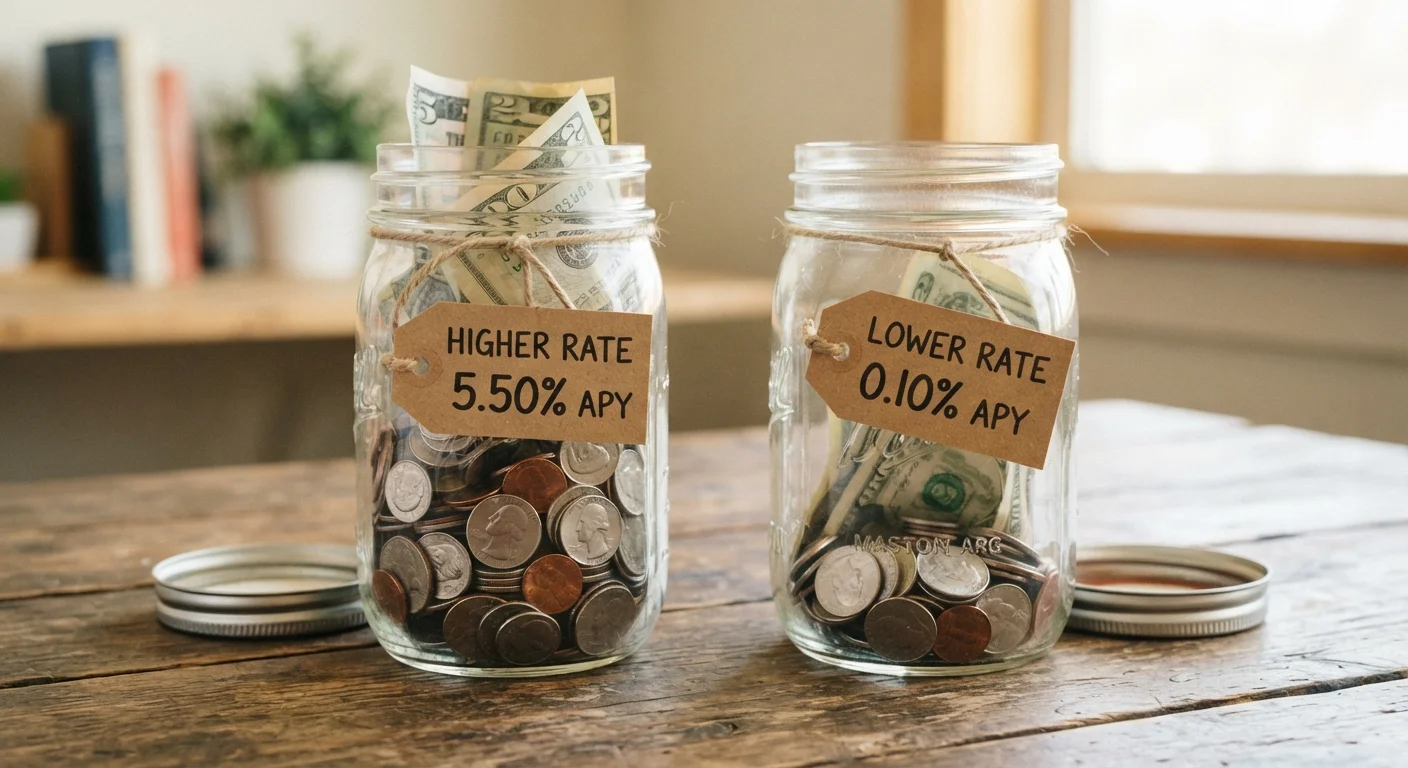
What Sets These Two Account Types Apart
Both high-yield savings accounts (HYSAs) and traditional savings accounts are federally insured deposit accounts designed to hold money safely while earning some interest. The core difference comes down to one number: the annual percentage yield, or APY — the rate at which your balance earns interest over a year.
Traditional savings accounts, offered by most large retail banks and credit unions, have historically carried low APYs — often well below the national average. High-yield savings accounts, frequently offered by online banks or online-only divisions of larger banks, typically offer APYs that are several times higher. The spread between the two can be significant, especially as balances grow over time.
For a plain-language breakdown of terms like APY and liquidity, see our savings glossary for everyday Americans.
| Criterion | High-Yield Savings Account | Traditional Savings Account |
|---|---|---|
| Typical APY | Often well above national average | Often at or below national average |
| FDIC Insurance | Yes, up to federal limits | Yes, up to federal limits |
| Where offered | Primarily online banks | Brick-and-mortar and online banks |
| In-person branch access | Rarely available | Commonly available |
| Monthly fees | Often none | Sometimes apply; may be waivable |
| Minimum balance | Often low or none | Varies; sometimes required to waive fees |
| Transfer speed (external) | 1–3 business days typically | Often instant within same bank |
| Rate stability | Variable; can change anytime | Variable; can change anytime |
Interest Rates: How Big Is the Gap?
The Federal Deposit Insurance Corporation (FDIC) publishes a national average savings rate that is updated regularly. Traditional savings accounts at large banks frequently pay at or below that average. High-yield savings accounts, by contrast, can pay substantially more — sometimes 10 to 20 times the national average, depending on prevailing interest rate conditions set by the Federal Reserve.
It's important to understand that neither type locks in a rate permanently. Both HYSAs and traditional accounts offer variable rates, meaning the bank can raise or lower your APY at any time. When the Federal Reserve raises its benchmark rate, high-yield account rates often rise quickly. When rates fall, they tend to follow.
~0.45%
National average savings APY (FDIC)
The FDIC regularly publishes the national average deposit rate; traditional savings accounts at large banks often pay at or below this figure.
Up to $250,000
FDIC deposit insurance limit per depositor
Both high-yield and traditional savings accounts at FDIC-member banks are insured up to this amount per depositor, per institution, per ownership category.
1–3 days
Typical external transfer time for online HYSAs
Most online banks require an ACH transfer to move money out, which generally settles within one to three business days depending on the institutions involved.
The practical impact: on a $5,000 balance, the difference between a 0.10% APY and a 4.50% APY amounts to roughly $5 versus $225 in annual interest. Over several years, that gap compounds meaningfully.
Access, Fees, and Everyday Usability
Both account types are savings vehicles — not checking accounts — so neither is designed for daily spending. Federal regulations once capped withdrawals at six per month, though that rule was relaxed in 2020. Still, many banks enforce their own limits, so check your institution's terms.
Traditional savings accounts shine when it comes to accessibility. If you bank at a large institution, you can transfer money between checking and savings instantly. In-person deposits, teller support, and physical branches are available. ATM access may also be included.
High-yield accounts are mostly offered online, which means transfers to an external bank can take one to three business days. Some HYSAs offer ATM cards; many do not. Deposits are typically made by electronic transfer or mobile check deposit. For most savers this is a minor inconvenience — but it's worth knowing upfront.
On fees: many online banks offering HYSAs charge no monthly maintenance fee and have no minimum balance requirement. Traditional accounts sometimes have monthly fees that are waived only if you meet a minimum balance threshold.
If you're working on building savings alongside managing debt, our article on starting a financial cushion walks through realistic first steps. And if you're sorting out which credit tools to use alongside your savings, see our comparison of secured vs. unsecured credit cards.
One more thing worth busting upfront: you don't need a large income or a big lump sum to open either type of account. Our piece on savings myths covers this and other misconceptions in detail.
This article is for general informational purposes only and does not constitute personalized financial advice. Consult a qualified financial professional for guidance specific to your situation.