
The Core Idea: Interest on Interest
Most people learn that interest is a percentage charged on money borrowed — or paid on money saved. What catches many off guard is how that interest is applied over time.
With simple interest, you earn or owe a fixed percentage on the original amount only. Borrow $1,000 at 10% simple interest for two years, and you owe $200 in interest total.
With compound interest, the interest that builds up gets folded back into your balance — and then that larger balance earns or accrues more interest. So in year two, you're not just paying interest on $1,000. You're paying interest on $1,100 (the original plus the first year's interest). The balance grows faster and faster the longer it continues.
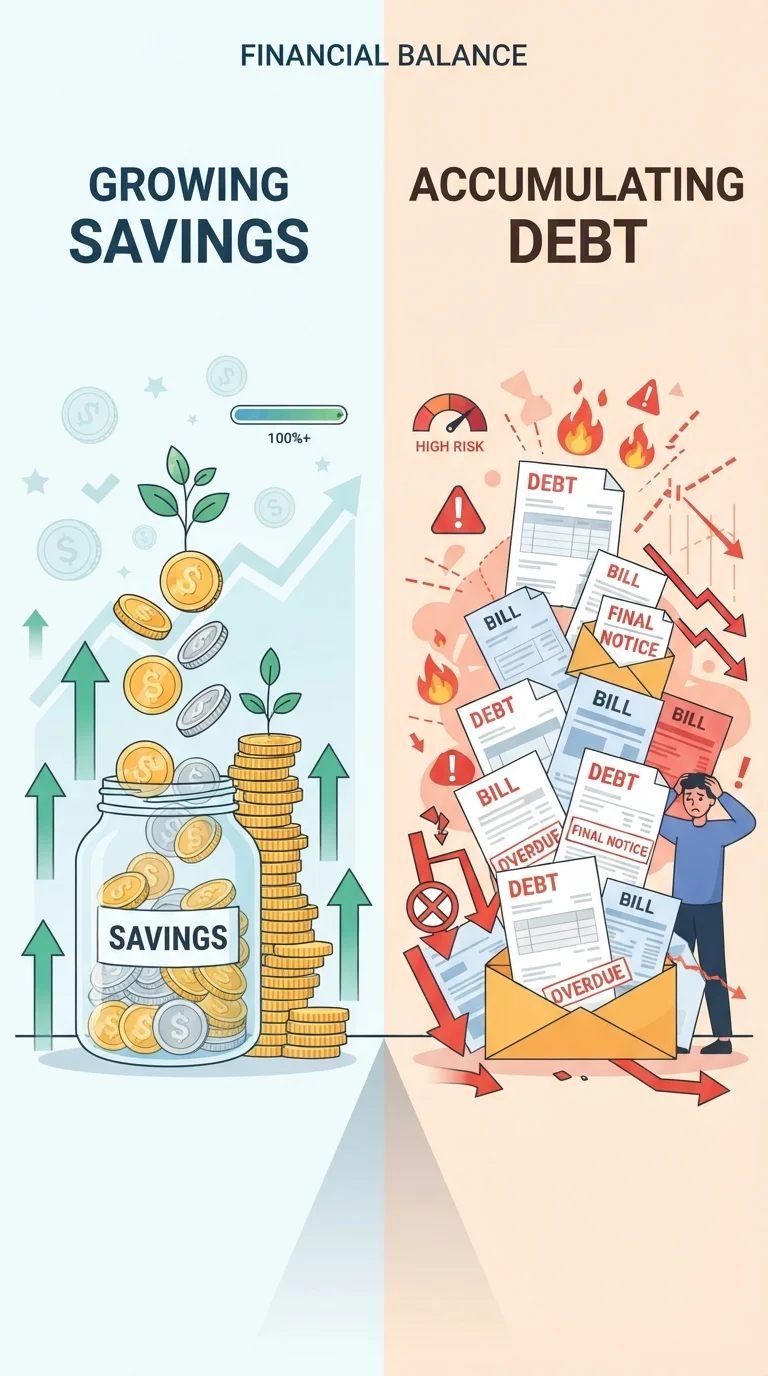
This concept is the engine behind both long-term wealth building and long-term debt traps. Understanding it helps you make smarter choices on both fronts. For a handy glossary of related terms like APY and principal, see Savings Terminology Every American Should Know.
22%+
Average credit card APR in recent years
According to the Federal Reserve, average credit card interest rates have risen significantly, making high balances increasingly costly to carry.
~$12,900
$3,000 grown at 5% APY over 30 years
Based on standard compound interest calculations with no additional contributions, illustrating how compounding accelerates growth over time.
Daily
How often most credit cards compound interest
Most major U.S. credit card issuers compound interest daily on any unpaid balance, making it one of the most aggressive forms of compounding consumers encounter.
How Compounding Grows Your Savings
Imagine you deposit $5,000 into a savings account with a 5% annual interest rate, and you never touch it. In the first year, you earn $250 in interest. Now your balance is $5,250.
In year two, the 5% rate is applied to $5,250 — not the original $5,000. That's $262.50. Your balance is now $5,512.50. By year ten, that same $5,000 would grow to roughly $8,144 without a single additional deposit.
The more frequently interest compounds — daily versus monthly versus annually — the faster your balance grows. That's why the APY shown on savings accounts is a better comparison tool than the stated rate alone.
High-yield savings accounts are one place where compounding is especially relevant. For a deeper look at how they compare to standard accounts, see High-Yield Savings Accounts vs. Traditional Savings Accounts.
Let Time Do the Heavy Lifting
The single most powerful factor in compound growth is how long your money stays invested. Even modest regular contributions to a savings account — left untouched — can grow substantially over decades. Starting early matters far more than starting big.
How Compounding Works Against You on Debt
The same math that grows savings can quietly balloon a debt. Credit cards are the most common example. They typically compound interest daily on any unpaid balance. That means every day you carry a balance, interest is added — and tomorrow's interest is calculated on the higher total.
Carry a $3,000 credit card balance at 22% APR and make only minimum payments? You could end up paying hundreds in extra interest charges and take years to pay it off. The minimum payment often barely covers the interest that accrued, leaving the principal largely untouched.
This is the quiet cost of minimum payments that surprises so many people. For a detailed breakdown of exactly how that plays out, see Why Paying Only the Minimum on a Credit Card Costs So Much More Than You Think.
What You Can Do About It
Once you understand compound interest, you can start using it deliberately — rather than being surprised by it.
For savings: Start contributing as early as possible, even in small amounts. Time is the most powerful factor in compounding. Leaving money invested or in a savings account rather than spending it gives compounding more periods to work.
For debt: Pay more than the minimum whenever you can. Every extra dollar applied to the principal reduces the base that interest is calculated on — slowing the compounding effect. Paying down high-interest debt first (such as credit cards) produces the greatest impact because those rates compound aggressively.
If you're managing multiple debts, there are structured strategies specifically designed to help — the debt snowball and debt avalanche methods both take compounding into account. Compare them in Snowball vs. Avalanche: Two Debt Payoff Strategies and How They Differ. If multiple high-interest debts are an issue, Debt Consolidation: What It Is, How It Works, and What to Watch Out For explains another option worth understanding.
This article is for general informational purposes only and does not constitute personalized financial advice. Consult a qualified financial professional for guidance specific to your situation.