
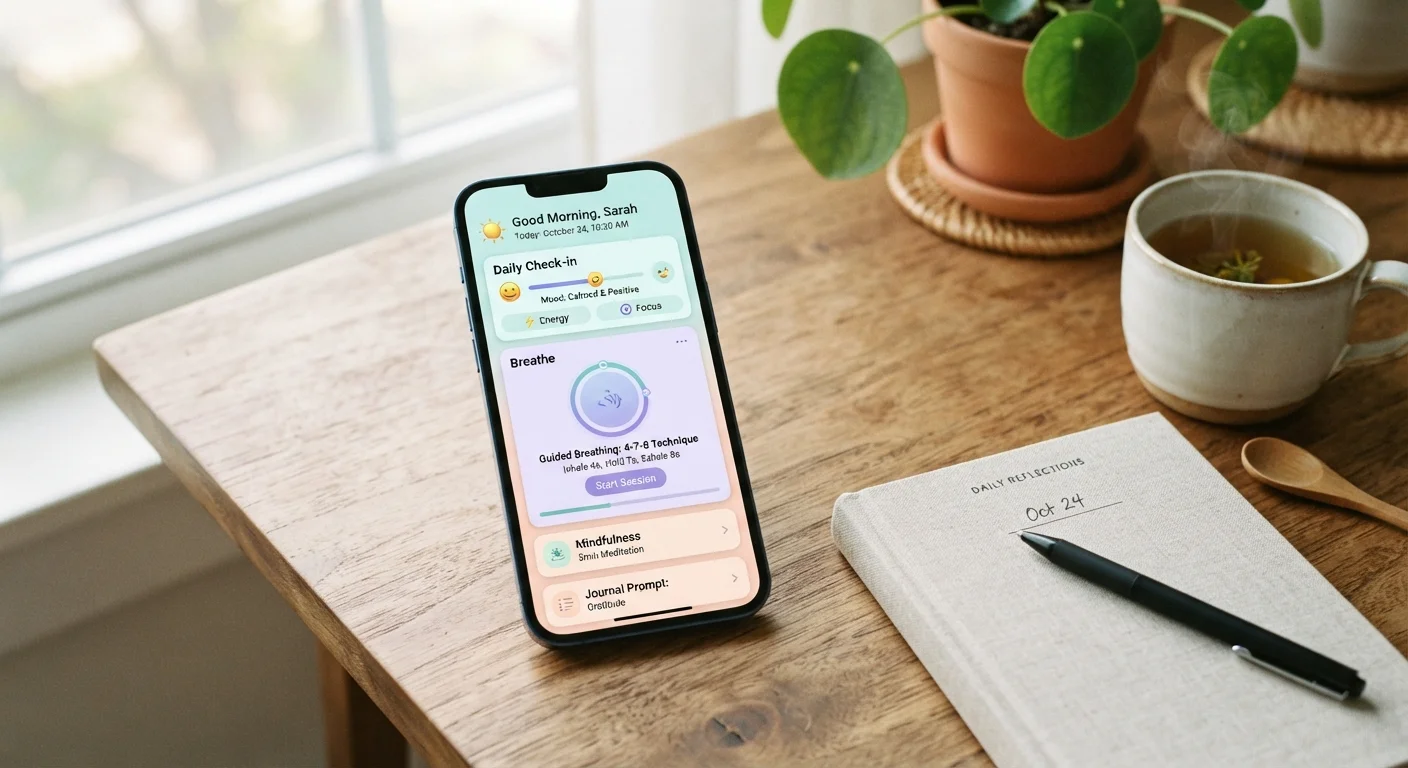
What Mental Wellness Apps Actually Do
Mental wellness apps are smartphone or tablet applications designed to support emotional and psychological well-being outside of formal clinical settings. They typically offer features like guided meditation, breathing exercises, mood journaling, cognitive behavioral therapy (CBT)-inspired prompts, sleep support, and stress tracking.
It's important to understand from the start: these apps are general wellness tools, not medical devices or therapy replacements. They can help you build awareness around your mental state and practice coping techniques, but they do not diagnose conditions, provide treatment, or replicate the individualized relationship of working with a licensed therapist. For a clear comparison of different support options, see how therapy, counseling, and self-help differ.
This article is for informational purposes only and is not a substitute for professional mental health advice, diagnosis, or treatment. If you are experiencing a mental health crisis or serious symptoms, please contact a qualified healthcare provider or crisis service immediately.
The Real Upsides of Using a Mental Wellness App
For many people, mental wellness apps genuinely lower the barrier to starting a self-care routine. Here's where they tend to deliver real value:
Low barrier to entry for daily mental self-care
Apps are typically available 24/7 on devices most people already own, removing common obstacles like cost, scheduling, and travel to access basic coping tools.
Builds consistent practice through reminders and tracking
Built-in streaks, notifications, and progress logs help users maintain habits like breathing exercises or mood journaling more reliably than relying on memory alone.
Introduces evidence-informed techniques accessibly
Many apps adapt concepts from cognitive behavioral therapy (CBT) or mindfulness research into brief, easy-to-follow exercises suitable for people with no prior background.
Supports self-awareness through mood and pattern tracking
Regular mood logging can help users notice emotional patterns over time - useful context for conversations with a therapist or for recognizing when stress is escalating.
Offers anonymity for those hesitant to seek help
For people who feel uncertain or stigmatized about mental health support, apps provide a private, low-stakes starting point to explore wellness techniques without disclosing to others.
Consistency is one of the most evidence-supported factors in building any habit. Apps that send gentle reminders, track streaks, and offer short sessions make it easier to practice wellness techniques daily - something that complements broader strategies like the ones outlined in daily habits that support a calmer mind.
The Meaningful Limits You Should Know
Recognizing what apps cannot do is just as important as understanding their benefits. Overrelying on an app - or treating it as a clinical solution - can sometimes delay more appropriate care.
Not a replacement for professional mental health care
Apps lack the ability to diagnose conditions, conduct clinical assessments, or provide individualized therapeutic relationships - all of which are central to evidence-based treatment.
Evidence quality varies significantly by app
While some apps are developed with clinical input, many are not rigorously peer-reviewed or validated in published research, making it difficult for users to assess their actual effectiveness.
Privacy and data security risks are real
Mental health data is highly sensitive, and app privacy policies vary widely. Some apps have faced scrutiny over data sharing practices that users may not be aware of.
May foster avoidance of more appropriate care
Relying heavily on an app for serious symptoms can delay seeking professional support, potentially allowing conditions like depression or anxiety disorders to go unaddressed longer than is appropriate.
Engagement tends to drop off quickly over time
Research on digital health tools consistently shows that user engagement drops significantly within the first few weeks, which limits the real-world impact for many people.
Cannot respond to crisis situations
Apps are not equipped to detect or respond to mental health emergencies. Anyone experiencing a crisis needs human contact - a crisis line, a clinician, or emergency services.
When an App Isn't Enough
If you are experiencing persistent sadness, anxiety that interferes with daily functioning, thoughts of self-harm, or any symptoms that feel beyond ordinary stress, a mental wellness app is not the appropriate primary response. Please reach out to a licensed mental health professional, your primary care provider, or a crisis helpline. Apps can complement care - they are not a substitute for it.
If you notice signs of burnout building over time, it's worth knowing that some well-intentioned self-management strategies can inadvertently prolong recovery. See ways people accidentally make burnout worse for more context.
How to Get the Most Out of a Mental Wellness App
If you decide to use a mental wellness app, a few practical approaches can help you use it wisely:
- Check the evidence: Look for apps that describe using research-backed frameworks like CBT or mindfulness, and are transparent about any clinical studies behind their design.
- Review the privacy policy: Mental health data is sensitive. Before downloading, read how the app stores, uses, and shares your information.
- Pair it with other habits: Apps work best as one layer of a broader routine. A weekly mental wellness check-in can help you notice trends an app alone might miss.
- Don't replace professional care: If you're experiencing persistent low mood, anxiety, or emotional distress, an app is not a sufficient response. Speak with a qualified mental health professional.
10,000+
Mental health apps available in major app stores
Estimates from mental health researchers suggest tens of thousands of mental health and wellness apps exist, making quality evaluation a significant challenge for consumers.
~25%
Users who continue using wellness apps after 30 days
Studies on digital health app engagement consistently find that a large majority of users disengage within the first month of downloading a wellness app.
Practices like mindfulness - commonly built into wellness apps - are worth understanding on their own terms. Mindfulness and meditation are meaningfully different, and knowing how can help you choose app features that genuinely match what you're looking for.