Why the Ingredient List Matters More Than the Front of the Box
The front of a food package is marketing real estate. Terms like "natural," "wholesome," or "made with real fruit" are largely unregulated and tell you very little about what's actually inside. The ingredient list, by contrast, is a federally regulated document - every item on it must be there for a reason, and the format follows rules designed to give consumers useful information.
Understanding those rules is a practical skill that applies every time you shop. It doesn't require a nutrition degree, and it doesn't mean scrutinizing every label for an hour. A few targeted checks - covered in the steps below - take under a minute once you know what to look for.
If you want to go deeper on what the broader food label communicates beyond ingredients, see What Food Labels Are Actually Telling You for a plain-language walkthrough of the full Nutrition Facts panel. And if you're curious how similar labeling logic applies in a different context, Reading the Label: What Pet Food Ingredients Really Mean shows how ingredient list conventions carry over - and where they diverge - on pet food packaging.
What you will need
How to Read an Ingredient List Step by Step
The steps below walk you through a practical, repeatable process for reading any ingredient list on U.S. packaged food. You don't need to memorize every additive name - you need to know the framework.
This Is General Education, Not Medical Advice
The information in this article is intended to help you understand food labels as a general consumer skill. It is not a substitute for personalized dietary guidance. If you have a health condition, food allergy, or specific nutritional needs, consult a registered dietitian or your healthcare provider before making significant changes to your diet.
Find the ingredient list and orient yourself
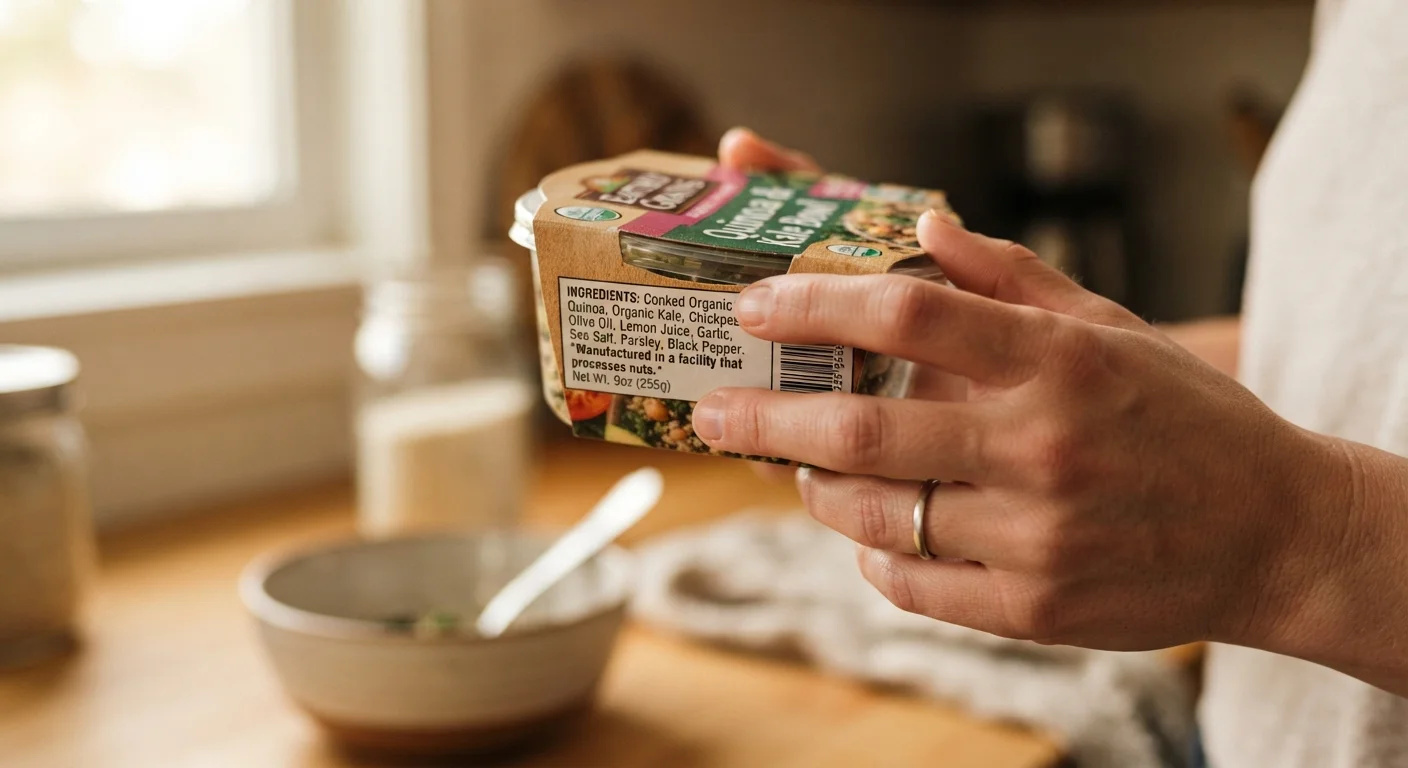
Turn the package to the back or side panel. The ingredient list is a legally required section on virtually all packaged foods sold in the United States. It typically appears near or below the Nutrition Facts box, introduced by the word "Ingredients:" in bold.
If the product has only one ingredient - such as a bag of raw almonds or a bottle of olive oil - the list may be very short or the single ingredient may simply be named on the front. That's normal.
Understand the order: weight, not importance
U.S. regulations require ingredients to be listed in descending order by weight - meaning the ingredient that makes up the largest portion of the product by weight comes first, and the smallest portion comes last.
In practice, this means the first three to five ingredients tell you what you're mostly eating. If the first ingredient in a cereal is whole grain oats, oats are the dominant component. If it's sugar, the product is predominantly sweetener by weight.
This is one of the most useful facts most people don't know - and it takes seconds to apply.
Spot the many names for added sugar
Sugar is one of the most commonly misread sections of an ingredient list because it rarely appears as just "sugar." Manufacturers may use multiple sweeteners, each listed separately - which keeps any single sugar lower on the list even if their combined contribution is substantial.
Common names to watch for include:
- Sucrose, glucose, fructose, dextrose, maltose, lactose
- High-fructose corn syrup, corn syrup, corn syrup solids
- Cane juice, evaporated cane juice, cane syrup
- Honey, agave nectar, maple syrup, molasses
- Barley malt, rice syrup, fruit juice concentrate
These are all forms of added sugar regardless of how "natural" they sound. The Nutrition Facts panel's Added Sugars row (required since 2020) gives you the total grams - the ingredient list shows you where they're coming from.
Decode additives and preservatives
Many packaged foods contain additives - substances added for purposes like preservation, texture, color, or flavor stability. U.S. labeling rules require that additives be listed by their common or usual name, and functional additives must also list their purpose.
You'll often see entries like "sodium benzoate (preservative)" or "annatto (color)." The word in parentheses tells you what the ingredient is doing in the product. This format is there specifically to help consumers understand function, not just chemistry.
Common additive functions include:
- Preservatives
- Extend shelf life by slowing microbial growth or oxidation (e.g., sodium benzoate, tocopherols, ascorbic acid)
- Emulsifiers
- Help ingredients that normally separate (like oil and water) stay blended (e.g., lecithin, mono- and diglycerides)
- Stabilizers and thickeners
- Improve texture and consistency (e.g., xanthan gum, carrageenan, guar gum)
- Artificial colors
- Add or restore color; listed by certified color name (e.g., Red 40, Yellow 5)
Don't be misled by list length alone
A common misconception is that fewer ingredients always means healthier. Length alone isn't a reliable quality signal. A multigrain bread with whole seeds, various flours, and a few natural preservatives may have a longer list than a product made of refined flour and little else.
What matters more than count is what the ingredients are and where they fall in the order. Evaluate based on position and function, not quantity. For related context on how grain processing affects nutritional content, see Whole Grains vs. Refined Grains: What Changes in Processing.
Look up anything unfamiliar before dismissing it
If you encounter an ingredient you don't recognize, resist the urge to assume it's harmful - or harmless. Many intimidating-sounding names are simply the chemical names of common nutrients (e.g., pyridoxine hydrochloride is vitamin B6; cholecalciferol is vitamin D3).
The FDA's website (fda.gov) maintains publicly accessible information on food additives and what they are generally recognized as safe (GRAS) for. It's a reliable first stop for looking up unfamiliar terms without relying on unverified sources.
For a broader reference on nutrition terminology you'll encounter while reading labels, A Plain-English Glossary of Nutrition Terms is a useful companion resource.
Use the Ingredient List and Nutrition Facts Together
The Nutrition Facts panel tells you how much of each nutrient is in a serving; the ingredient list tells you where those nutrients are coming from. Reading both together gives you a much clearer picture than either one alone. For a full breakdown of the Nutrition Facts panel, see What Food Labels Are Actually Telling You.
Putting It Into Practice
The best way to build this skill is to practice on products you already have at home. Pull three or four items from your pantry and run through the steps above: identify the dominant ingredients, scan for added sugar synonyms, note any additives and their listed functions, and look up one unfamiliar term. Most people find the process becomes fast and almost automatic within a few sessions.
Label reading pairs well with a broader understanding of how to build meals around whole foods. Building a Balanced Plate Without Counting Every Calorie offers practical guidance on food group ratios and meal structure that complements what you learn from labels. And for a wider look at how front-of-package claims can mislead shoppers, Reading a Product Label Without Getting Fooled by the Front of the Box covers the marketing tactics most consumers encounter every day.
Allergens Can Hide Behind Technical Names
Common allergens like milk, wheat, soy, and tree nuts may appear in ingredient lists under scientific or processing terms - for example, 'casein' is a milk protein and 'semolina' is a wheat product. If you or someone in your household has a diagnosed food allergy, always check both the ingredient list and the separate 'Contains' allergen statement required on U.S. packaged foods. When in doubt, contact the manufacturer directly.
This article is for general informational and educational purposes only and does not constitute medical or dietary advice. Consult a qualified healthcare professional or registered dietitian for guidance specific to your health needs.