Start Here: Serving Size and Servings Per Container
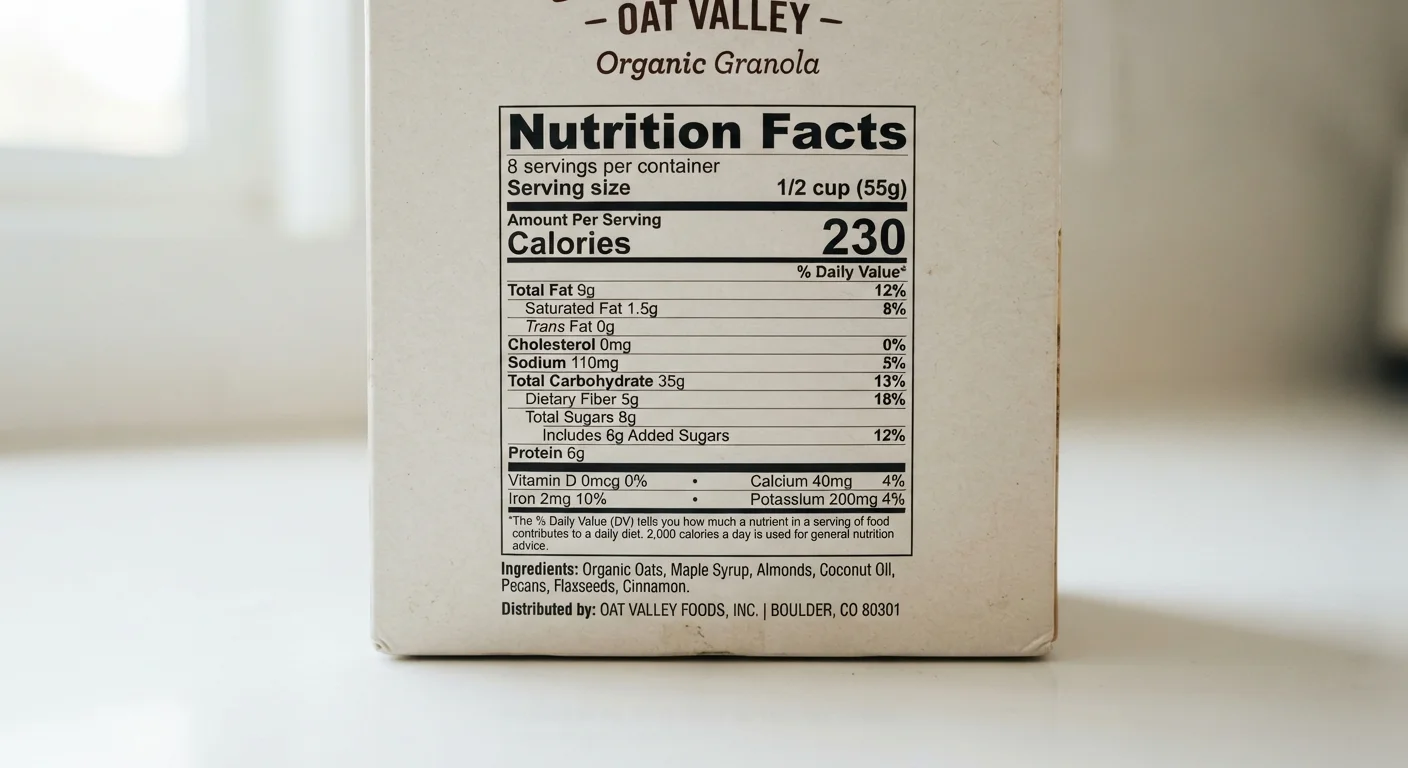
The very first lines of any Nutrition Facts panel - serving size and servings per container - are the most important lines on the entire label. Every calorie count, every gram of fat, every milligram of sodium listed below those two lines applies to one serving only.
If a bag of crackers lists a serving size of 16 crackers and shows 140 calories, but you typically eat 32 crackers in one sitting, your actual calorie intake from that snack is 280. The math is simple, but it's easy to overlook when serving sizes feel arbitrary.
The FDA updated the rules so that serving sizes must reflect amounts people actually eat - not aspirational portions. That's why a 20-oz soda bottle is now labeled as one serving rather than 2.5. For more on how this gap between labeled and real-world portions plays out, see why portion size distortion is so hard to spot.
Calories: A Measure of Energy, Not Quality
Calories measure how much energy a food provides. The number shown is per serving. Under the updated label format, the calorie count appears in large, bold type - intentionally easy to find.
One common misconception: a lower calorie count doesn't automatically make a food more nutritious. A handful of almonds has more calories than a handful of marshmallows, but the almonds provide fiber, healthy fats, and protein. Calories are one data point, not a complete picture of nutritional value.
70%
Americans who misread serving sizes
Research cited by the FDA found a majority of consumers misidentify the serving size on food labels, leading to systematic underestimation of calorie and nutrient intake.
20%+
%DV threshold considered 'high' for any nutrient
The FDA's official guidance defines 20% Daily Value or more per serving as a high amount, a benchmark useful for both nutrients to seek and nutrients to limit.
3,400 mg
Average daily sodium intake for U.S. adults
According to the CDC, U.S. adults consume an average of about 3,400mg of sodium per day - well above the general guideline of 2,300mg, making sodium a particularly relevant label line for most Americans.
The Nutrient Rows: What Each Line Means
Below calories, the label lists specific nutrients in two groups - those to be mindful of consuming in excess, and those many Americans don't get enough of.
Nutrients to Watch
- Total Fat - broken down into saturated fat and trans fat. Saturated fat is linked to cardiovascular health considerations; trans fat, which occurs in partially hydrogenated oils, is one to minimize.
- Cholesterol - listed in milligrams. Dietary guidelines have evolved on this; individual responses to dietary cholesterol vary.
- Sodium - particularly relevant for people monitoring blood pressure. Most Americans consume more sodium than general guidelines suggest.
- Total Carbohydrates - includes fiber, total sugars, and added sugars as sub-lines.
- Added Sugars - a newer requirement added in the 2016 update. This tells you specifically how much sugar was mixed in during manufacturing, separate from naturally occurring sugars.
Nutrients to Seek Out
- Dietary Fiber - supports digestive health. Most Americans fall short of recommended amounts.
- Protein - important for muscle maintenance, immune function, and satiety.
- Vitamins and Minerals - the label is required to show Vitamin D, Calcium, Iron, and Potassium, nutrients identified as commonly under-consumed in the U.S. population.
For plain definitions of terms like bioavailability or net carbs that sometimes appear in nutrition discussions, our nutrition glossary is a helpful reference.
Use %DV as a Quick Comparison Tool
When choosing between two similar products, line up their %DV columns rather than comparing raw grams. It's much faster to see that one bread provides 15% DV of fiber and another provides 4% DV than to judge whether 3.5g vs. 0.9g of fiber is meaningful. The %DV column does the reference-point math for you.
Understanding % Daily Value
The right-hand column - % Daily Value, or %DV - is one of the most useful tools on the label, yet many shoppers ignore it. It shows what percentage of the recommended daily intake for each nutrient one serving provides, based on a 2,000-calorie-per-day reference diet.
The FDA's rule of thumb: 5% DV or less is low for a nutrient; 20% DV or more is high. Use this to make quick comparisons between similar products or to assess whether a food is a meaningful source of a nutrient like fiber or iron.
%DV is based on a 2,000-calorie diet, which doesn't fit everyone. People with significantly different calorie needs - children, very active adults, people with specific health conditions - should work with a healthcare provider or registered dietitian to understand what targets make sense for them.
The 2,000-Calorie Reference Is a Starting Point
The %DV figures on every label are calculated using a 2,000-calorie-per-day reference diet - a round number chosen for standardization, not because it applies to everyone. Children, older adults, pregnant individuals, and highly active people may have meaningfully different needs. Use %DV as a relative comparison tool, and speak with a healthcare provider or registered dietitian if you want guidance specific to your situation.
Front-of-Package Claims vs. the Label Itself
The front of a food package is marketing territory. Words like "natural," "wholesome," "clean," or "simple" carry no standard FDA definition and can appear on almost any product. Even regulated terms can be misleading in context: a food labeled "low fat" may still be high in added sugars.
The Nutrition Facts panel is the regulated, standardized part of the package. When a front-label claim catches your eye, flip the package and verify it against the actual numbers. You can also learn more about what common label phrases are - and aren't - allowed to imply in our companion article on misleading product labels and what they're allowed to say.
The ingredient list, which appears separately from the Nutrition Facts panel, adds another layer of information. Ingredients are listed in descending order by weight, which can reveal a lot about what's really in a product. For a deeper look at that, see reading an ingredient list without getting overwhelmed.
This article is for general informational and educational purposes only and is not a substitute for advice from a qualified healthcare professional or registered dietitian. Individual nutritional needs vary - consult a professional for guidance tailored to your health situation.