Why Your Eyes Are an Unreliable Measuring Tool
Portion distortion - the gap between how much food a label describes and how much you actually eat - is one of the most common and least noticed factors affecting daily calorie and nutrient intake. It isn't about willpower or carelessness. It's about how food packaging, restaurant culture, and human visual perception work together against accurate estimation.
The Nutrition Facts panel was designed to inform, but its utility depends on a detail most people skip: the serving size. That number is a standardized reference point, not a personal prescription. Understanding the difference is the first step to reading labels accurately.
Serving Size ≠ Recommended Amount
A serving size on a Nutrition Facts panel is a standardized reference quantity set by the FDA - not a recommendation of how much you should eat. Many people confuse the two. Consuming the actual product amount you eat may mean multiplying every number on the label by two or three.
Tracking nutrients - whether you're monitoring sodium for a health condition, watching fiber intake, or simply curious - only works if the serving size math is correct. That means knowing how much you're actually eating relative to what the label describes.
The Most Common Portion Mistakes - and How to Correct Them
The errors below aren't rare oversights. They're built into how most people interact with packaged food every day. Recognizing them is more useful than any strict food-tracking system.
Treating the label's serving size as a recommended portion.
Why it happens: The word "serving" implies guidance, so readers naturally assume the listed amount is what they should eat. In reality, the FDA sets serving sizes based on typical consumption patterns recorded in dietary surveys, not on health recommendations.
Assuming a single package equals a single serving.
Why it happens: Packaging design - a resealable bag, a personal-size container - implies the contents are meant for one person in one sitting. Manufacturers use this intuition to their advantage, often fitting 2-3 servings into what feels like an individual item.
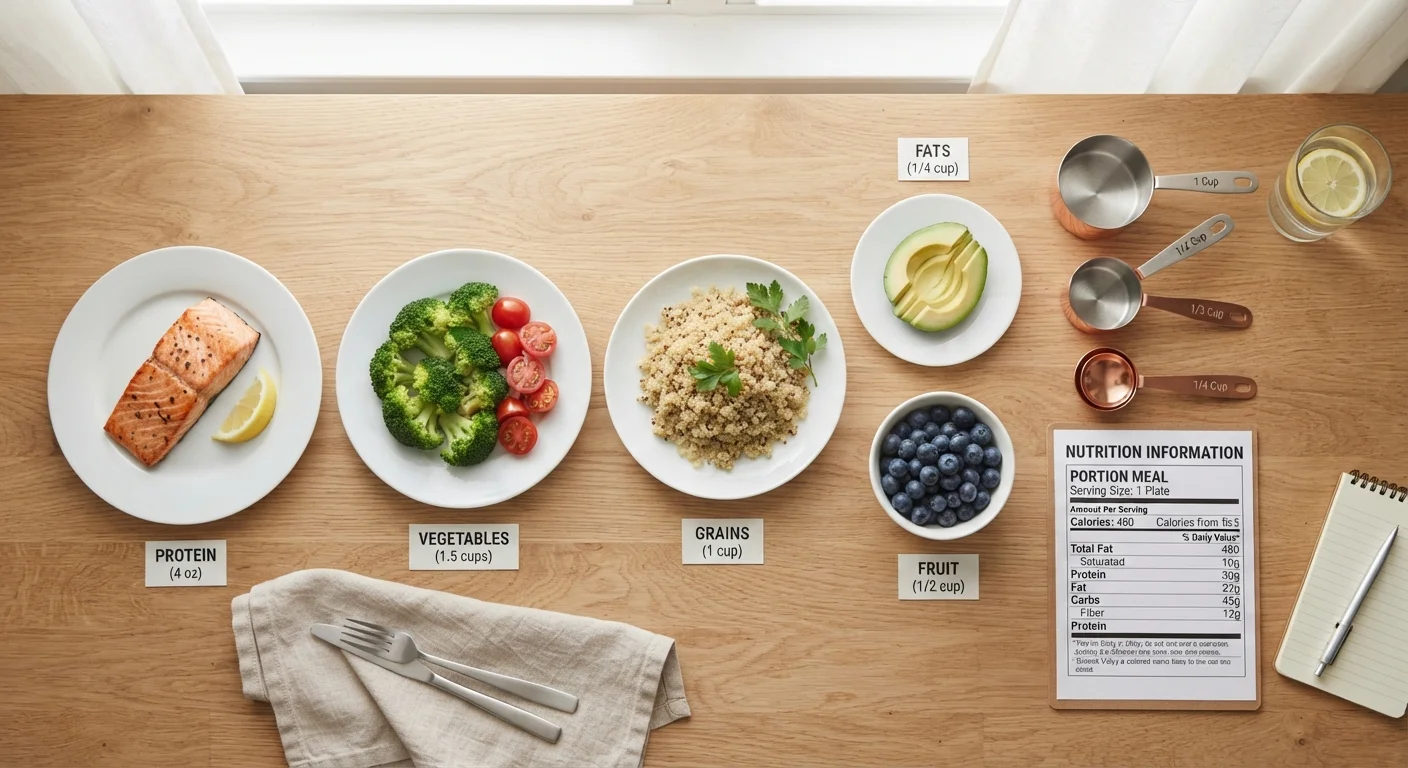
Eyeballing portions of calorie-dense foods without a reference.
Why it happens: Human visual estimation of volume and weight is unreliable, and it gets worse with small, dense items. Research consistently shows people underestimate portions of foods like nuts, cooking oils, peanut butter, and shredded cheese - sometimes by 50% or more.
Ignoring how restaurant and supersized portions have shifted baseline expectations.
Why it happens: Over decades, plate sizes in restaurants have grown substantially. When large portions become routine, they start to feel normal, and a standardized portion begins to look inadequate. This phenomenon - sometimes called the portion size effect - has been documented in nutritional science literature.
Overlooking how cooking methods and combinations change actual intake.
Why it happens: A label on dry pasta shows nutrition for the uncooked weight. Cooked pasta weighs more due to water absorption, so using the dry-weight figure to estimate a cooked bowlful leads to underestimates. Similarly, adding sauces, oils, or toppings after measuring a base food adds uncounted calories.
Single-Serve Packaging Can Mislead
Items sold in one package - a bottled coffee drink, a bag of chips, a muffin - are frequently labeled as containing 2 or 2.5 servings. If you eat the whole thing without checking, every calorie, sodium, and sugar figure on the label doubles or more. Always check "servings per container" before estimating your intake.
Portion awareness also matters beyond calorie counting. If you're trying to understand whether your diet supplies adequate fiber, potassium, or vitamin D - nutrients that federal dietary surveys show Americans consistently fall short on - accurate portion tracking changes the math significantly. See which nutrients are most commonly under-consumed to understand why closing this gap matters.
For a deeper look at how labels are structured and what each row actually means, the Nutrition Facts panel explained breaks it down without jargon. And if front-of-package health claims are adding to the confusion, reading past the marketing language on packaging explains which label details actually signal nutritional quality.
This article is for general informational and educational purposes only and is not medical or dietary advice. For guidance tailored to your individual health needs, consult a registered dietitian or qualified healthcare professional.