Why Clutter Comes Back After You Organize
You spent a weekend sorting, donating, and reorganizing - and the space felt genuinely good. Then three months later, surfaces are crowded again and the closet is mysteriously full. This pattern is so common that it has its own name among professional organizers: re-clutter. It happens not because you failed, but because a one-time declutter doesn't address the ongoing flow of items entering your home.
The good news is that a handful of simple, repeatable habits can interrupt that cycle. If you haven't done the initial purge yet, the room-by-room decluttering roadmap is a solid place to start. Once the baseline is set, the habits below are what keep it that way - without heroic effort every few months.
Start With Just One Habit
Trying to implement all of these habits simultaneously is a reliable way to burn out quickly. Choose the one that addresses your most common clutter pattern - for many people, that's the one-in-one-out rule or the daily reset - and practice it for three to four weeks before adding another. Small, consistent changes compound into lasting systems.
Habits That Stop Clutter Before It Settles
Apply the one-in-one-out rule consistently
The core idea is disarmingly simple: every time something new comes into your home, something else leaves. Buy a new pair of shoes? One pair goes to the donation bin. Receive a kitchen gadget as a gift? Identify one you haven't used in six months and pass it along. This rule works because it puts a natural cap on the total volume of possessions in your home - growth is structurally impossible if you enforce it honestly.
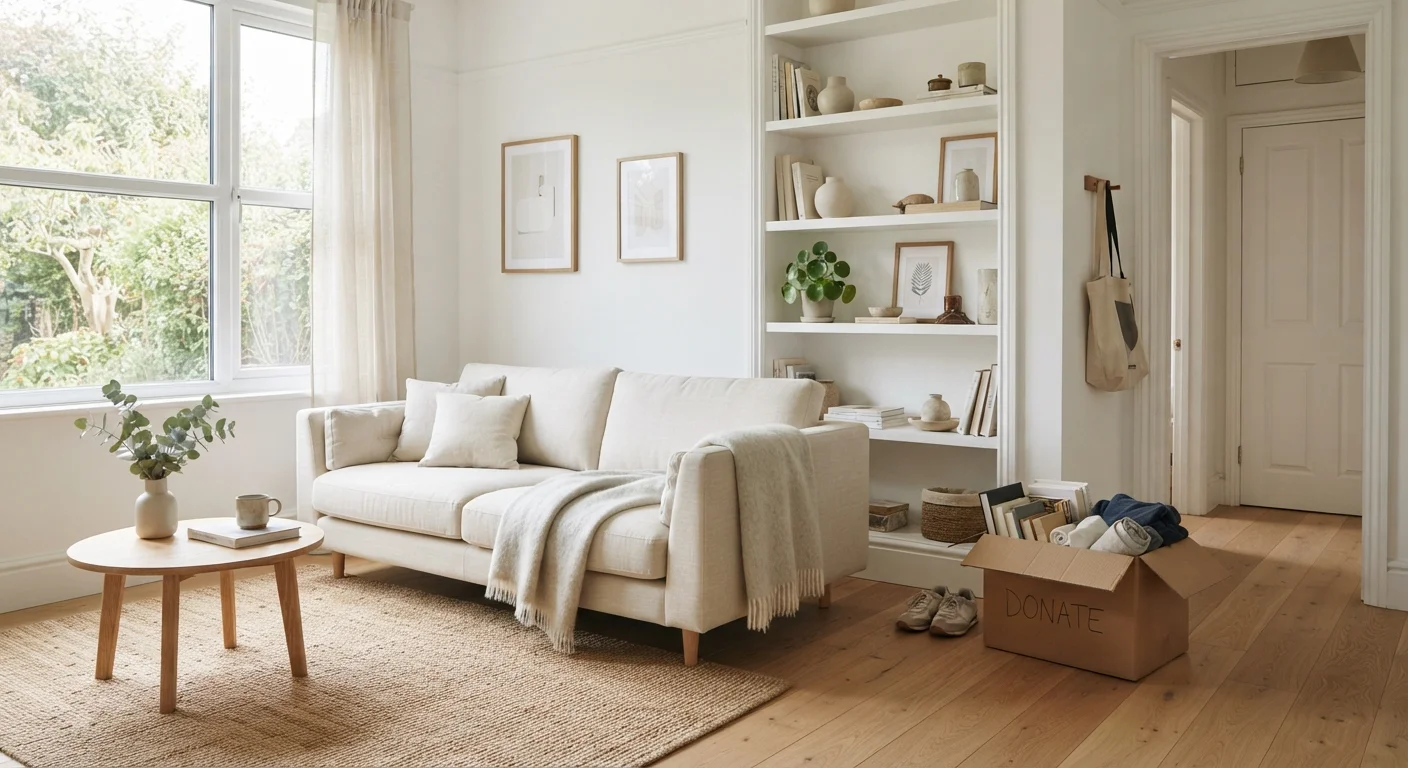
Start by applying the rule only to categories where you already feel overstocked - clothing, books, or kitchen tools are common starting points. Once it feels natural, extend it to other areas. Keep a small donation box in a closet so outgoing items have somewhere to land immediately.
One-in-one-out puts a permanent ceiling on how much can accumulate in your home.
Create a daily 10-minute reset
A short, end-of-day reset - 10 minutes or less - prevents small dispersals from hardening into clutter. The goal isn't deep cleaning; it's returning displaced items to their designated homes. Shoes go back to the entryway, mail gets sorted, and countertops get cleared. Done consistently, this habit means you wake up to a tidy space every morning, which makes it easier to maintain order throughout the day.
Pick a consistent time, such as after dinner or before bed, and keep it non-negotiable. Think of it less as a chore and more as a brief daily audit that costs almost no effort but saves enormous time over the long term.
A daily 10-minute reset is the simplest insurance policy against re-clutter.
Give every item a fixed, labeled home
Clutter often forms not because people are disorganized by nature, but because items lack a clear, consistent place to live. When something doesn't have a designated spot, it drifts to horizontal surfaces - counters, tables, chairs - and that drift is the origin of most clutter. Assign every category of item a specific location, and where possible, label shelves, bins, or drawers so the system is obvious to everyone in the household.
Labeling is especially effective for shared spaces and for households with children. When the location is unambiguous, putting things away becomes the path of least resistance rather than a decision that has to be made each time. For paper specifically, a dedicated filing system removes one of the most persistent sources of surface clutter.
When every item has a labeled home, putting things away requires no decision-making.
Pause before you purchase
The most effective way to prevent re-clutter is to slow the incoming flow. Before buying something non-essential, a brief pause - even just 24 to 48 hours - filters out impulse purchases that would have added volume without adding real value. Ask yourself where the item will live, whether you already own something that serves the same function, and how often you'll realistically use it.
This habit connects directly to financial wellbeing, too. Mindful purchasing aligned with smarter spending habits tends to reduce both clutter and buyer's remorse simultaneously. The goal isn't deprivation - it's intentionality about what earns a place in your space.
A 24-hour pause before non-essential purchases filters out clutter before it enters the home.
Schedule a monthly quick-pass
Even with good daily habits, some accumulation is inevitable - gift bags, expired coupons, duplicates that sneak in. A monthly 20- to 30-minute walkthrough of your most-used spaces catches these outliers before they compound. Go through one drawer, one shelf, or one cabinet per session rather than trying to do the whole house at once. The goal is to identify anything that has drifted from its home, anything that no longer serves a purpose, and anything that should be donated or discarded.
This habit also functions as an early-warning system. If you notice a category expanding - more cables in a drawer than you'd expect, for example - it's a signal to revisit that area before it becomes a real problem. For a more comprehensive approach to maintaining the whole house, the whole-house decluttering guide offers structured maintenance strategies alongside the initial sorting process.
A monthly quick-pass catches small accumulations before they grow into real clutter.
Set up a donation station
One practical barrier to regular decluttering is the friction of deciding what to do with outgoing items in the moment. A permanent, accessible donation station - typically a box or bag in a closet, garage, or mudroom - removes that friction entirely. When you notice something you no longer need, it goes directly into the station. When the container fills, it gets dropped off. No staging, no second-guessing.
This system works because it decouples the decision to let something go from the logistics of actually removing it. The decision is made once, at the moment of clarity, and the physical act of removal follows naturally on a regular schedule rather than requiring a separate dedicated effort.
A permanent donation station decouples the decision to let go from the logistics of removal.
Household Buy-In Makes a Real Difference
Maintenance habits are significantly easier when everyone in the household follows the same systems. A brief family conversation about where things belong and why the habits exist can prevent one person's efforts from being undone by others. Framing it around shared comfort rather than rules tends to get more cooperation, especially with children.
Building these habits takes a few weeks of conscious effort before they feel automatic. If you find yourself slipping back into old patterns, understanding why decluttering efforts lose momentum can help you identify and fix the real friction points. For those juggling both physical and digital disorder, pairing physical decluttering with digital minimalism can amplify your results in both areas.