
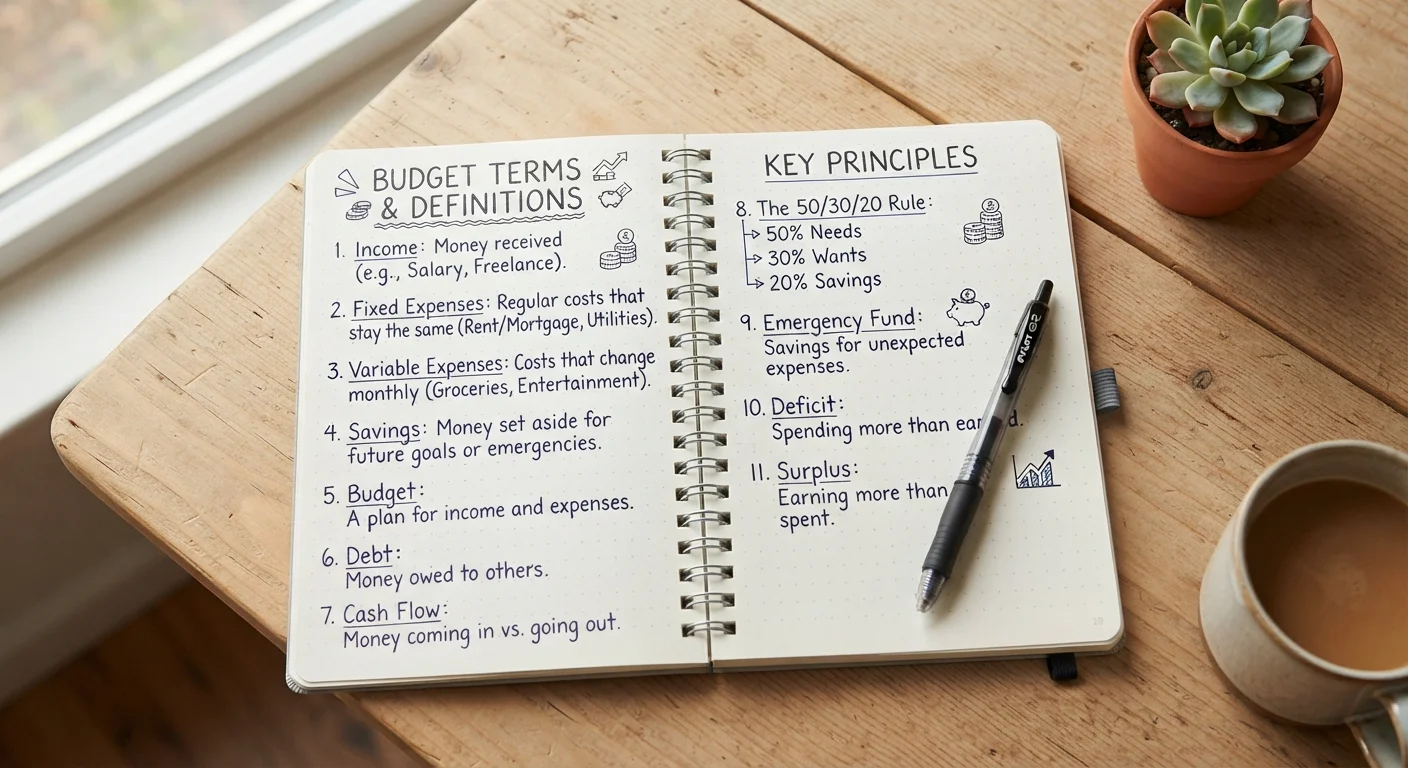
Why Budgeting Has Its Own Language
If you've ever opened a personal finance article and felt like you were reading a foreign language, you're not alone. Words like discretionary income, cash flow, and zero-based budget get thrown around as if everyone already knows what they mean. They don't need to stay mysterious.
This reference covers the terms you'll run into most often when building or following a budget. You don't need to memorize all of them at once - bookmark this page and come back whenever something sounds unfamiliar. Once the vocabulary clicks, the concepts behind it become much easier to apply.
If you're just getting started, it also helps to understand what a budget actually is before diving into the details. Learn what a monthly budget really means - the definition is simpler than most people expect.
| Budget starting point | Net income (take-home pay) |
| Most common budgeting rule | 50/30/20 (needs / wants / savings) |
| Emergency fund target (common guideline) | 3-6 months of essential expenses (Consumer Financial Protection Bureau general guidance) |
| Fixed vs. variable expenses | Fixed stay constant; variable change monthly |
| Zero-based budget goal | Every dollar assigned; income minus allocations = $0 |
| Discretionary spending | Wants, not needs - most adjustable category |
The Core Budgeting Terms Defined
Below are the most common budgeting terms, explained in plain English. Think of this as your go-to reference guide.
Gross Income
The total amount you earn before any taxes or deductions are taken out. This is usually the number on your offer letter or salary agreement, but it's not what you actually take home.
Net Income
The money you actually receive after taxes, Social Security, health insurance premiums, and other deductions are subtracted. This is the number your budget should be built on.
Fixed Expense
A cost that stays the same amount each month, such as rent, a car loan payment, or a fixed-rate insurance premium. These are predictable and easy to plan for.
Variable Expense
A cost that changes from month to month, such as groceries, gas, or utilities. You can estimate these based on past spending, but the exact amount will vary.
Discretionary Spending
Money spent on wants rather than needs - dining out, entertainment, hobbies, and similar choices. This category is usually the most flexible part of any budget.
Cash Flow
The net difference between money coming in (income) and money going out (expenses) during a given period. Positive cash flow means you're keeping more than you spend; negative means the reverse.
Zero-Based Budget
A budgeting method where you assign every dollar of your income a specific purpose - savings, bills, spending - so that income minus all allocations equals zero. No money is left unaccounted for.
50/30/20 Rule
A popular budgeting guideline suggesting you direct roughly 50% of net income to needs, 30% to wants, and 20% to savings or debt repayment. It's a starting framework, not a strict rule.
Emergency Fund
A dedicated savings reserve set aside to cover unexpected expenses - a car repair, a medical bill, or a temporary job loss - without disrupting the rest of your budget.
Budget Deficit
What occurs when your expenses in a given period exceed your income. Identifying a deficit is the first step toward correcting it by reducing spending or increasing income.
Envelope System
A cash-based budgeting method where you divide spending money into physical or digital envelopes by category. When an envelope is empty, spending in that category stops for the month.
Sinking Fund
Money set aside gradually over time for a specific planned future expense, such as a vacation, holiday gifts, or a car repair. Unlike an emergency fund, it targets a known cost.
Understanding the difference between fixed and variable expenses is especially useful when you start categorizing your spending. See how fixed and variable expenses shape any budget for a deeper look at that distinction.
You'll also encounter savings-specific vocabulary - terms like APY and liquidity - once you start putting money aside. Review savings terminology every American should know when you're ready to go further.
Putting the Terms to Work
Knowing the vocabulary is only the first step. The real payoff comes when you start applying these concepts to your own numbers. A few practical ways to do that:
- Start with net income. Every budget starts with what actually lands in your bank account - not your gross pay. Work from that number.
- Sort your expenses. Separate fixed costs (rent, loan payments) from variable ones (groceries, gas) and discretionary spending (dining out, subscriptions you could pause).
- Track cash flow monthly. Compare what comes in against what goes out. A negative number is a signal to adjust, not a reason to panic.
- Pick a budgeting method. Whether it's the 50/30/20 rule, zero-based budgeting, or an envelope system, the method matters less than consistency.
When you're ready to put these ideas into practice, building your first budget from scratch walks through the whole process step by step - no spreadsheet expertise required.
One common obstacle is the belief that budgeting requires sacrifice or financial expertise. Common budgeting myths can stop people before they even begin - knowing what's actually true makes it easier to start.
This article is for general informational and educational purposes only and does not constitute personalized financial advice. Consult a qualified financial professional for guidance specific to your situation.