
Why Tracking Matters Before Anything Else
You can't manage money you can't see. Before picking a budgeting structure or setting savings goals, you need a clear picture of what you actually spend - not what you think you spend. Most people are surprised by the gap between those two numbers.
This is why spending awareness is considered the essential first step before building any budget. Tracking is the mechanism that creates that awareness - and how you do it shapes how well it works for you personally.
Neither handwritten tracking nor app-based tracking is objectively superior. Each has real advantages and genuine drawbacks. What matters is finding the method you'll actually stick with long enough to see results.
How Each Method Works
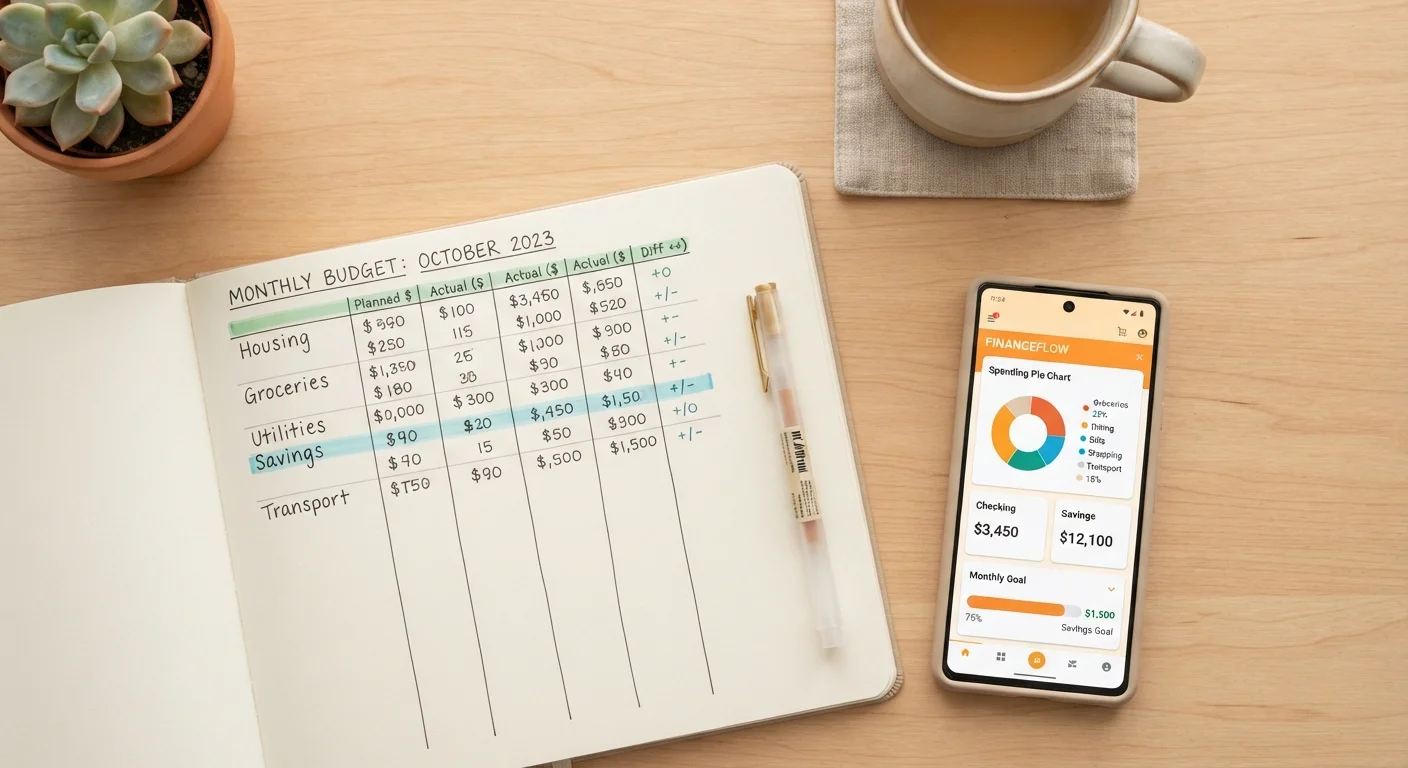
Tracking by hand means recording your purchases in a notebook, planner, or spreadsheet - manually, every time you spend. You write down the amount, category, and date. At the end of the week or month, you total everything up yourself.
Using a budgeting app typically means linking your bank accounts and credit cards so the app pulls in transactions automatically. You may assign categories, set limits, and view charts, but much of the data entry happens without your direct involvement.
| Criterion | Tracking by Hand | Using a Budgeting App |
|---|---|---|
| Data entry | Manual - you record every purchase | Mostly automated via account sync |
| Cash transaction capture | Easy - write it down | Unreliable or requires manual input |
| Privacy | No account linking required | Requires sharing financial login data |
| Consistency risk | High - gaps form if you miss days | Low - imports run automatically |
| Spending awareness | High - writing reinforces mindfulness | Moderate - easy to ignore notifications |
| Multi-account visibility | Difficult to manage | Strong - all accounts in one view |
| Cost | Free (notebook and pen) | Free to paid subscription tiers |
| Learning curve | None | Low to moderate setup required |
For a deeper look at how these two approaches compare in practice, see cash envelopes vs. digital budgeting apps, which explores similar trade-offs from a different angle.
What Works Well - and Where Each Method Falls Short
The case for tracking by hand: Research in behavioral science consistently suggests that writing information down by hand strengthens memory and engagement with that information. When you manually record a $60 impulse purchase, you feel it differently than when an app logs it silently overnight. That friction is actually useful - it slows down mindless spending over time.
The downside is sustainability. Manual tracking demands daily discipline. Miss a few days and your record becomes unreliable. It also struggles with digital payments spread across multiple accounts.
65%
Americans without a formal monthly budget
A Gallup survey found roughly two-thirds of U.S. households do not maintain a detailed monthly budget, highlighting how common it is to track spending inconsistently or not at all.
~$300
Average monthly spending underestimation
Consumer financial research has repeatedly found that people tend to underestimate their monthly discretionary spending, often by hundreds of dollars, when relying on memory alone.
The case for budgeting apps: Apps solve the consistency problem. Automated imports mean your spending history is nearly complete even if you don't open the app daily. Many apps also categorize transactions automatically, flag unusual charges, and show spending trends over time.
The limitations are real, though. Apps rarely capture cash spending. Some subscriptions or peer-to-peer payments get miscategorized. And linking financial accounts to a third-party platform carries privacy considerations worth understanding before you sign up.
If your goal is a full picture of where money leaks out, building a personal spending audit - using either method - is a practical next step.
Choosing What Fits Your Life
The right tracking method is the one you'll actually use consistently. A few questions worth asking yourself before you decide:
- Do I pay mostly with cards (app-friendly) or frequently with cash (hand-tracking wins)?
- Am I comfortable linking bank accounts to an app, or does that feel risky?
- Do I tend to follow through on manual habits, or do I need automation to fill gaps?
- Am I tracking for basic awareness, or do I need detailed reports across multiple accounts?
Many people find that combining both works best - using an app for automated card imports while keeping a simple notebook for cash purchases and weekly reflections. There's no rule requiring you to pick just one.
Once you've established how you'll track, the next natural step is choosing a budgeting structure. Zero-based budgeting vs. the 50/30/20 method walks through how to assign your spending data to a framework that fits your income and goals.
Tracking is only valuable if you review what you record and use it to make decisions. Whichever method you choose, schedule a regular check-in - weekly works for most people - to look at the numbers and ask what they're telling you.
This article is for general informational and educational purposes only and does not constitute personalized financial advice. Consider speaking with a qualified financial professional about your specific situation.