
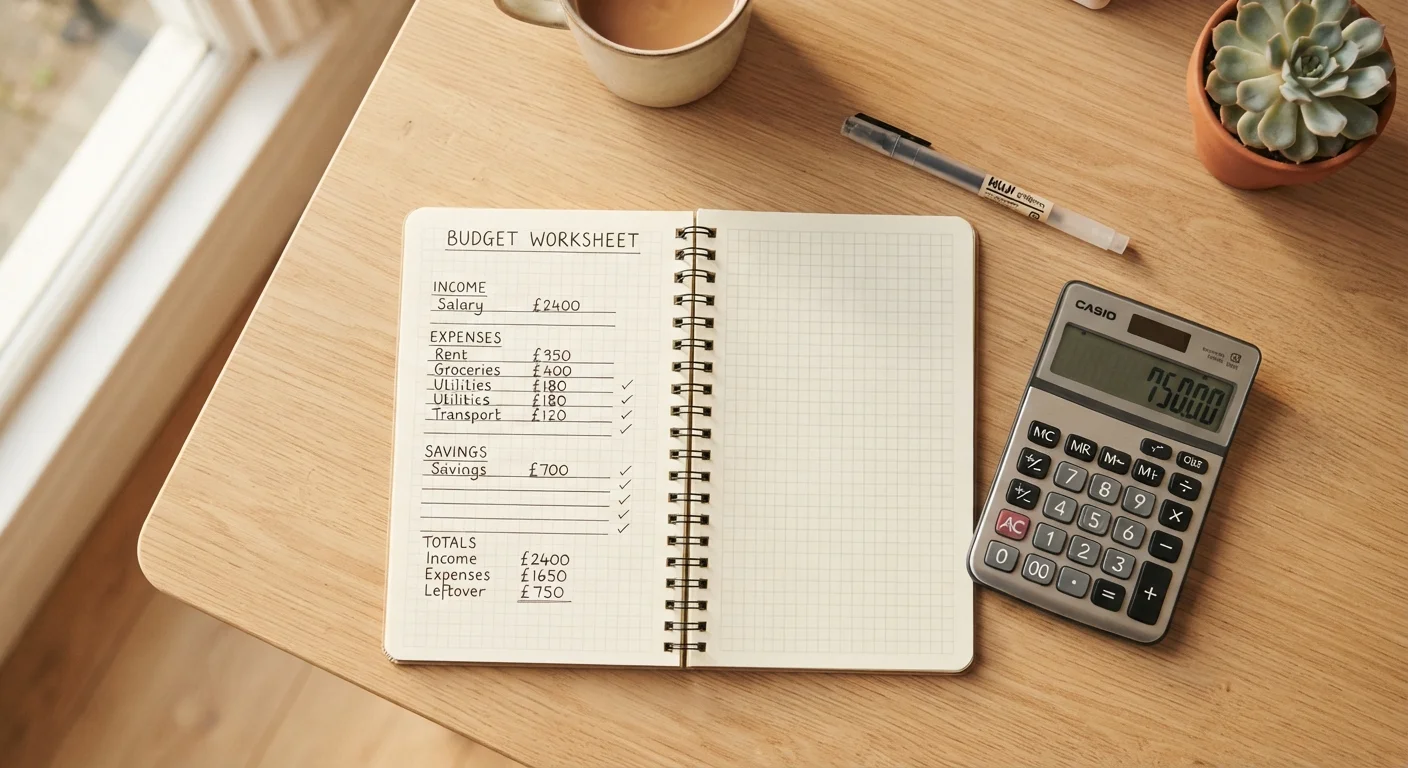
What a Budget Actually Is (and Isn't)
A budget is a written plan for how you'll use your money during a set time period - usually one month. That's it. It's not a strict punishment, a sign that you're broke, or something only people in financial trouble need. It's a tool anyone can use to feel more in control.
Before you write a single number down, it helps to understand a few key terms. The budgeting vocabulary guide covers the most common ones in plain language. Two worth knowing right now: net income (what you actually take home after taxes) and discretionary spending (money spent on wants, not needs).
A budget doesn't predict the future or guarantee you'll never overspend. What it does is give you a reference point - so when money gets tight or decisions get harder, you already have a plan to fall back on.
Net income
The money you actually receive after taxes and deductions are taken out of your paycheck. This is the number your budget should be built on.
Fixed expense
A cost that stays the same every month, like rent, a car payment, or an insurance premium. Easy to plan for because the amount doesn't change.
Variable expense
A cost that changes from month to month, like groceries, gas, or eating out. These require more attention in a budget because they're harder to predict.
Discretionary spending
Money spent on things you want but don't strictly need - dining out, entertainment, hobbies. This category is usually the most flexible in a budget.
Budget surplus
What's left over when your income is greater than your expenses. A surplus can go toward savings, debt payoff, or building an emergency fund.
Budget deficit
When your planned or actual spending exceeds your income. A deficit means something needs to change - either reduce spending or find ways to bring in more money.
Step 1: Add Up Your Monthly Income
Start with what actually lands in your bank account each month - your take-home pay, not your salary before taxes. If you're paid every two weeks, multiply one paycheck by 26 and divide by 12 to get a monthly figure.
If you have multiple income sources - a side job, freelance work, child support, rental income - list each one separately, then total them. For irregular income, use a conservative estimate based on your lowest recent months rather than your best months.
Use the monthly budget setup checklist to make sure you've gathered all your income figures before moving on. Missing a source - even a small one - throws off the whole plan.
Step 2: List Every Monthly Expense
This is where most first-time budgeters underestimate. Expenses fall into two categories:
- Fixed expenses - the same amount every month: rent or mortgage, car payment, insurance premiums, loan minimums.
- Variable expenses - amounts that shift: groceries, gas, dining out, clothing, entertainment.
List every fixed expense first - those are easy to pin down. Then go back through two to three months of bank and credit card statements to estimate your variable costs. Most people are surprised by how much small, routine purchases add up.
Don't forget irregular expenses that don't hit every month: car registration, annual subscriptions, back-to-school costs. Estimate their yearly total and divide by 12 to set aside a little each month.
If you want to dig deeper into where your money actually goes before finalizing these numbers, the spending awareness guide walks you through auditing your spending first.
Check Three Months of Statements
One month of spending data can be misleading - you might catch an unusually cheap or expensive month. Reviewing two to three months gives you a much more accurate picture of your real spending patterns. Most banks let you download statements as a PDF or spreadsheet for free.
Step 3: Choose a Budgeting Framework
Once you know your income and expenses, you need a way to organize them. A framework gives your numbers structure. Here are three approaches beginners commonly use:
- 50/30/20 Rule
- Allocate 50% of take-home pay to needs, 30% to wants, and 20% to savings and debt payoff. Simple and flexible. See the 50/30/20 plain-English guide for a full breakdown.
- Zero-Based Budget
- Assign every dollar of income a specific job - expenses, savings, or debt - until your income minus your allocations equals zero. More hands-on, but very precise.
- Pay-Yourself-First
- Move a savings amount out of your account the moment you're paid, then budget the rest for expenses. Prioritizes savings automatically.
There's no universally correct choice. Pick the method that feels manageable, and know you can switch later as you get more comfortable.
Step 4: Set Spending Limits and Track Them
Now assign a dollar limit to each expense category based on your framework. Your total planned spending must not exceed your total income - if it does, you'll need to adjust categories downward or find ways to increase income.
Once limits are set, tracking is what makes a budget real. Every week, compare what you've actually spent against your plan. This doesn't need to be elaborate: a notes app, a simple spreadsheet, or a free budgeting tool all work. What matters is consistency.
At the end of the first month, review the results honestly. Most first budgets need adjustment - that's normal and expected. Treat month one as a learning exercise, not a pass/fail test. Building lasting habits around your spending is part of a longer journey covered in the Smarter Spending Habits hub.
Your First Budget Won't Be Perfect
Financial planners widely agree that the first month of budgeting is really a data-gathering exercise. You'll discover expense categories you forgot, limits that were too tight, and habits you didn't realize you had. Use month one to calibrate, not to judge yourself. Accuracy improves significantly by month two or three.
Common First-Budget Mistakes to Avoid
Even with good intentions, beginners run into a few predictable traps:
- Using gross income instead of net income. Your budget should be built on take-home pay - the money you can actually spend.
- Forgetting irregular expenses. Annual fees, seasonal costs, and one-time bills wreck budgets when they aren't anticipated.
- Setting unrealistic limits. Cutting a $400 grocery habit to $150 overnight rarely works. Make gradual, achievable changes.
- Giving up after one bad week. One overspend doesn't ruin a budget. Reset and keep going.
- Not revisiting the budget monthly. Life changes. Your budget should change with it.
If you find your expenses consistently outpace your income, consider reviewing the Saving & Debt hub for strategies on reducing what you owe and building a cushion. And once you have a budget in place, managing credit wisely becomes the natural next step - the first credit card guide covers the basics without the jargon.
This article is for general informational and educational purposes only and does not constitute personalized financial advice. Please consult a qualified financial professional for guidance specific to your situation.