
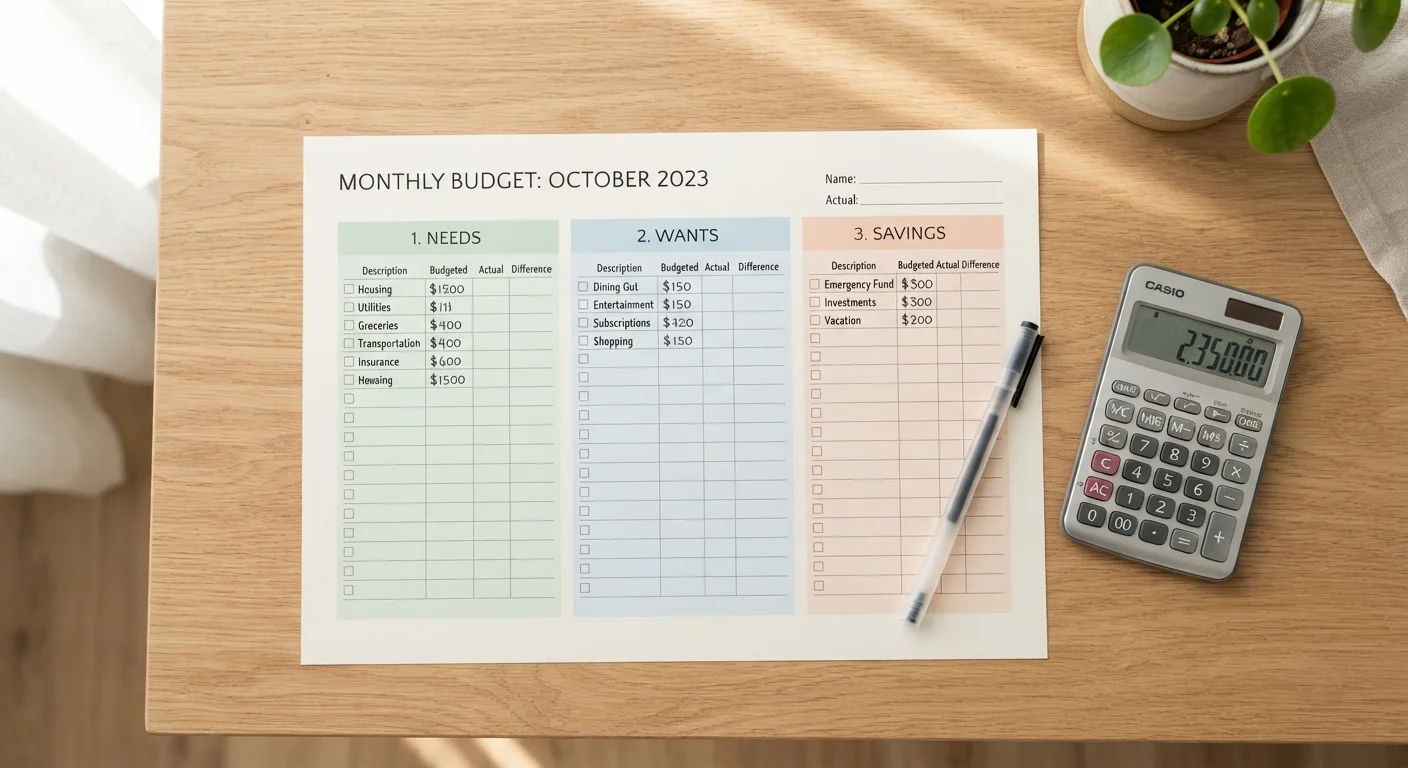
How the Three Buckets Work
The 50/30/20 rule works by splitting every dollar of take-home pay before you spend any of it. Here's what goes in each bucket:
- 50% — Needs: Rent or mortgage, groceries, utilities, health insurance, car payment and gas (if needed for work), and the minimum required payment on any loans or credit cards.
- 30% — Wants: Dining out, streaming services, clothing beyond the basics, gym memberships, vacations, and hobbies. These are real expenses, just not survival-level ones.
- 20% — Savings and debt payoff: An emergency fund, retirement contributions, and extra payments on debt above the minimum.
The distinction between needs and wants trips people up most often. Internet at home is often a need if your job depends on it. A premium cable package is a want. A used, reliable car can be a need; upgrading to a newer model is a want. Being honest with yourself about that line is where the framework actually earns its keep.
Automate Before You Spend
Set up an automatic transfer to your savings account on the same day your paycheck hits. Even a small recurring transfer builds the habit and removes the temptation to spend money you meant to save. Treat the 20% as a bill you pay yourself first.
If you've never built a formal budget before, the plain-English walkthrough for first-time budgeters is a helpful companion to this framework.
Applying It to a Real Paycheck
Say your household brings home $4,500 a month after taxes. Under the 50/30/20 rule, your target allocation looks like this:
| Category | Percentage | Monthly Amount |
|---|---|---|
| Needs | 50% | $2,250 |
| Wants | 30% | $1,350 |
| Savings / Debt payoff | 20% | $900 |
You don't need a spreadsheet to start. Add up your fixed monthly obligations — rent, insurance, utilities, minimum payments — and check whether that total is close to half your income. If it's well above 50%, that's a signal that your fixed costs may be crowding out savings and flexibility.
57%
Americans living paycheck to paycheck
A 2024 report by PYMNTS Intelligence and LendingClub found that 57% of U.S. consumers described themselves as living paycheck to paycheck, underscoring why a structured budgeting framework matters.
30%
Recommended share of income for housing
Financial guidance commonly cited by HUD and housing counselors suggests spending no more than 30% of gross income on housing — a benchmark the 50/30/20 rule's needs bucket is designed to accommodate.
$1,000
Common emergency fund starting target
Consumer finance educators widely recommend a $1,000 starter emergency fund as an initial savings milestone, which the 20% savings bucket is designed to help households build toward.
The goal isn't perfection. Getting directionally close to these targets — and adjusting them intentionally when life requires — is far more useful than abandoning the approach entirely when it doesn't fit perfectly on month one.
Where the Rule Has Real Limits
The 50/30/20 rule is widely praised for its simplicity, but that simplicity comes with trade-offs worth understanding.
It assumes your income is consistent
Freelancers, gig workers, and anyone with variable pay will find it harder to apply fixed percentages to an income that changes month to month. A modified approach — such as budgeting from a conservative baseline income estimate — can help.
Housing costs can break the math
In many U.S. metro areas, rent alone can consume 40–50% of a moderate income before any other need is counted. If that's your situation, the 50% needs target is more of an aspiration than an immediate reality. Adjust the percentages and work toward them over time rather than feeling locked into numbers that don't fit your city.
It doesn't prioritize aggressively
If you're carrying high-interest credit card debt, a flat 20% toward savings and debt may not get you out of the hole fast enough. You might temporarily compress the wants category to direct more toward debt payoff. The core principles behind long-term budgeting success can help you think through those trade-offs.
This Is General Financial Education
The 50/30/20 rule is a widely cited framework, but it's not a substitute for personalized financial advice. If you're managing significant debt, irregular income, or major financial decisions, consider speaking with a nonprofit credit counselor or a licensed financial adviser who can assess your specific situation.
This article provides general financial education and is not personalized financial advice. Everyone's financial situation is different. Consider speaking with a licensed financial adviser or nonprofit credit counselor if you're dealing with significant debt or income instability.
Making the Rule Work for You
The 50/30/20 rule is best treated as a framework to adapt, not a rigid prescription. Here's how to make it practical:
- Start with what you actually spend. Pull three months of bank statements and categorize your spending. Compare your real numbers to the 50/30/20 targets. Surprises are useful data.
- Automate the 20% first. If you wait until the end of the month to save whatever's left, there's usually nothing left. Set up an automatic transfer to savings on payday.
- Revisit it after major life changes. A new job, a move, a baby, or paying off a loan all shift the math. Treat the percentages as a living target, not a fixed contract.
Couples may need to decide together how to apply the rule to combined or separate incomes — an area explored further in our guide on budgeting as a couple.
The value of the 50/30/20 rule is that it gives you a fast sanity check on whether your money is going where it matters — without requiring you to log every coffee purchase. For most people, that clarity alone is worth the five minutes it takes to run the numbers.
This article is for general informational purposes only and does not constitute personalized financial, tax, or investment advice. Consult a qualified financial professional for guidance specific to your circumstances.