
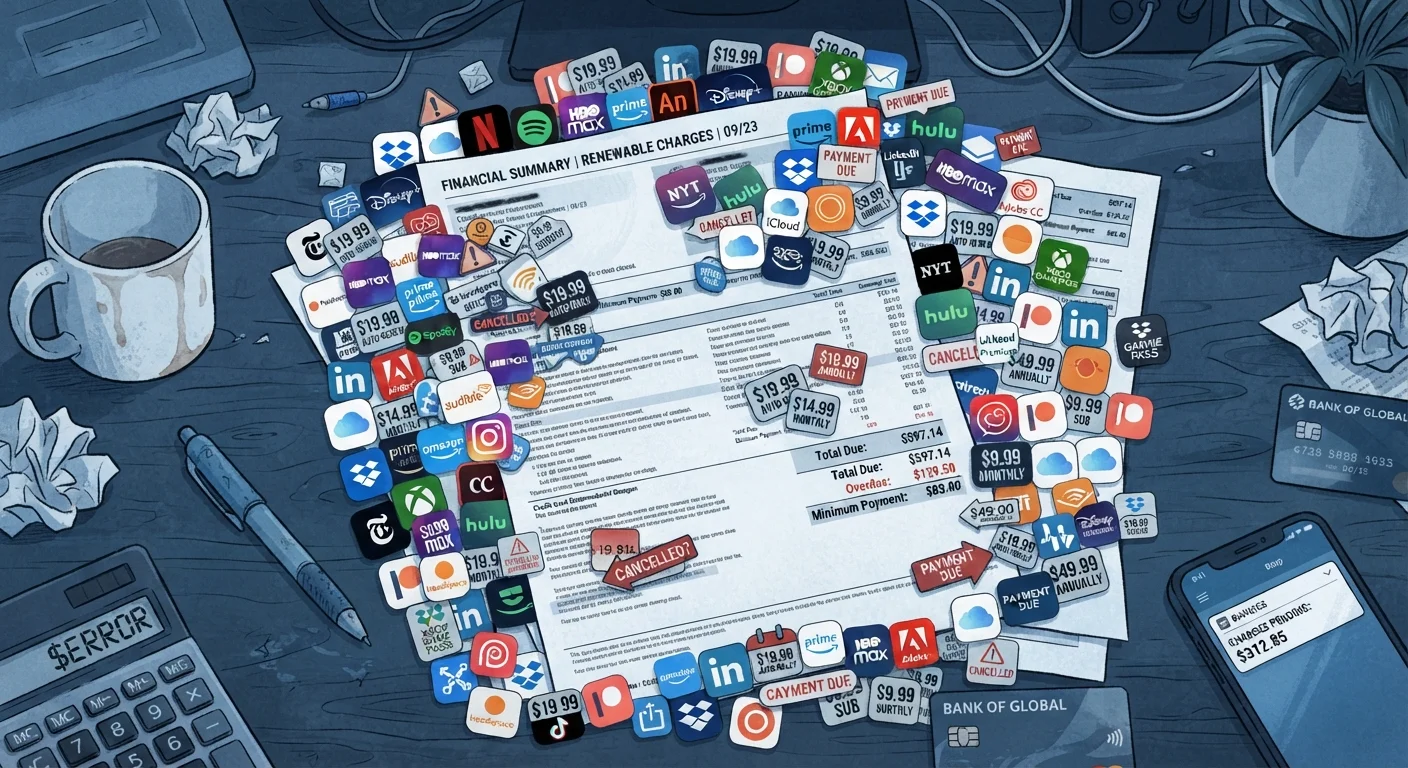
What Subscription Creep Actually Costs You
Subscription creep refers to the gradual accumulation of recurring charges — streaming services, app memberships, software licenses, meal kit plans, gym add-ons — that individually seem small but collectively carve a significant hole in your monthly budget. A $4.99 charge here, a $12.99 there: by the time most people notice, they're spending well over $200 a month on services they use inconsistently or forgot they signed up for at all.
Consumer research consistently finds that people underestimate their subscription spending — sometimes by 50% or more. This isn't carelessness. It's the product of how subscription billing is designed: charges are small enough to avoid triggering mental alerts, they arrive on varied dates, and they rarely appear as a lump sum. The result is a budget drain that's essentially invisible until you go looking for it.
Understanding the specific mistakes that allow subscription creep to take hold is the first step toward stopping it. For a broader look at how forgotten recurring costs disrupt monthly plans, see how irregular expenses wreck budgets.
$219/mo
Average estimated U.S. household subscription spending
Consumer surveys conducted by multiple financial research firms have found average monthly subscription costs well above what households self-report when asked to estimate.
~50%
How much people underestimate their subscription costs
Studies on subscription awareness consistently find consumers underestimate their recurring charges by roughly half compared to their actual bank statement totals.
The Most Common Subscription Mistakes — and How to Avoid Them
Most people don't actively choose to overspend on subscriptions. The mistakes below explain exactly why it happens and what to do differently.
Signing up for free trials without setting a cancellation reminder.
Why it happens: Free trials are designed to feel low-risk. Signing up takes 30 seconds; the billing date is weeks away and easy to forget.
Never auditing which subscriptions are actually active.
Why it happens: Without a routine review, there's no moment that forces the question. Charges process automatically, so silence feels like everything is fine.
Keeping subscriptions that duplicated coverage you already have.
Why it happens: Services are acquired over time in response to different needs. It's easy to accumulate two cloud storage plans, two music apps, or overlapping news paywalls without noticing.
Letting household members subscribe independently without a shared view.
Why it happens: Partners and older children often manage their own apps and accounts, meaning no single person has a complete picture of what the household pays monthly.
Confusing 'pausing' with canceling, and then forgetting to revisit.
Why it happens: Pausing a subscription feels responsible — less final than canceling — but pause periods expire automatically, restarting charges without any notice most people notice.
Overlooking small app-store charges buried in monthly billing summaries.
Why it happens: App stores bundle many small charges into a single monthly statement line. Individual $0.99 or $2.99 charges rarely stand out.
Watch Out for Price Increases on Auto-Renewing Plans
Many subscription services raise prices at renewal without prominent notice. Unless you actively check your statements, a service that cost $9.99 a year ago may now cost $13.99 — and you'd never know. Make it a habit to compare the current renewal charge against what you paid previously, especially for annual plans.
The fix for most of these mistakes is the same: build a deliberate review habit. Set a recurring calendar reminder — quarterly works well for most households — to pull up every active subscription and ask: Did I use this? Is the cost worth continued access? Could I pause instead of cancel? This disciplined spending habit sounds simple because it is, but very few people actually do it.
Building a System That Keeps Creep from Coming Back
Canceling subscriptions you don't use is only half the job. Without a system, new ones pile up just as quietly. A few structural changes make a real difference:
- Route all subscriptions through one card. When recurring charges land in multiple places — one card, a PayPal account, a bank debit — they're nearly impossible to track at a glance. Designating a single payment method for subscriptions creates a single audit point.
- Use a dedicated email folder. Most subscription confirmations and renewal notices arrive by email. Filtering them into one folder means you can scan all active services in under two minutes.
- Convert annual subscriptions to monthly temporarily. Annual billing often costs less overall, but it obscures the monthly cost and makes you less likely to cancel. Switching to monthly billing briefly — while you evaluate usage — can sharpen your awareness before committing to another year.
If you use automatic payments more broadly, structuring them thoughtfully reduces financial stress rather than adding to it. The guide on automating your finances offers a practical framework for doing that without losing visibility into where your money goes. Subscription discipline is also one of the clearest ways to free up cash that can go toward building savings or paying down debt rather than funding services you barely use.
This article is for general informational purposes only and does not constitute personalized financial advice. Consult a qualified financial professional for guidance specific to your situation.