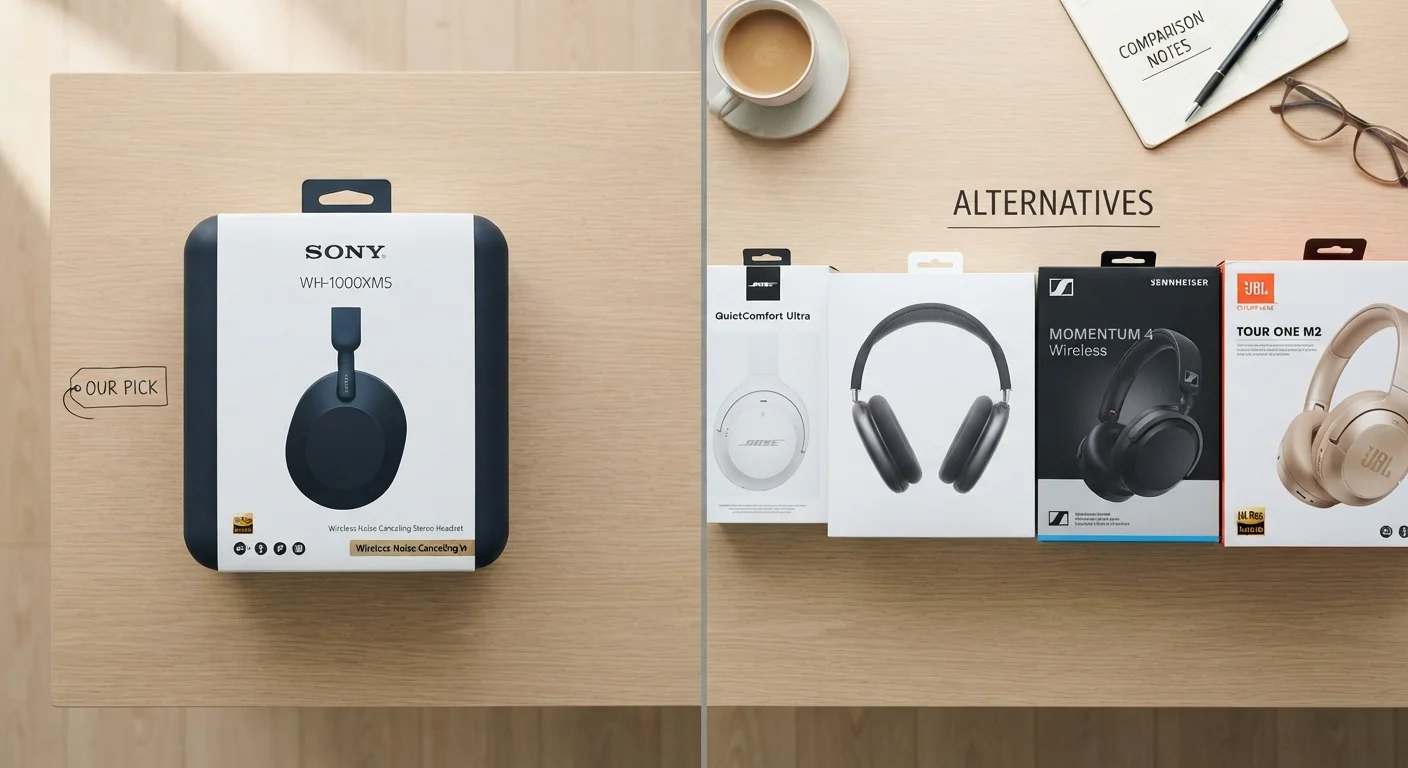

The Three-Tool Persuasion Kit
Retailers and online marketplaces don't rely on luck to move products. They systematically apply three overlapping psychological techniques — anchoring, urgency, and social proof — that together can make almost any purchase feel obvious and immediate. Understanding each one separately is the groundwork for shopping more deliberately.
These tactics aren't obscure. They're visible in virtually every sales environment, from big-box stores to e-commerce product pages. What makes them powerful is that they work through perception, not logic — they shape how a price or product feels before your rational mind has a chance to weigh in.
For a broader look at how the retail environment is engineered around your decision-making, see how retail psychology shapes buying behavior.
Anchoring: The First Number Wins
Anchoring is one of the most studied effects in behavioral economics. It refers to the human tendency to rely heavily on the first piece of numerical information encountered when making a judgment. In retail, that means the original or list price shown before a sale price sets a mental benchmark — even if that benchmark is inflated or rarely reflected a real transaction price.
When you see an item marked down from $199 to $89, your brain doesn't calculate whether $89 is a fair price for the item. It calculates the distance from $199 and registers a $110 gain. The anchor does the persuasion work.
~$18B
Annual U.S. revenue from flash sale and limited-time offer marketing
Industry estimates consistently place the flash-sale and deal-site market in the tens of billions, driven in large part by urgency-based conversion tactics.
60–70%
Shoppers influenced by seeing a crossed-out reference price
Consumer psychology research has repeatedly found that displaying a higher reference price alongside a sale price significantly increases purchase likelihood, independent of the actual selling price.
95%
Online shoppers who read reviews before buying
Surveys from consumer research organizations consistently show that the vast majority of online shoppers consult ratings and reviews as part of their purchase decision process.
Common anchor tactics include crossed-out prices, manufacturer suggested retail prices (MSRPs) that are rarely charged, and side-by-side comparisons between a basic and premium tier designed to make the middle option look reasonable by contrast. That middle-option strategy is sometimes called the 'decoy effect.'
What to do: Research what similar products actually sell for across multiple retailers before deciding whether a price is genuinely competitive. The anchor number is marketing context, not market value.
Urgency: Pressure That Compresses Thinking
Urgency tactics exploit a real cognitive pattern: when people believe an opportunity is about to disappear, careful deliberation gives way to fast action. Retailers manufacture this effect with countdown timers, 'only 3 left in stock' labels, 'today only' banners, and flash sale windows.
The goal is to compress your decision window. A longer decision window means more time to comparison shop, sleep on it, or reconsider. Urgency removes that buffer. Research on how time pressure alters purchase decisions shows that even mild artificial deadlines measurably increase conversion rates for retailers.
Test the Timer Before You Buy
If a countdown timer is pushing you toward a purchase, open the product page in a private browser window or on another device. If the same timer appears — often reset to the same duration — it's a persistent marketing element, not a real deadline. This one check can neutralize a significant amount of urgency-based pressure.
Genuine scarcity does exist — clearance stock runs out, event seats sell — but manufactured urgency is far more common. A practical rule: if the same retailer runs the same promotion on the same item repeatedly, the urgency is built into the marketing strategy, not the inventory.
Social Proof: Borrowing Other People's Confidence
Social proof is the principle that people look to the behavior or endorsement of others as a guide when they're uncertain. In a shopping context, this shows up as star ratings, review counts, 'bestseller' labels, influencer endorsements, and 'customers also bought' recommendations.
None of these signals are inherently dishonest, but they're also not straightforward measures of quality. Review counts can be padded by incentivized reviews. 'Bestseller' status can reflect aggressive promotion rather than independent consumer preference. Ratings are often skewed toward early enthusiasts who received a product for free.
The deeper issue is that social proof often substitutes for evaluation rather than supplementing it. When a product has 4,800 reviews and a 4.6-star average, most shoppers stop there. That number carries persuasive weight that may not be warranted.
What to do: Read a representative sample of mid-range (2- and 3-star) reviews. They often surface specific, recurring problems that five-star reviews bury. For higher-stakes purchases, check independent review sources outside the retailer's own platform.
Using Awareness as a Practical Tool
Knowing these tactics exist is useful, but awareness alone doesn't fully insulate you from them. Behavioral research consistently finds that even people who can describe a cognitive bias in detail remain vulnerable to it under real shopping conditions. The goal is to build habits that create structural distance between the persuasion trigger and your decision.
Simple habits with documented impact include: waiting at least 24 hours before completing any non-essential purchase, checking whether a 'sale' price is actually lower than the item's historical price, and treating countdown timers as information about the retailer's tactics rather than your deadline.
For a practical framework to categorize whether you actually need something before a persuasion technique can take hold, see the needs, wants, and wishes framework. And if you want to understand the emotional pull behind unplanned purchases, the psychology of impulse buying is a useful companion read.
Retailers are skilled at what they do. The persuasion playbook they use is refined and evidence-backed. But it works best when you're unaware it's happening — and that's a condition you can change.