Why Pressure Makes You a Less Careful Shopper
Shopping should be a rational exercise: you evaluate options, compare value, and choose what fits your needs and budget. In practice, it rarely works that way — especially when you're rushed or surrounded by other shoppers.
Cognitive load research consistently shows that when people are under time pressure or navigating a stimulating environment, they shift from deliberate, analytical thinking to faster, more instinctive decision-making. Psychologists call this moving from System 2 (slow, effortful reasoning) to System 1 (quick, automatic judgment). Retailers understand this shift — and many store and promotional designs are built around triggering it.
That doesn't mean you're helpless. Understanding the mechanics of pressure-driven decisions puts you in a much stronger position to push back. For a broader view of how these tactics operate, see our overview of retail psychology tactics that shape what you buy.
The Specific Tactics That Create Shopping Pressure
Pressure doesn't just happen — it's often engineered. Knowing the most common tools helps you spot them in real time.
2x
How much more losses hurt compared to equivalent gains
Loss aversion is a foundational finding in behavioral economics, documented extensively in research by Kahneman and Tversky, explaining why expiring offers feel so compelling.
~40%
Share of purchases that are unplanned
Consumer research has consistently found that a substantial portion of in-store purchases are unplanned, with environmental factors — including crowding and promotional cues — identified as contributing drivers.
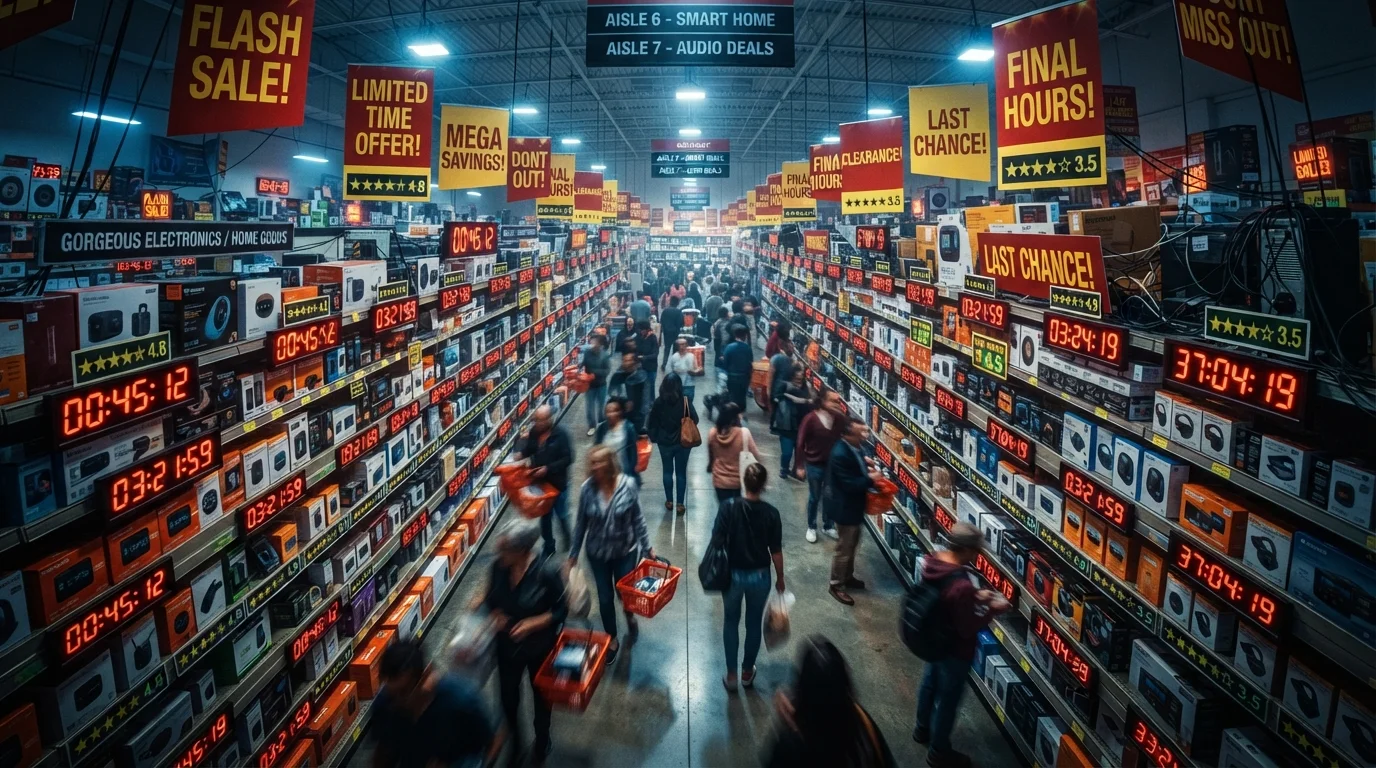
Countdown timers and expiring offers. Whether on a website or a sale tag, a ticking clock triggers loss aversion — the psychological discomfort of missing out. Research in behavioral economics suggests people feel the pain of a loss roughly twice as intensely as the pleasure of an equivalent gain. A deal expiring in 12 minutes feels like a threat, not an opportunity.
Low-stock and scarcity signals. "Only 3 left in stock" warnings tap into the same wiring. They imply that other people are buying, that the option is scarce, and that hesitation carries a cost. As we explain in our article on scarcity warnings online, these messages are sometimes accurate — and sometimes not.
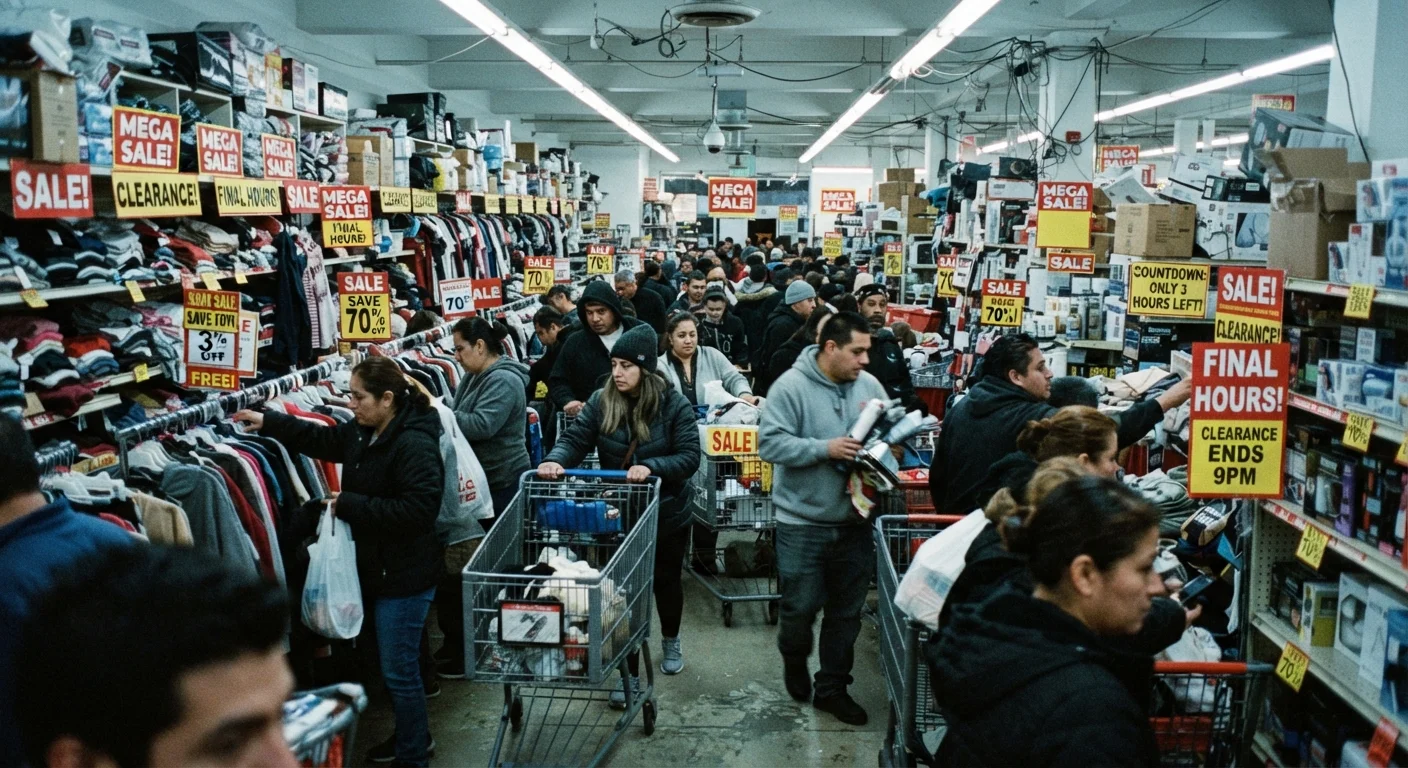
Peak-hour crowding. A busy store raises your cognitive load. Navigating around people, managing noise, and feeling mildly rushed all reduce your available mental bandwidth. Studies on environmental stress suggest that ambient crowding can increase impulsive purchase behavior, partly because shoppers want to resolve the discomfort of the situation quickly — and buying feels like resolution.
Social proof cues. Seeing a product in many carts, or being told it's a "crowd favorite," nudges you to assume it must be worth buying. This shortcut works because it offloads the evaluation work to others — which is exactly the point. To understand how these and related tactics fit together, our piece on anchoring, urgency, and social proof covers the full persuasion playbook.
Best Practices for Shopping Under Pressure
These habits don't require willpower in the moment — they work by reducing how much pressure you're exposed to in the first place, and by giving you a decision framework that works even when your thinking is compromised.
Decide your budget and list before entering any shopping environment.
Pre-commitment is one of the most well-supported strategies in behavioral economics. When you've already decided what you need and what you'll spend, pressure tactics have a smaller surface area to work on. You're not deliberating in the store — you're just executing a plan.
Name the tactic out loud (or in your head) when you notice it.
Labeling a manipulation attempt — "that's a countdown timer designed to rush me" — activates the analytical part of your thinking and reduces its emotional power. This technique is sometimes called psychological distancing, and it's a recognized approach in consumer decision research.
Use a personal purchase threshold for non-essentials.
A threshold is a dollar amount above which you automatically wait before buying. It converts a real-time emotional decision into a policy decision made in advance — under no pressure at all. Thresholds are especially useful in environments engineered to create urgency.
Shop during off-peak hours when possible.
Reducing environmental crowding directly reduces cognitive load. With fewer people around, you have more mental space to think carefully, compare options, and resist pressure. You're also less likely to experience the ambient stress that accelerates impulsive decisions.
Treat urgency signals as a cue to slow down, not speed up.
Countdown timers and scarcity warnings are designed to make you feel that hesitation is costly. In reality, for most consumer purchases, the cost of waiting is low and the cost of a pressure-driven mistake can be significant. Reversing the default response — using urgency as a signal to pause — directly counters the tactic.
Separate browsing sessions from buying decisions when shopping online.
Online retail environments are particularly rich in pressure tools: timers, stock counters, personalized urgency messages, and one-click purchasing. Keeping a browsing session (evaluating options) distinct from a buying session (returning to purchase after reflection) removes the pressure of the in-the-moment environment from the final decision.
Putting It Into Practice
The goal isn't to become a suspicious or joyless shopper. It's to ensure that when you spend money, the choice is genuinely yours — not a reflex triggered by a timer or a crowded aisle.
Building these habits takes a few intentional shopping trips before they become automatic. Start with one or two practices from the list above rather than trying to overhaul everything at once. If impulse buying is a recurring issue, our deeper look at the psychology behind impulse buying can help you understand what's driving it.
And if you're weighing whether to buy now or wait — a decision that pressure tactics are specifically designed to short-circuit — our guide on why a 24-hour waiting rule changes how you spend offers a practical framework worth reading before your next big purchase.