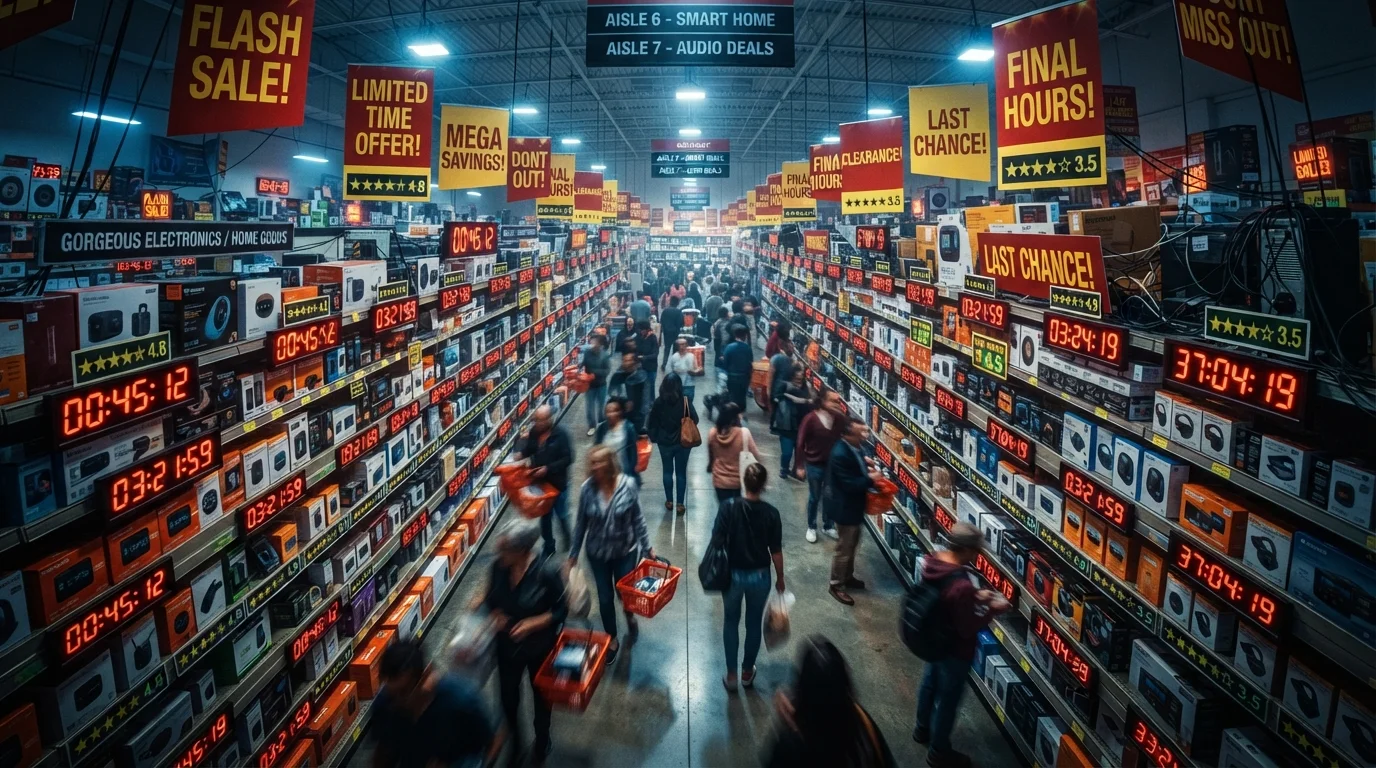

How Urgency Cues Became Standard E-Commerce Practice
Flip through almost any major retail website today and you'll encounter the same familiar triggers: a dwindling stock counter, a timer counting down to midnight, or a pop-up announcing that 12 other shoppers are eyeing the same item. These elements aren't accidental design choices — they're deliberate applications of behavioral psychology research showing that perceived scarcity and time pressure increase purchase likelihood.
The underlying principle is sometimes called the scarcity heuristic: when people believe something is in short supply, they tend to assign it higher value and act faster to acquire it. Retailers learned this from decades of consumer research, and e-commerce platforms made it technically trivial to deploy. Many platforms offer built-in plugins that display low-stock labels or visitor counts that are, at best, loosely connected to actual data.
That doesn't mean every scarcity warning is fabricated. Supply chain disruptions, limited production runs, and genuine seasonal demand all create real shortages. The problem is that the presentation of a warning — red font, bold numbers, flashing timers — looks identical whether the shortage is real or manufactured. Learning to evaluate these signals critically is one of the most practical shopping skills you can build.
Myths vs. Facts: What Those Warnings Actually Mean
Let's break down the most common misconceptions shoppers hold about online scarcity and urgency cues — and what the evidence actually shows.
Myth
If a site says 'Only 3 left in stock,' the product is genuinely about to sell out.
Fact
Many low-stock labels are set by threshold rules in retailer software, not live warehouse counts. A product showing '3 remaining' may have hundreds of units in distribution centers.
Most e-commerce platforms allow sellers to configure inventory display rules — for example, showing a 'low stock' warning any time inventory drops below a set number, say 10 or 20. That threshold is a business decision, not a factual ceiling. Additionally, some smaller sellers and dropshippers display stock warnings that are entirely disconnected from real supply. Independent research into e-commerce persuasion design consistently finds that low-stock labels are among the most widely used conversion tactics, regardless of actual inventory levels.
Myth
Countdown timers mean the sale price will disappear when the clock hits zero.
Fact
Many countdown timers on retail sites reset automatically once they expire, continuing the 'sale' indefinitely. A timer is a design element, not a binding commitment.
Regulatory agencies in the U.S., including the Federal Trade Commission, have guidelines requiring that advertised sale prices reflect genuine, time-limited discounts — but enforcement at the individual product level is inconsistent. Consumer watchdog testing has repeatedly documented cases where countdown timers on e-commerce pages refresh upon expiration rather than ending the promotion. If you're uncertain, note the timer's end time, navigate away, and return after it supposedly expires to see what happens.
Myth
The 'X people are viewing this right now' notification means you're in direct competition for limited stock.
Fact
Viewer-count notifications are often generated by scripts that display approximate or estimated figures, and they typically have no bearing on actual available stock.
Live visitor counters became popular through booking and travel sites, where real-time seat or room inventory does create genuine competition. Many general retail sites borrowed the visual format without the underlying reality. Some platforms use approximate session data; others display algorithmically suggested numbers. Unless you're booking a specific seat on a specific flight or a hotel room on a specific night, 'X viewers' is a social proof signal engineered to create competition anxiety — not a reliable supply alert.
Myth
Scarcity warnings are only used by shady or low-quality retailers.
Fact
Urgency tactics are used across the retail spectrum, from small marketplace sellers to well-established national retailers. The tactic itself says nothing about product quality or seller legitimacy.
This misconception leads shoppers to lower their guard on familiar brand sites. Major retailers invest significantly in conversion rate optimization, and urgency cues are a standard part of that toolkit. Seeing a scarcity warning on a reputable site may even make it feel more credible — which is precisely why it works so well there. Evaluating the warning independently of your trust in the brand is important. For more on distinguishing genuine value signals from marketing noise, see the Spotting True Value hub.
Myth
Acting fast when you see a scarcity warning protects you from missing out.
Fact
Rushing a purchase because of a scarcity cue is one of the most reliable pathways to buyer's remorse — and the item is often still available days later at the same or lower price.
The fear of missing out (FOMO) is a well-documented psychological response, and scarcity messaging is designed to activate it. When shoppers act on FOMO rather than genuine need or informed judgment, they frequently report dissatisfaction with their purchases. Return policies and restocking fees can make reversing a rushed decision costly. Building a habit of pausing — even briefly — consistently reduces the influence of these cues on final purchase decisions.
Recognizing these patterns won't make you a cynic — it'll make you a more deliberate spender. For a deeper look at how time pressure affects your decision-making in the moment, see how time limits change your decisions.
Practical Steps to Test Whether Scarcity Is Real
Don't Let a Timer Override Your Budget
Urgency cues are specifically designed to shift your focus from 'Do I need this?' to 'Will I miss out?' If a countdown or low-stock alert is the primary reason you're considering a purchase, that's worth pausing on. A product you weren't planning to buy an hour ago is rarely a genuine emergency. Check whether the item fits your budget and actual needs before the timer factors into your decision at all.
Before reacting to a low-stock or limited-time message, run through a quick mental checklist:
- Search for the same item on other channels. If a product is truly running out, stock pressure should appear across multiple retailers, not just one.
- Refresh the page a day later. Genuine countdown timers expire. Many reset or repopulate automatically — a reliable signal the deadline is cosmetic.
- Check the product's availability history. Browser extensions and price-tracking tools can sometimes show whether an item has been flagged as 'low stock' for weeks on end.
- Ask customer service. A quick chat inquiry — 'Is this item actually about to sell out?' — often yields a more honest answer than the page itself.
One of the most consistently supported countermeasures is simply building in a pause. A 24-hour waiting rule gives urgency cues time to lose their emotional grip so you can evaluate the purchase on its actual merits. If the item is still available the next day — and it usually is — you'll buy with confidence rather than anxiety.
It's also worth comparing the pressure you're feeling to the real trade-off at stake. Paying full price versus waiting is a genuine calculation, but it should be driven by your needs and budget — not by a blinking red counter on a product page.