Why Distracted Driving Myths Are So Dangerous
Distracted driving claims thousands of lives on American roads every year. Yet many drivers genuinely believe their habits are safer than the data suggests. The reason? Pervasive myths that feel like common sense but are contradicted by decades of traffic safety research.
Unlike obvious risks such as drunk driving, distraction is invisible - it produces no impairment you can see or smell. That invisibility makes myths about it easy to believe and hard to challenge. The result is a widespread, dangerous overconfidence behind the wheel.
Understanding where these myths go wrong is the first step toward building genuinely safer driving habits. For a related look at how other common driving risks compound each other, see our guide on why speeding is riskier than most drivers assume.
Myth
Using a hands-free device is just as safe as not using a phone at all while driving.
Fact
Hands-free calling still creates significant cognitive distraction that measurably slows reaction time and narrows a driver's field of attention.
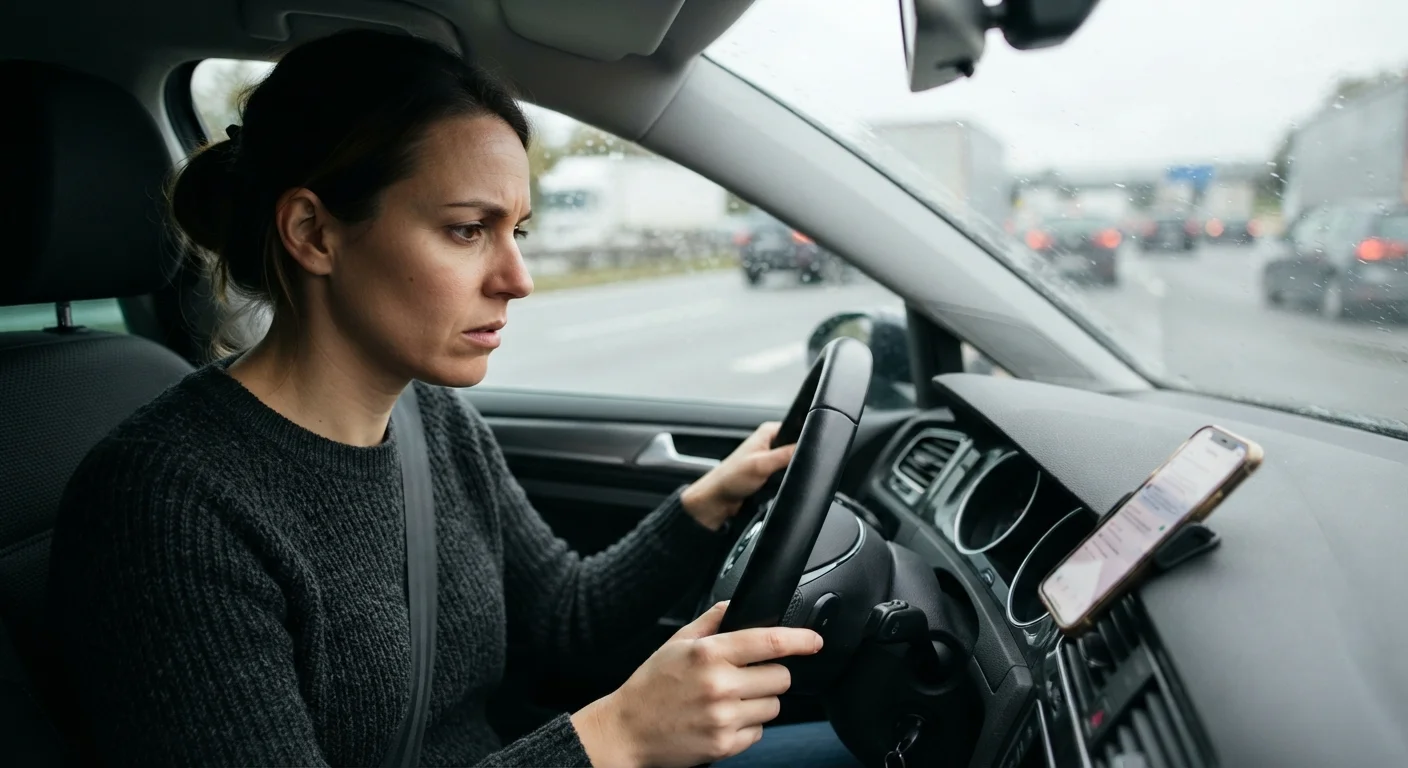
The hands-free myth is one of the most consequential in traffic safety. While hands-free devices keep your hands on the wheel, the conversation itself diverts mental resources away from driving. Research from the National Safety Council and multiple university traffic labs has consistently found that drivers engaged in phone conversations - even hands-free ones - miss visual cues, react more slowly, and are more likely to drift within lanes compared to drivers who are not on a call.
The problem is cognitive load, not hand position. A passenger conversation, by contrast, tends to be self-regulating: passengers naturally pause when driving gets complex. Remote callers have no awareness of traffic conditions and don't adjust accordingly.
Myth
A quick two-second glance at your phone is harmless - nothing can go wrong that fast.
Fact
At 60 mph, two seconds of inattention means your vehicle travels approximately 176 feet - nearly the length of a 17-story building - with no driver awareness.
Human intuition consistently underestimates how quickly distance accumulates at highway speeds. Two seconds feels trivial, but road conditions can change dramatically in that window: a car braking ahead, a child stepping into a crosswalk, or a merging vehicle appearing from a blind spot.
The NHTSA has identified visual distraction - eyes off the forward roadway - as a leading factor in rear-end crashes, which are among the most common collision types. Even in lower-speed urban driving, a two-second gap is enough for a cyclist or pedestrian to enter your path.
Myth
Experienced drivers can handle distractions better than new drivers because of their instincts.
Fact
Experience does not protect drivers from cognitive distraction; in some situations, familiarity with a route can actually encourage more inattention.
Years behind the wheel build procedural skill - smooth lane changes, smoother braking - but they do not create immunity to distraction. Traffic safety researchers have found that experienced drivers on familiar routes sometimes enter a state called highway hypnosis or inattention blindness, where their eyes are open but their minds are not processing the road.
Overconfidence compounds the issue. Experienced drivers who believe they can safely multitask are more likely to attempt it. The cognitive mechanisms that govern divided attention do not improve meaningfully with driving experience; they are a fixed feature of human neurology.
Myth
If you can multitask in everyday life, you can multitask while driving.
Fact
The human brain does not truly multitask - it switches rapidly between tasks, and driving suffers every time attention shifts away from it.
What feels like multitasking is actually rapid task-switching, and each switch carries a small but real cognitive cost. When driving is one of those tasks, the consequences of even brief lapses can be severe. Unlike reviewing a spreadsheet while on a call - where a moment of inattention costs a typo - inattention while driving can cost a life.
Driving demands continuous, dynamic processing: reading road geometry, tracking other vehicles, anticipating pedestrian behavior, and responding to the unexpected. No secondary task - regardless of how routine it feels - is compatible with that level of sustained vigilance.
Myth
Eating or adjusting the radio briefly is nothing like looking at a phone - it's not really distracted driving.
Fact
Any activity that takes your eyes, hands, or focus away from driving qualifies as distraction and raises crash risk, regardless of whether a phone is involved.
Phone use gets the headlines, but distracted driving encompasses a broader set of behaviors: eating and drinking, adjusting in-vehicle controls, grooming, interacting with passengers, and even intense thinking about something unrelated to driving. Each of these can create visual, manual, or cognitive distraction - and often more than one at a time.
Traffic safety professionals use the term secondary task engagement to describe any activity that competes with driving. Studies using instrumented vehicles and naturalistic driving data have found meaningful crash-risk increases associated with non-phone distractions as well. The phone is common and measurable, but it is not uniquely dangerous - the distraction mechanism is.
What Distraction-Free Driving Actually Looks Like
True attentiveness behind the wheel means keeping your eyes, hands, and - critically - your mind focused on the driving task. Research in traffic safety distinguishes three categories of distraction: visual (eyes off the road), manual (hands off the wheel), and cognitive (mind off driving). Many distractions trigger all three simultaneously.
~9
Americans killed daily in distraction-related crashes
According to the NHTSA, distracted driving claimed approximately 3,308 lives in a recent reporting year - an average of roughly nine per day.
4x
Increased crash risk from hand-held phone use
Multiple large-scale naturalistic driving studies estimate that hand-held phone use while driving increases crash or near-crash risk by approximately four times compared to undistracted driving.
27x
Increased crash risk from texting while driving
The Virginia Tech Transportation Institute has reported that text messaging while driving can increase crash risk by roughly 23-27 times compared to driving without distraction.
Practical steps that research consistently supports include silencing notifications before starting the engine, placing your phone out of reach, and pulling over safely if a conversation or task genuinely requires your full attention. Pre-setting GPS, music, and climate controls before you move is another habit that meaningfully reduces in-trip distraction.
Fatigue can amplify the effects of distraction significantly. Our article on how fatigue impairs driving and what actually helps explains why tired drivers are also more vulnerable to cognitive distraction. Similarly, night driving habits that significantly reduce your risk covers how lower visibility raises the stakes for any lapse in attention.
No Notification Is Worth a Crash
Every distracted driving statistic represents a preventable incident. The most effective single habit safety researchers consistently recommend is placing your phone in do-not-disturb mode - or physically out of reach - before you start driving. No message, notification, or call warrants the risk to yourself or others on the road. If something requires your immediate attention, pull over safely before engaging with your device.
Every driver has moments of inattention. The goal is not perfection - it is reducing the frequency and duration of those moments through deliberate habits, not myths.