Why Starting Order Matters
Decluttering an entire house can feel paralyzing precisely because there is so much to decide. Most people stall not because they lack motivation, but because they begin in the wrong place - usually a sentimental or overwhelming space like an attic or a packed garage. That early friction burns out energy before real progress is made.
The sequence in which you declutter directly affects how much you get done and whether the results hold. Spaces you use every day - and see constantly - have an outsized effect on how your home feels. Clearing those first creates a visible payoff that fuels the harder work ahead. Research in behavioral psychology consistently shows that visible, early wins reinforce the habit loop needed to complete large projects.
Think of whole-house decluttering not as a single event, but as a campaign with a defined strategy. For a deeper look at how this plays out room by room, see our Room-by-Room Decluttering Roadmap.
The Initial Assessment: Taking Stock Before You Touch Anything
Before moving a single item, walk through every room with a notepad or your phone and record what you observe. Note which spaces feel most chaotic, which are nearly functional but need minor editing, and which are genuinely fine. This assessment prevents over-investing time in low-problem areas while ignoring genuine trouble spots.
As you walk, ask three diagnostic questions for each room: Does this space have a clear purpose? Can I find what I need here within 30 seconds? Does clutter here affect other people in the household daily? Rooms that score poorly on all three get prioritized.
25%
Of two-car garages too cluttered to park in
According to the U.S. Department of Energy, roughly one in four two-car garages cannot fit a single vehicle due to stored items.
40%
Of housework eliminated by reducing clutter
The National Soap and Detergent Association has estimated that eliminating excess clutter can reduce the work needed to clean a home by a significant margin.
1 hour
Average time lost daily searching for misplaced items
Research cited in various time-management studies suggests Americans spend substantial daily time locating misplaced belongings at home and work.
It also helps to estimate rough volume - are you dealing with a few hours of sorting per room, or an entire weekend? Being realistic about scope prevents the classic mistake of starting too ambitiously on a Saturday morning and abandoning the project by afternoon.
Where to Start: High-Impact Zones First
The most effective starting point is almost always the main living area - the space your household passes through most often. Clearing it first delivers immediate, visible relief and creates a clutter-free anchor that motivates progress elsewhere. From there, move to the kitchen, since it is both highly used and directly tied to daily routines.
After the shared spaces, move to personal spaces: bedrooms, then bathrooms. These tend to accumulate category-specific clutter (clothing, toiletries, paperwork) that is easier to sort once your decision-making muscles are warmed up. Storage-only spaces - attics, basements, garages - come last. These areas often contain items from every other room, and you will make much smarter decisions about what to keep once the rest of the house is already organized.
Set a hard stop time for each sorting session - 90 minutes maximum. Decision fatigue is real, and pushing past that threshold leads to poor choices and abandoned piles.
Cognitive research consistently shows that decision quality degrades after sustained choice-making. Shorter, focused sessions produce better outcomes than marathon efforts.
Before touching storage areas like garages or attics, fully declutter the rooms those spaces serve. You will immediately know which stored items are worth keeping once you can see what the main rooms actually need.
Storage areas act as overflow for every other room. Sorting them before the primary rooms means repeatedly re-evaluating items as the primary rooms change.
Closets deserve special attention as you move through bedrooms. A well-organized closet dramatically reduces daily friction. Our Closet Organization From the Ground Up walks through that process in detail.
The Sorting Framework: Four Categories That Actually Work
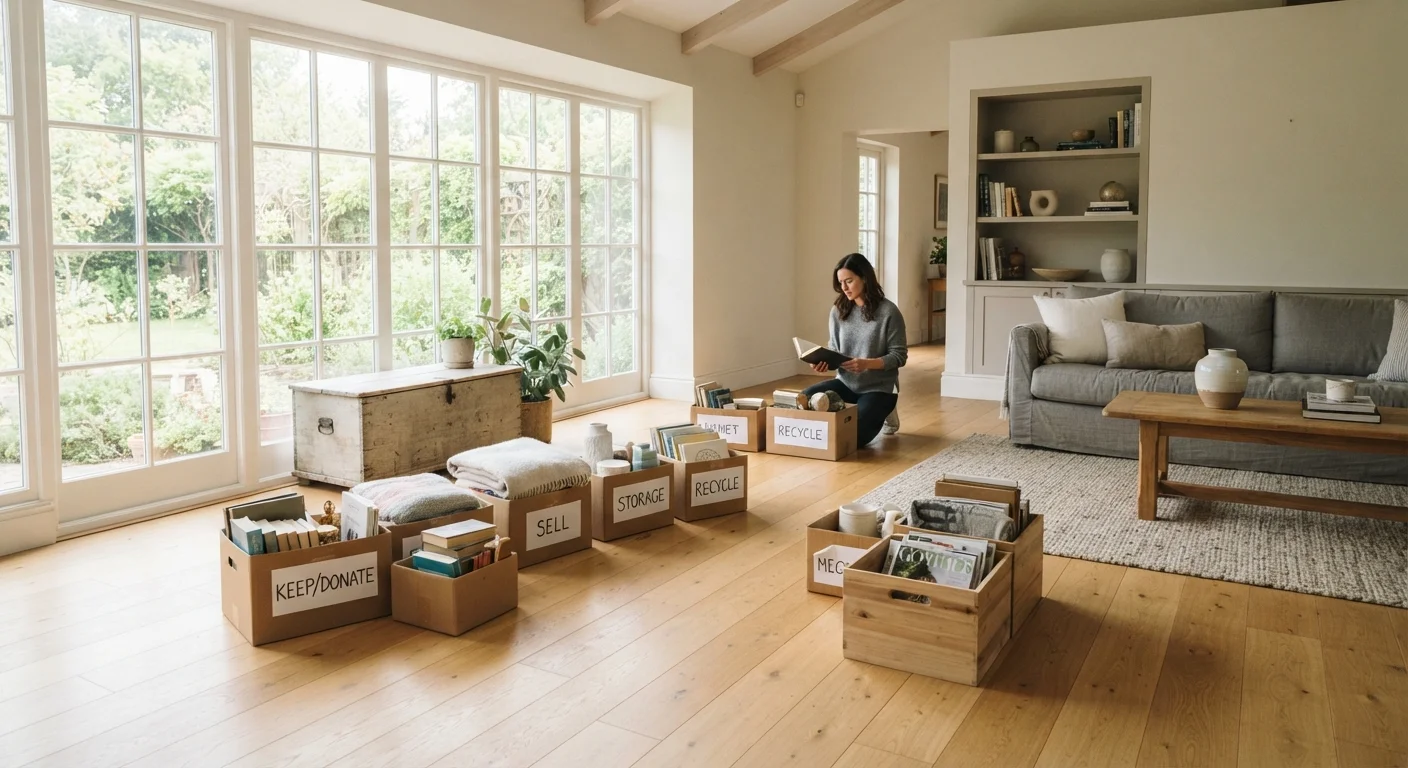
Every item you pick up belongs in one of four places: Keep, Donate/Give Away, Trash/Recycle, or Relocate. Using physical containers or designated floor zones for each category as you sort prevents items from drifting back into limbo.
- Keep: Items used regularly, in working condition, and stored in the room where they are used.
- Donate/Give Away: Items in good condition that you no longer use. Schedule a pickup or drop-off before you finish sorting so these leave the house promptly.
- Trash/Recycle: Broken, expired, or otherwise unusable items. Check local recycling guidelines for electronics and hazardous materials like old paint or batteries.
- Relocate: Items that belong in a different room. Collect these in a basket and redistribute at the end of each session rather than interrupting your flow mid-sort.
The Relocate category is frequently overlooked, but it is essential. Many homes accumulate clutter not because people own too much, but because items are stored in the wrong places. For a plain-language glossary of organization terms you may encounter, visit our Home Organization Glossary.
Handling Sentimental Items Without Getting Stuck
Sentimental items - family photos, inherited objects, childhood keepsakes - are emotionally heavy and should never be the starting point of a decluttering session. Handle them last, after you have built confidence and clarity through simpler sorting decisions.
When you do reach them, give yourself a defined boundary rather than an open-ended sorting session. A single afternoon, a single box, or a single category (such as all children's artwork) works better than trying to process everything at once. Ask: Does keeping this serve me or someone I love, or am I keeping it out of guilt? Both are valid reasons - but naming the reason honestly helps you decide with intention.
For items you want to remember but cannot keep, photography is a practical middle ground. Photograph the item, note any meaningful context, and then donate or discard it. Some people find that journaling about the memory also helps with the release. Our article on journaling for mental clarity offers a useful starting point for that practice.
Building a Maintenance System That Lasts
The declutter itself is only half the work. Without a maintenance system, most homes return to their previous state within months. The most durable systems share two traits: they are simple enough to follow on a tired weeknight, and they assign everything a designated home.
A practical starting structure is the one-in, one-out rule: when a new item enters the house, something comparable leaves. This keeps total volume stable without requiring periodic purges. Pair it with a weekly ten-minute tidy - a fast pass through shared spaces to return items to their designated spots before disorder accumulates.
For households with multiple people, shared ownership of the system matters. Assigning zones of responsibility and making storage intuitive (labels, clear bins, accessible shelves at the right height) reduces the friction that causes backsliding. For a candid look at why decluttering efforts often unravel, see Why Your Decluttering Efforts Never Seem to Stick.
Finally, consider addressing digital clutter alongside physical organization - the two overlap more than most people expect. Our piece on digital minimalism and physical decluttering explores how clearing both kinds of chaos reinforces each other.