Why Paper Piles Up in the First Place
Paper clutter has a simple root cause: it arrives faster than most households process it. Mail comes six days a week. Children bring home permission slips, newsletters, and artwork. Receipts accumulate in wallets and pockets. Each piece of paper seems like it might be important, so it gets set down instead of acted on - and then buried under the next day's arrivals.
There's also a psychological element. Paper often carries a sense of obligation - a bill to pay, a form to return, a coupon to use. That pressure makes it feel easier to leave the pile for later. Over time, "later" becomes a six-inch stack that feels impossible to tackle.
Understanding this pattern is the first step. Paper clutter isn't a personality flaw or a sign of being disorganized at heart - it's a systems problem. When there's no clear process for where paper goes and what happens to it, accumulation is the predictable result. This is the same reason decluttering efforts often don't last - the root habit never gets established.
Paper Clutter Has a Digital Counterpart
For many households, reducing physical paper clutter and managing digital chaos go hand in hand - especially when documents are scanned and saved without an organized folder structure. If you're considering going more paperless, digital minimalism principles can help you build a filing logic that works in both worlds.
The Three-Category Sort: A Simple Framework
The most effective paper management systems are built around a decision made immediately when paper enters the home. Rather than setting paper aside, sort it into one of three categories on the spot:
- Action: Requires a task - pay this bill, sign this form, RSVP to this event. This stack should be small and reviewed at least once a week.
- File: Needs to be kept for reference but requires no task - an insurance explanation of benefits, a warranty card, a tax document.
- Recycle or Shred: Everything else - junk mail, catalogues, receipts for small cash purchases, instruction manuals for items you no longer own. Most incoming paper falls into this category.
The key insight here is that the majority of paper that enters a home can be discarded immediately. Studies in home organization consistently find that most people keep far more paper than they actually need. When in doubt, ask: "Would I ever search for this, and if I did, could I get it digitally?" If the answer to the second part is yes, discarding is almost always the right call.
Process Paper Once, Not Twice
Try to handle each piece of paper only one time. When you pick it up, make a decision: act on it, file it, or discard it. Setting it back down to "decide later" is what creates the pile in the first place. Even a quick 30-second decision now prevents a 30-minute sorting session later.
Setting Up a System That Works Long-Term
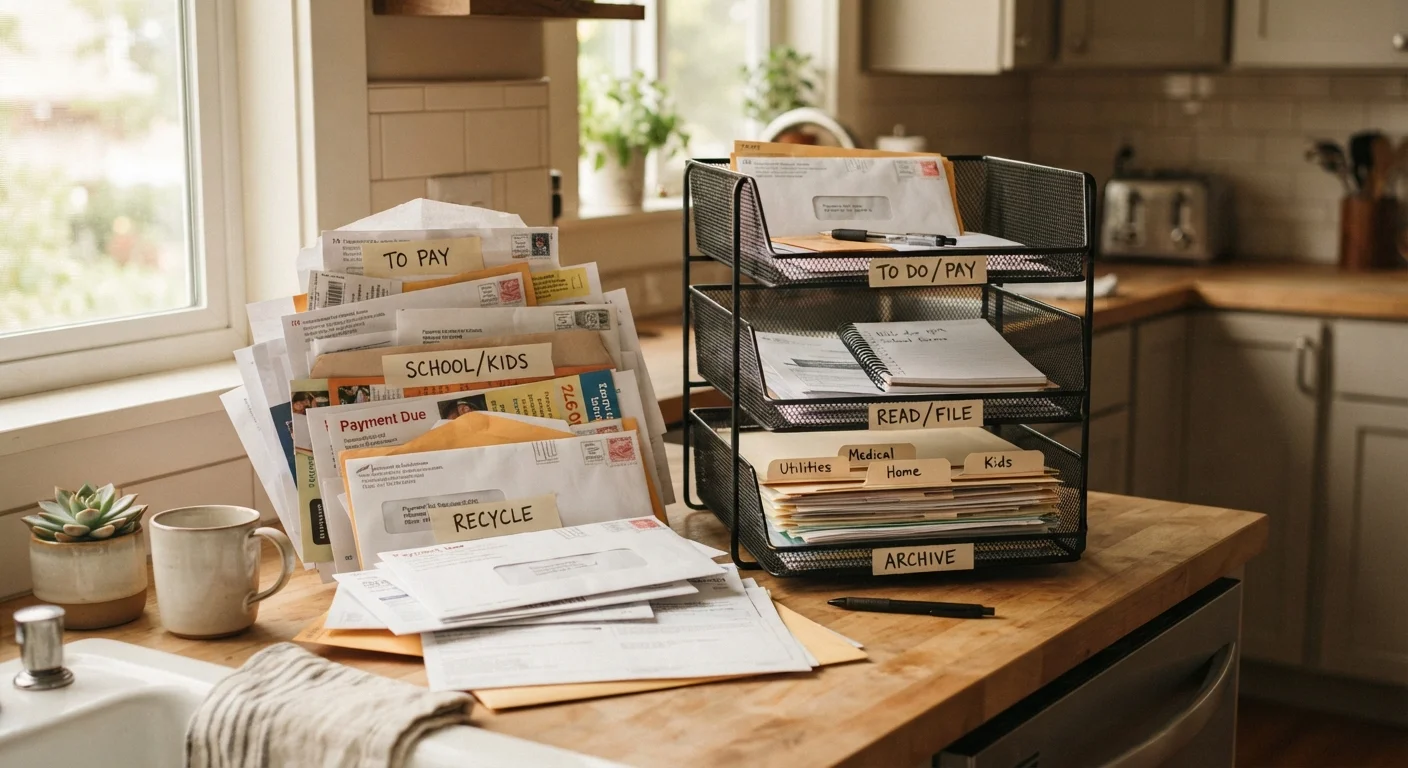
Once you understand the three-category framework, the goal is to build physical infrastructure that makes sorting effortless. A few simple tools go a long way:
- An inbox tray near your entry point for all incoming paper - this prevents scatter across counters and tables.
- A small accordion file or binder for active action items, organized by due date or type (bills, forms, invitations).
- A filing cabinet or box for long-term storage, with broad labeled categories: Financial, Medical, Home, Insurance, Legal.
- A shredder positioned close to the sorting spot - friction reduction is critical. If shredding requires walking to another room, it won't happen consistently.
Broad file categories beat narrow ones. A single "Medical" folder is more sustainable than folders for each provider or year, especially if you're new to filing systems. You can always subdivide later if volume demands it.
This approach fits naturally into a room-by-room organization plan - the home office or kitchen, wherever paper concentrates, usually benefits the most from being tackled deliberately.
80%
Of filed papers are never referenced again
Home organization professionals commonly cite this figure to illustrate how much paper households keep unnecessarily, suggesting most documents can be discarded or stored digitally.
2-3 hrs
Average time spent searching for misplaced documents monthly
Consumer research on household productivity suggests Americans lose significant time each month hunting for papers that lack a designated home.
1 per day
Average pieces of junk mail per U.S. household
The U.S. Postal Service and direct mail industry data indicate the average household receives roughly 450 pieces of advertising mail annually, contributing heavily to paper volume.
Making It a Habit, Not a Project
Even the best filing system falls apart without a regular maintenance routine. Two habits keep paper under control:
- Daily sort: Spend two minutes at the end of each day processing whatever landed in the inbox tray. This prevents overnight accumulation from becoming a week-long pile.
- Weekly action review: Once a week, work through the action folder. Pay bills, sign forms, make calls. This one session, kept to 15-20 minutes, prevents tasks from going overdue.
Another powerful lever is reducing incoming paper volume at the source. Opting into electronic billing, unsubscribing from catalogues, and registering with mail preference services can meaningfully reduce the volume arriving at your door - which makes the entire system easier to maintain.
For households working on broader organization, this kind of habit-building connects directly to strategies like the one-in-one-out rule - the principle that preventing re-clutter is about consistent small decisions, not periodic large efforts. If you're thinking about tackling clutter across the whole home, the whole-house decluttering guide can help you sequence your efforts effectively.