Why Small Spaces Demand a Different Approach
Living in a studio, one-bedroom, or compact apartment doesn't automatically mean living with clutter - but it does mean that standard organizational advice often falls short. Strategies designed for larger homes assume dedicated storage rooms, wide hallways, and sprawling closets that most apartment dwellers simply don't have.
The good news: tight footprints force creative thinking, and many of the most effective storage systems are ones that work with the architecture rather than against it. Before diving into specific strategies, it helps to take an honest look at where clutter actually accumulates. A room-by-room clutter audit is a practical first step that reveals your real problem areas rather than letting you guess. From there, the strategies below give you a concrete framework to act on - room by room, surface by surface.
Declutter Before You Organize
The single most common mistake in small-space organization is buying storage solutions before reducing what needs to be stored. Adding bins and shelves to a full apartment often just relocates the clutter into more expensive containers.
Start by sorting every category - clothing, kitchen tools, paper, hobby supplies - and making deliberate decisions about what earns a place in your limited square footage. A structured approach, like the room-by-room decluttering roadmap, keeps the process manageable and prevents decision fatigue from stalling your progress mid-project.
Storage solutions only work after you've reduced what actually needs storing.
Go Vertical on Every Wall
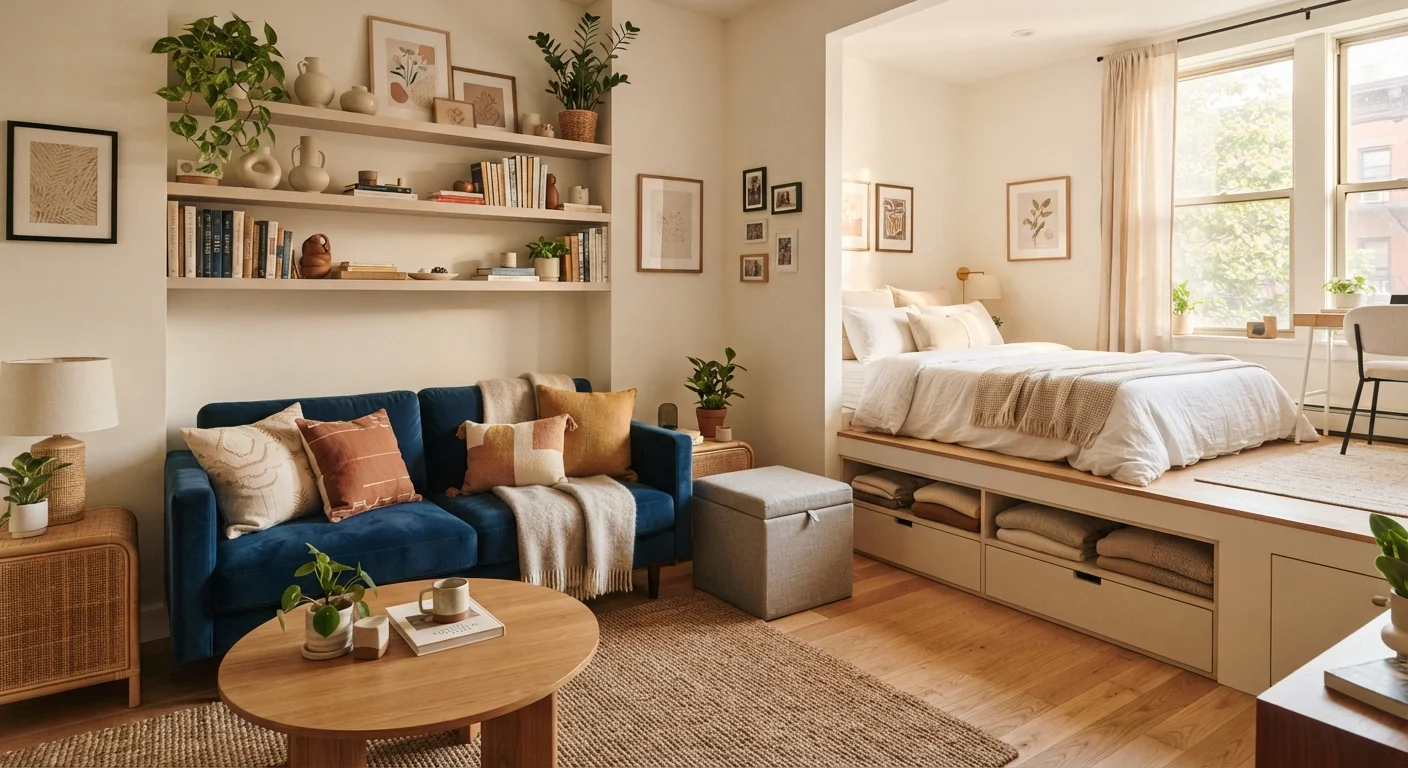
Floor space is scarce, but vertical space on walls is frequently left empty. Wall-mounted shelves, pegboards in the kitchen or entryway, and tall bookcases that reach toward the ceiling all move storage off the floor and into unused air space.
In rental apartments, look for tension-mounted or freestanding shelving units that don't require permanent wall anchors. In spaces where drilling is an option, floating shelves along a single wall can hold books, pantry overflow, toiletries, or display items without consuming any floor area at all. For a deeper look at how vertical and horizontal approaches compare across different room types, see vertical vs. horizontal storage in small spaces.
Walls are free real estate - use them from floor to ceiling wherever possible.
Choose Furniture That Earns Double Duty
Every piece of furniture in a small apartment should justify its footprint by serving at least two functions. A storage ottoman replaces both a coffee table and a linen chest. A bed frame with built-in drawers eliminates the need for a separate dresser. A dining bench with a hollow interior stores seasonal items that would otherwise crowd a closet.
When evaluating any new furniture purchase, ask whether a storage-enabled version exists at a comparable size. The upfront cost is often higher, but the square footage saved is genuine and immediate.
Every furniture piece should serve at least two functions in a compact home.
Assign a Zone to Every Category
Clutter accumulates fastest when items don't have a designated home. In small apartments, this problem multiplies because there's little buffer space to absorb misplaced objects - a single pile on the counter can make a studio kitchen feel completely unusable.
Create fixed zones for categories: a hook-and-tray system near the front door for keys, bags, and outerwear; a single drawer dedicated to charging cables and small electronics; a basket on a bathroom shelf for daily-use toiletries. When everything has an assigned place, putting things away becomes automatic rather than effortful.
Fixed zones for each category make tidying automatic instead of effortful.
Use the Back of Every Door
The back of closet doors, cabinet doors, and even the bathroom door represents storage space that most people never activate. Over-the-door organizers can hold shoes, cleaning supplies, pantry items, or toiletries - keeping those categories accessible while freeing up shelves and drawers for other uses.
In closets specifically, a behind-the-door shoe rack or accessory organizer can add the equivalent of an entire shelf's worth of capacity to a tight wardrobe. For a comprehensive look at maximizing closet space from scratch, the closet organization guide walks through a full system step by step.
The back of every door is untapped storage - activate it for immediate gains.
Build a Weekly Reset Habit
Even a perfectly organized small apartment will drift toward disorder without a consistent maintenance routine. The key insight for tight spaces is that a small amount of regular attention prevents the kind of full-scale chaos that takes hours to address.
A ten-to-fifteen minute weekly reset - returning items to their zones, clearing surfaces, and doing a quick visual scan of problem areas - is far more sustainable than waiting for clutter to become overwhelming before acting. Small spaces also benefit from seasonal reassessments: rotating out-of-season clothing, reassessing what's accumulated in storage areas, and culling anything that's no longer serving a purpose.
A fifteen-minute weekly reset prevents the buildup that makes small spaces feel unlivable.
Building a System That Sticks
The strategies above work best when they're treated as a connected system rather than isolated fixes. Combining vertical storage with multi-use furniture, clear categories, and a regular reset habit creates an environment that stays functional with minimal ongoing effort.
Start With One Room, Not the Whole Apartment
Trying to reorganize an entire apartment in a single session almost always leads to abandonment halfway through. Instead, choose one room - ideally the one that causes the most daily friction - and fully implement your storage system there before moving on. A visible win in one space builds momentum and helps you refine your approach before applying it elsewhere.
If you share your space with others, organizing decisions rarely happen in a vacuum. The guide to organizing when household members disagree offers practical ways to build compromise systems everyone can maintain. And for readers thinking carefully about what storage furniture to invest in versus what to keep flexible, it's worth exploring what organizers consider when choosing storage furniture. The goal in any small space isn't perfection - it's a workable, repeatable routine that makes the space feel like yours.