
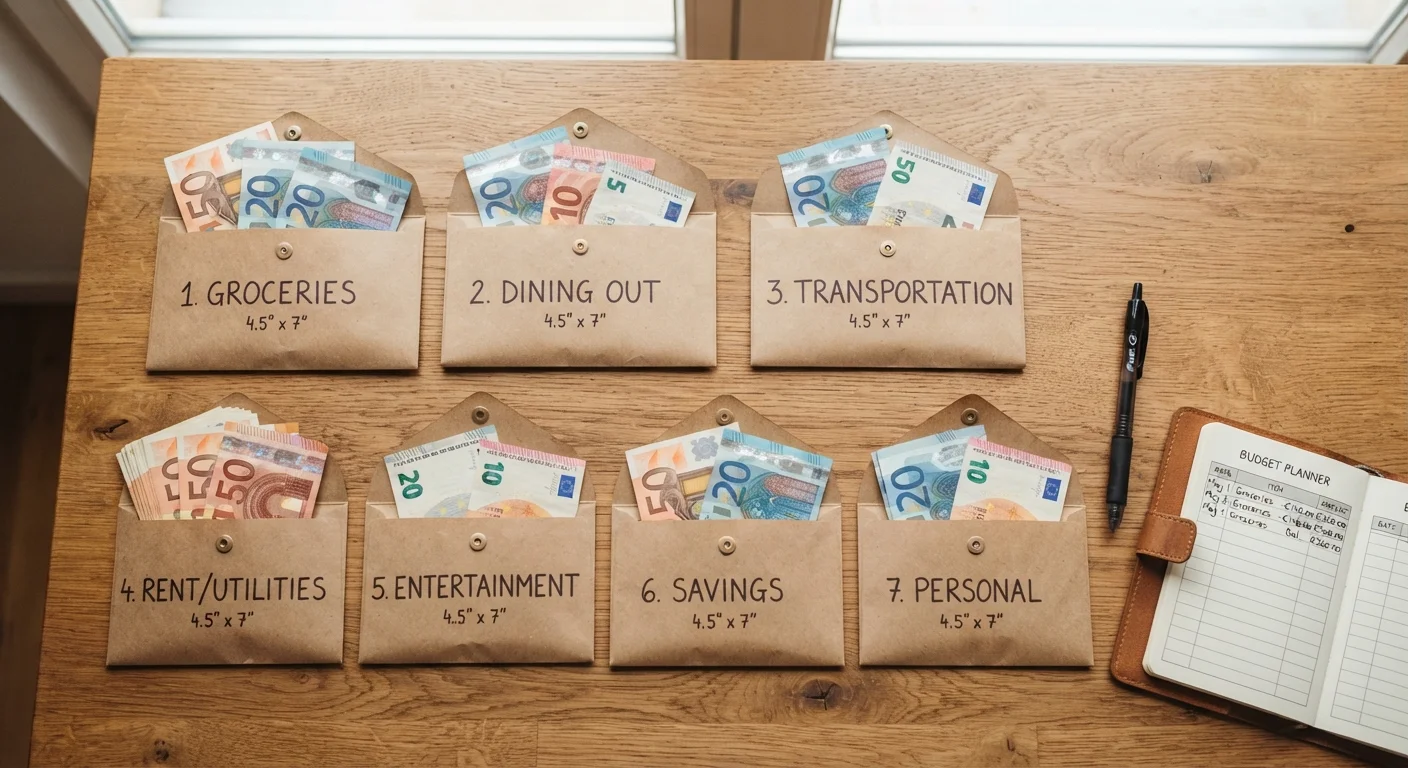
What the Envelope System Actually Is
The envelope system is a cash-based budgeting method. At the start of each pay period, you withdraw a set amount of money and divide it into physical envelopes - each one labeled for a specific spending category. Common examples include groceries, gas, dining out, clothing, and personal care.
The rule is simple: once an envelope is empty, you stop spending in that category until the next funding period. There's no overdraft, no tab to run up - just cash on hand and a clear visual cue of what's left.
Before you try any budgeting method, it helps to understand the basic vocabulary. Our plain-language budgeting glossary breaks down terms like discretionary spending and net income so you're not guessing as you set up your envelopes.
The system tends to work best for variable expenses - things where your spending fluctuates week to week. Fixed costs like rent, utilities, and loan payments are usually handled separately by direct transfer or auto-pay.
The Advantages: Why People Swear by It
The envelope system has endured for decades because it solves a genuine problem: most people don't feel card transactions the way they feel handing over physical bills.
Creates a hard stop on overspending
An empty envelope is impossible to ignore - unlike a running credit card balance. The physical limit enforces your plan without willpower alone.
Makes spending feel real and tangible
Studies on consumer behavior consistently find that people spend less when using cash compared to cards, partly because handing over bills registers as a more meaningful loss.
No tech setup or subscription required
The entire system runs on paper envelopes and cash. There's nothing to download, learn, or pay for - which lowers the barrier for complete beginners.
Builds category-level spending awareness
Dividing money by category forces you to think deliberately about priorities before you spend, reinforcing a habit of intentional financial decision-making.
Easy to adjust month to month
If your grocery envelope is consistently too thin, you can reallocate without changing any account settings - just rethink the amounts and refill differently next cycle.
~20% less
Spending reduction linked to cash use
Research in behavioral economics, including work published in the Journal of Consumer Research, suggests consumers tend to spend notably less when paying with cash versus cards.
~1 in 3
Americans without a working budget
Surveys by organizations like the National Foundation for Credit Counseling have found roughly a third of U.S. adults do not actively follow a monthly budget of any kind.
Beyond the psychological friction of cash, the method forces a spending plan before the month begins - which is one of the core principles behind any budget that actually sticks. You can't overspend one category by quietly borrowing from another without noticing. The envelope is right there; it either has money or it doesn't.
For beginners especially, that clarity removes ambiguity. You don't need an app, a spreadsheet, or a subscription. A stack of envelopes and a pen is a complete system.
The Drawbacks: Where It Gets Complicated
No budgeting method is perfect for everyone, and the envelope system comes with real friction in a world built around digital payments.
Doesn't work well for digital or online payments
Subscriptions, online shopping, and automatic bill pay all require a card or bank transfer, leaving a gap that cash envelopes can't fill without a workaround.
Carrying cash poses a security risk
Unlike a debit or credit card, physical cash cannot be cancelled or recovered if it's lost or stolen, which is a meaningful concern for larger monthly budgets.
Requires frequent ATM trips and cash handling
Withdrawing and sorting cash on payday is an added logistical step that busy households may find difficult to maintain consistently over months.
Can feel rigid when unexpected expenses arise
Life doesn't always fit neatly into preset categories, and a system with no buffer can become stressful when an unplanned expense demands money from multiple envelopes.
Less useful for high fixed-cost budgets
If most of your monthly spending is rent, loan payments, and utilities, the envelope system only addresses a small slice of your overall finances.
Online shopping, subscription services, automatic bill pay, and peer-to-peer payments like Venmo all fall outside the cash envelope model. You can work around some of this by using a debit card for fixed bills while keeping envelopes for variable spending - but that hybrid approach takes discipline to track honestly.
Carrying significant amounts of cash also introduces a security concern. Lost or stolen cash is gone; a lost debit card can be cancelled. For households in areas where physical cash is impractical, or for people who travel frequently, the envelope system may create more stress than it relieves.
If you're weighing cash envelopes against a fully digital approach, our comparison of cash envelopes vs. digital budgeting apps lays out the trade-offs based on personality type and lifestyle.
How to Set It Up in a Few Steps
Getting started doesn't require much. Here's a basic framework:
- Start with your take-home income. Know what actually lands in your account each month after taxes.
- List your variable spending categories. Focus on areas where you routinely overspend or lose track.
- Assign a dollar amount to each envelope. Base this on realistic past spending, not an idealized version. Our article on auditing your spending before you budget can help you find those real numbers.
- Withdraw the cash and fill the envelopes. Do this on payday so the money is allocated before it can drift elsewhere.
- Spend only from the envelope. When it's gone, it's gone.
A Hybrid Approach Often Works Best
Many people use the envelope system only for their highest-risk variable categories - groceries, eating out, and entertainment - while handling fixed bills digitally. This hybrid model reduces the cash-handling burden while still putting a hard cap on the spending areas most likely to run over. You don't have to apply envelopes to every dollar you spend for the method to be useful.
For a broader look at how the envelope system compares to more structured frameworks, see our breakdown of zero-based budgeting vs. the 50/30/20 method.
This article is for general informational purposes only and does not constitute personalized financial advice. Consider consulting a qualified financial professional for guidance specific to your situation.