How Each Method Works
Both clicker training and verbal cues are marker-based training tools — they signal to your pet that a reward is coming. The difference lies in the signal itself.
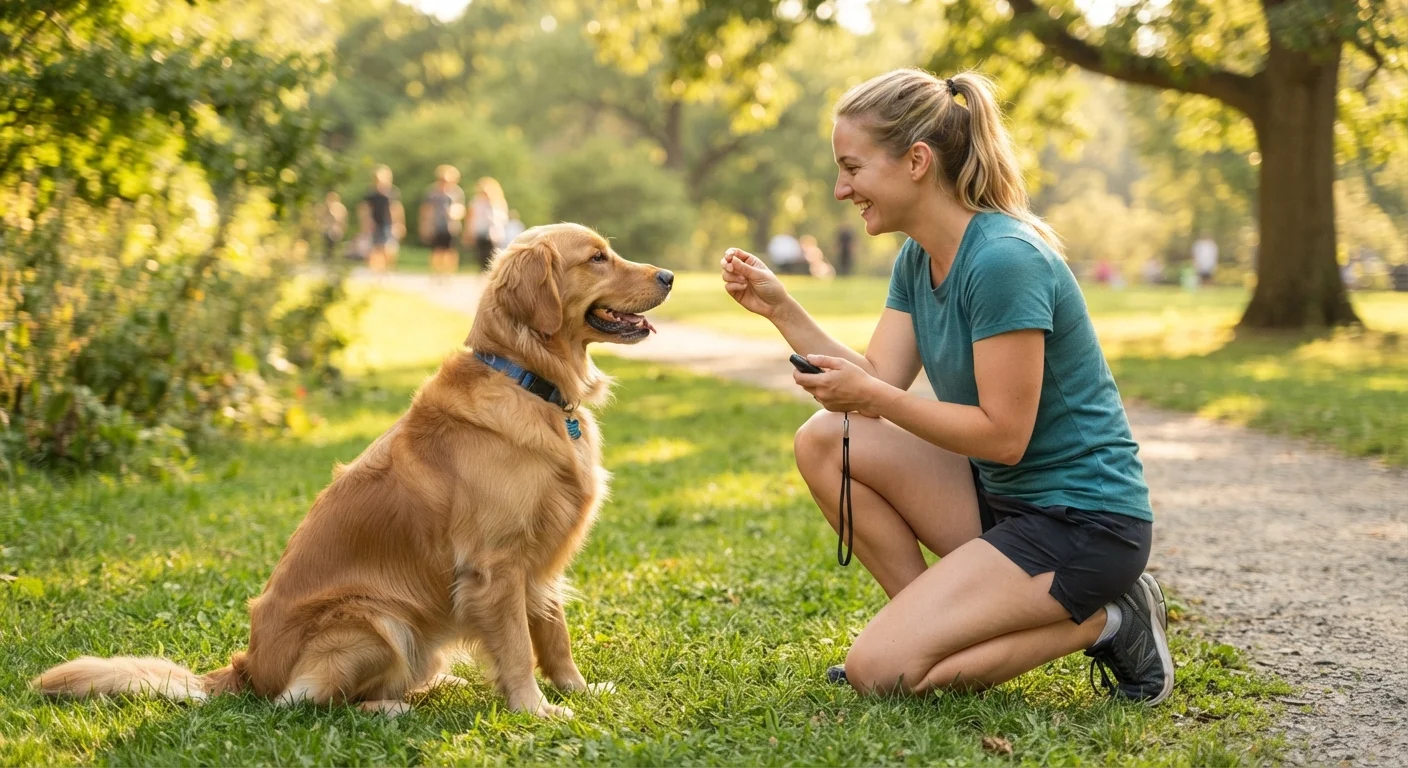
A clicker is a small handheld device that makes a short, sharp clicking sound. The click is always identical — same pitch, same duration — which makes it easy for pets to distinguish from background conversation or household noise. You click at the exact instant your pet does the right thing, then follow with a treat or praise. Over time, the click becomes a reliable predictor of reward.
Verbal cues work on the same principle, but your voice is the marker. Words like "yes" or "good" can serve as a verbal marker, or you might use spoken commands — "sit," "stay," "come" — once a behavior is already established. The convenience is real: your voice is always with you. The challenge is that your tone shifts depending on your mood, energy level, or environment, which can introduce subtle inconsistency.
To understand why timing matters so much in both approaches, see our guide to the science of reward-based training.
| Criterion | Clicker Training | Verbal Cues |
|---|---|---|
| Signal consistency | Identical every time | Varies with tone and mood |
| Timing precision | Very high — millisecond accuracy | Moderate — often slightly delayed |
| Equipment needed | Clicker device required | None — voice only |
| Ease for beginners | Moderate learning curve | Intuitive for most owners |
| Works well for cats | Yes — especially effective | Can work with practice |
| Portability | Requires free hand and device | Always available |
| Long-term maintenance | Often phased out over time | Stays in use indefinitely |
Strengths and Limitations of Each Approach
Clicker training's biggest strength is timing precision. Animals learn by associating a specific behavior with an outcome, and that association is only as strong as the gap between the behavior and the signal. A click lands in milliseconds; a spoken word often comes a beat too late. This precision makes clicker training especially useful in early learning, when your pet is still figuring out what behavior earned the reward.
The main drawback is that you need a hand free and a clicker nearby. In everyday life — carrying groceries, managing kids, or simply walking the dog — that's not always realistic.
Verbal cues, on the other hand, scale naturally. Once a pet has learned a behavior well, a simple spoken word can maintain it without any equipment. Verbal cues also allow more nuance: tone and volume can communicate urgency or calm, which experienced trainers often use deliberately. The limitation is that human voices vary, and pets are sensitive to those variations — a command spoken sharply after a stressful day may land very differently than the same word spoken calmly.
~0.5 sec
Learning association window in animals
Animal behavior research suggests pets form the strongest behavior-reward associations when the marker arrives within roughly half a second of the desired action.
2–5 min
Recommended session length for cats
Feline behaviorists generally advise keeping training sessions very short — two to five minutes — to maintain attention and avoid frustration.
For owners training cats specifically, the clicker's consistency is a notable advantage. Feline learners often respond to very brief windows of engagement, and a precise click captures those moments better than a spoken word. Research on cat training confirms that cats can and do learn marker-based behaviors — they simply need shorter, more focused sessions.
Choosing the Right Method — or Combining Both
There's no universal answer, because the right method depends on your pet, your goals, and your daily routine. A few practical factors can guide your decision:
- Early learning: Clicker training tends to accelerate the initial acquisition of new behaviors, because the signal is unambiguous.
- Maintenance: Once a behavior is solid, verbal cues often work just as well — and are far more convenient for daily life.
- Species and temperament: Dogs generally adapt to both methods readily. Cats and other small pets often respond better to the clicker's precision. Training approaches vary across pet types, so consider what's known about your specific animal.
- Age: Older pets can learn with either method. Adjusting technique for older pets may matter more than which marker you choose.
Many trainers recommend a combined approach: use the clicker to teach a new behavior, then pair in a verbal cue once the pet understands what's being asked. Eventually you can phase the clicker out for that behavior, leaving the verbal cue in place. This gives you the precision of a clicker during learning and the convenience of voice for everyday reinforcement.
Whatever method you choose, reward quality matters too — explore when food treats help and when they hinder to make sure your rewards are working as hard as your marker.
This article is for general informational and educational purposes. For personalized guidance on your pet's behavior or training needs, consult a certified professional animal trainer or veterinary behaviorist.