Why Crate Training Works
Crate training is one of the most misunderstood tools in dog ownership. Many new owners associate crates with confinement or punishment — but when introduced correctly, a crate taps into a puppy's natural instinct to seek out a small, safe space. Dogs are denning animals; a properly sized crate mimics that secure environment.
The practical benefits extend well beyond instinct. A crate prevents destructive behavior when you can't supervise, accelerates house training by teaching a puppy to hold its bladder, and reduces anxiety during travel or vet visits. It also gives your puppy a predictable place to decompress in a busy household.
Before you bring your puppy home, it's worth reading our readiness checklist for pet owners to make sure your environment and expectations are set before training begins.
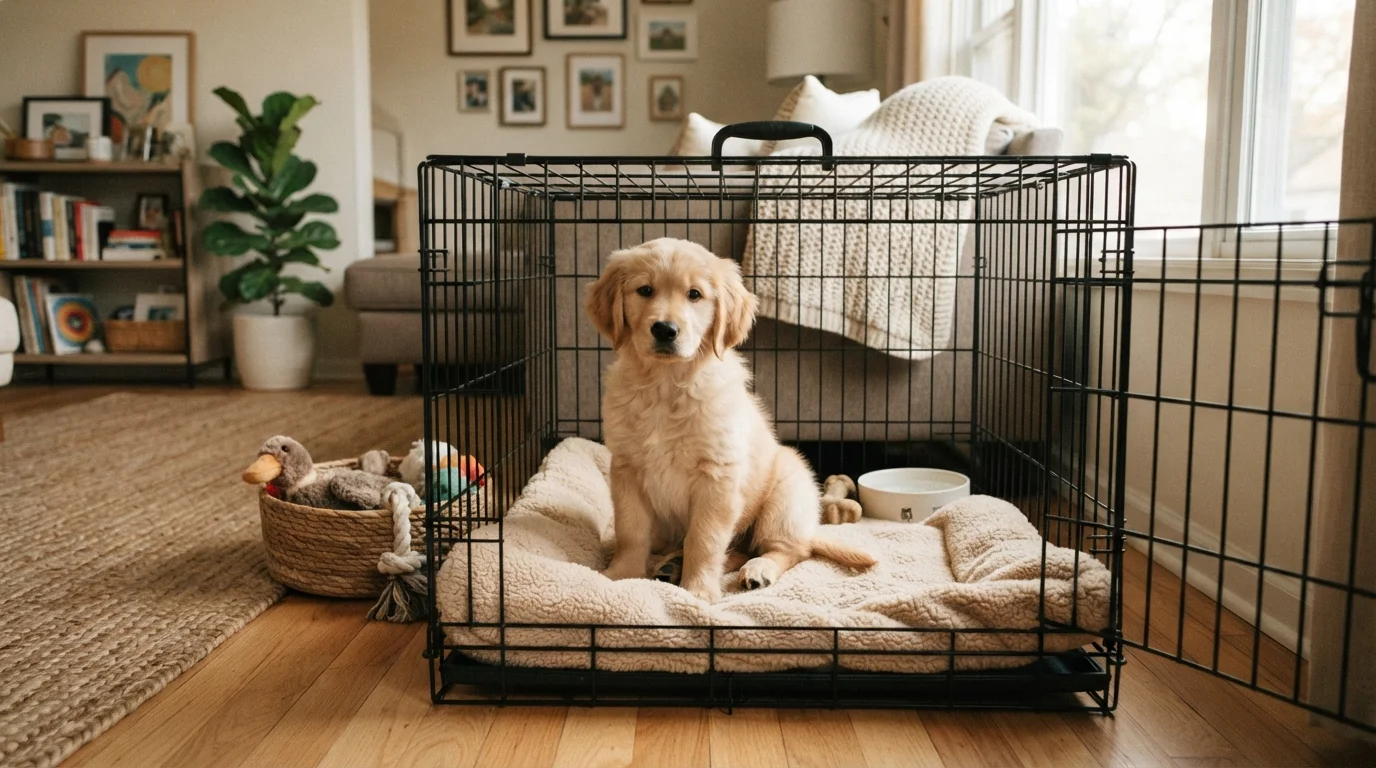
Cover three sides of the wire crate with a blanket to create a more den-like feel — many puppies settle faster in a partially darkened space.
Reducing visual stimulation can lower arousal and help a puppy transition from alert to calm more quickly, mimicking the enclosed feel of a natural den.
Feed every meal inside or immediately in front of the crate for the first two weeks. Meals are your strongest positive association tool — don't waste them.
Pairing a high-value event (eating) with the crate repeatedly accelerates positive association far more reliably than treats alone, which can become less motivating over time.
Choosing and Setting Up the Crate
Crates come in three main styles: wire (collapsible, good ventilation), plastic (more enclosed, travel-friendly), and soft-sided fabric (lightweight but less durable for chewers). For most puppies, a wire crate with a divider panel is the most practical choice — the divider lets you adjust the interior space as your puppy grows without buying a new crate.
Getting the Size Right
The crate should be just large enough for your puppy to stand up, turn around, and lie down comfortably. A crate that's too large gives the puppy room to use one end as a bathroom — which defeats house-training entirely. If you're buying for the adult size, use a divider panel to reduce the space now.
What to Put Inside
- Bedding: A washable mat or blanket. Avoid thick padded beds until you're confident your puppy won't soil them.
- A chew toy or Kong: Gives your puppy something to focus on during crate time.
- Water access: For longer stretches, attach a clip-on water bottle rather than a bowl that spills.
Place the crate in a social area of your home — a corner of the living room or bedroom works well. Puppies do better when they can see and hear household activity rather than feeling isolated.
For a broader look at housing setups across different pet types, see housing basics by pet type.
Introducing the Crate Step by Step
Rushing the introduction is the single most common mistake new owners make. Give the process at least a few days before expecting your puppy to settle comfortably inside.
- Day 1 — Open door exploration: Leave the crate door open and let your puppy investigate on its own terms. Toss a few treats near and inside the crate without forcing entry.
- Day 2 — Feeding near the crate: Move your puppy's meals progressively closer to and eventually inside the crate. The association between the crate and something pleasant is the foundation of the whole process.
- Day 3–4 — Short closed sessions: Once your puppy eats comfortably inside, close the door briefly while they finish. Stay nearby. Open the door before any signs of distress.
- Day 5–7 — Gradual duration increases: Extend closed-door sessions in small increments — five minutes, then ten, building toward thirty. Reward calm behavior, not whining.
Keep training sessions short and positive. If your puppy is consistently distressed, slow down rather than pushing through. Our guide on building good habits in your first week pairs well with this phase.
Building a Realistic Schedule
Puppies have small bladders and limited ability to hold them. A general rule of thumb: puppies can hold their bladder approximately one hour for every month of age — so a two-month-old puppy needs a break every two hours at most. This is a guideline, not a guarantee; individual puppies vary.
~1 hr/month
Bladder hold time by age
Commonly cited guideline in veterinary and trainer resources: puppies can hold their bladder roughly one hour per month of age.
4–6 months
Typical age for expanded freedom
Many certified trainers and veterinary behaviorists suggest most puppies are ready to begin supervised free time outside the crate around this age, with consistent prior training.
A Sample Daily Routine
| Time | Activity |
|---|---|
| 6:00 AM | Out of crate → immediate bathroom break |
| 6:15 AM | Breakfast in or near crate |
| 7:00 AM | Playtime, brief training session |
| 8:00 AM | Crate rest (nap time) |
| 10:00 AM | Bathroom break → supervised play |
| 12:00 PM | Lunch → crate rest |
Overnight, most puppies between 8–12 weeks will need one or two nighttime bathroom breaks. Place the crate near your bed if possible — you'll hear your puppy stir before it escalates to distress.
Common Sticking Points — and How to Move Past Them
Even well-planned training hits snags. Here are the most frequent challenges and how to handle them:
Whining and Crying
Some whining at the start is normal and not a sign that crate training is failing. Wait for a brief pause in the whining before opening the door — otherwise you teach your puppy that crying is the exit code. If whining is intense and persistent from the very first session, go back a step in the introduction process.
Refusing to Enter
Don't push or lure aggressively. Instead, scatter high-value treats across the floor leading into the crate, let your puppy choose to go in, and keep sessions short enough that there's no negative experience to associate with it.
Accidents Inside the Crate
If your puppy is regularly soiling the crate, the space may be too large, or crate sessions are lasting longer than the puppy can physically hold. Resize with a divider and shorten the intervals.
Inconsistency from everyone in the household is a silent training killer. See what quietly undermines training progress for a frank look at habits that work against you.
Long-Term Use: When and How to Transition
The goal of crate training isn't lifelong confinement — it's a scaffold that helps your puppy build the self-regulation and house training habits that allow for more freedom over time. Most owners find that somewhere between 4 and 6 months, with consistent training, puppies can begin short unsupervised stretches outside the crate. That timeline varies considerably by breed and individual temperament.
Testing Readiness for More Freedom
- No accidents inside the crate for at least four to six weeks
- Able to settle quietly in the crate voluntarily
- No destructive chewing during supervised free time
When you do start expanding freedom, do it room by room rather than giving full-house access all at once. Start with a puppy-proofed single room for short periods before gradually expanding.
Some dogs continue using their crate as a resting spot into adulthood entirely on their own terms — the door open, the crate a familiar comfort object. That's a sign of successful training. If you've adopted an older dog and are starting from scratch, training older pets outlines what changes with age and what doesn't.
This article is for general informational purposes only and is not a substitute for personalized advice from a certified dog trainer or veterinary behaviorist. If your puppy shows signs of severe anxiety or distress, consult a qualified professional.