Why the Security Line Is Where Packing Mistakes Reveal Themselves
You can spend weeks planning a trip perfectly, then lose twenty minutes at a TSA checkpoint because of what's sitting at the bottom of your carry-on. Security screening is where vague packing habits become concrete, public problems — and the people behind you in line will notice.
The good news: most of these mistakes are completely avoidable with a little advance knowledge. This guide walks through the errors that slow travelers down most often, why they're easy to make, and exactly what to do instead. For a broader look at trip prep, see our pre-trip checklist — security readiness is just one piece of the puzzle.
Packing full-size toiletries and assuming they'll pass through security.
Why it happens: Many travelers grab their usual bathroom products without checking whether the container size complies with TSA's 3.4 oz limit.
Leaving a laptop buried deep in the bag and not removing it at the checkpoint.
Why it happens: Travelers who use TSA PreCheck regularly sometimes forget the rule applies only in designated PreCheck lanes — standard lanes require separate screening for large electronics.
Arriving at the checkpoint with items still in jacket or trouser pockets.
Why it happens: Travelers are often focused on their bags and forget that keys, phones, coins, and belts trigger the body scanner and require removal.
Packing prohibited items without realizing they're on the restricted list.
Why it happens: TSA's prohibited items list is longer than most people expect, and some items — like certain multi-tools, sharp objects, or large lithium battery packs — are easy to overlook.
Overpacking the carry-on so densely that X-ray operators can't read the contents clearly.
Why it happens: Travelers trying to avoid checked bag fees often compress as much as possible into a single bag, creating a cluttered X-ray image that's hard to interpret.
The Liquids Rule Is Stricter Than Most People Remember
The 3-1-1 rule has been in effect for years, yet it still catches travelers off guard: liquids must be in containers of 3.4 oz (100ml) or less, all fitting in one quart-sized clear bag, with one bag per person. The confusion usually comes from assumptions — a travel-size label doesn't automatically mean it meets the size requirement, and some full-size bottles look smaller than they are.
4,600+
Gallons of liquids confiscated by TSA annually
TSA has publicly reported confiscating millions of prohibited items each year, with oversized liquids among the most frequent categories.
~10 min
Average delay added by a flagged bag
Security experts and frequent travelers commonly report that a hand-inspection adds roughly 5–15 minutes per flagged bag, affecting the traveler and the line.
If you're unsure whether something counts as a liquid, TSA's general guidance is: if you can pour it, pump it, squeeze it, spread it, spray it, or smear it, treat it as a liquid. That includes peanut butter, yogurt, and even some gels in first-aid kits. When in doubt, check the TSA website directly or pack it in checked luggage. For more on checked bag rules, our checked baggage guide has the specifics.
Medically Necessary Liquids Are Treated Differently
If you're traveling with prescription medications, baby formula, breast milk, or other medically necessary liquids, TSA allows these in quantities exceeding 3.4 oz — but you must declare them separately at the checkpoint. Rules can vary, so verify current TSA guidelines and bring documentation from your healthcare provider where possible. Do not assume standard liquid rules apply to all medical items without checking first.
Electronics, Accessories, and the X-Ray Blind Spots
Standard security lanes require laptops and tablets larger than a standard notebook to come out of your bag and go into a separate bin. Many travelers forget this or assume it only applies to laptops — then the X-ray image comes back cluttered and an agent has to hand-search the bag. That interaction adds 5–10 minutes to your wait and everyone else's.
Similarly, bulky cables, battery packs, and camera equipment can obscure other items on the scan. Packing electronics in an easy-access outer pocket — rather than buried under clothes — makes the process faster for you and the TSA officer. If you travel frequently, programs like TSA PreCheck let you keep laptops in your bag; see our comparison of TSA PreCheck vs. Global Entry to decide if either program fits your travel habits.
The Habits That Make Security Faster Every Single Time
Consistency is the real secret. Travelers who move quickly through checkpoints aren't lucky — they've standardized their system. A few habits that consistently shave time off the process:
- Wear slip-on shoes or shoes you can remove in under five seconds if you're in a standard lane.
- Empty pockets before arriving at the checkpoint — keys, change, phones, and belts go into your bag, not the bin.
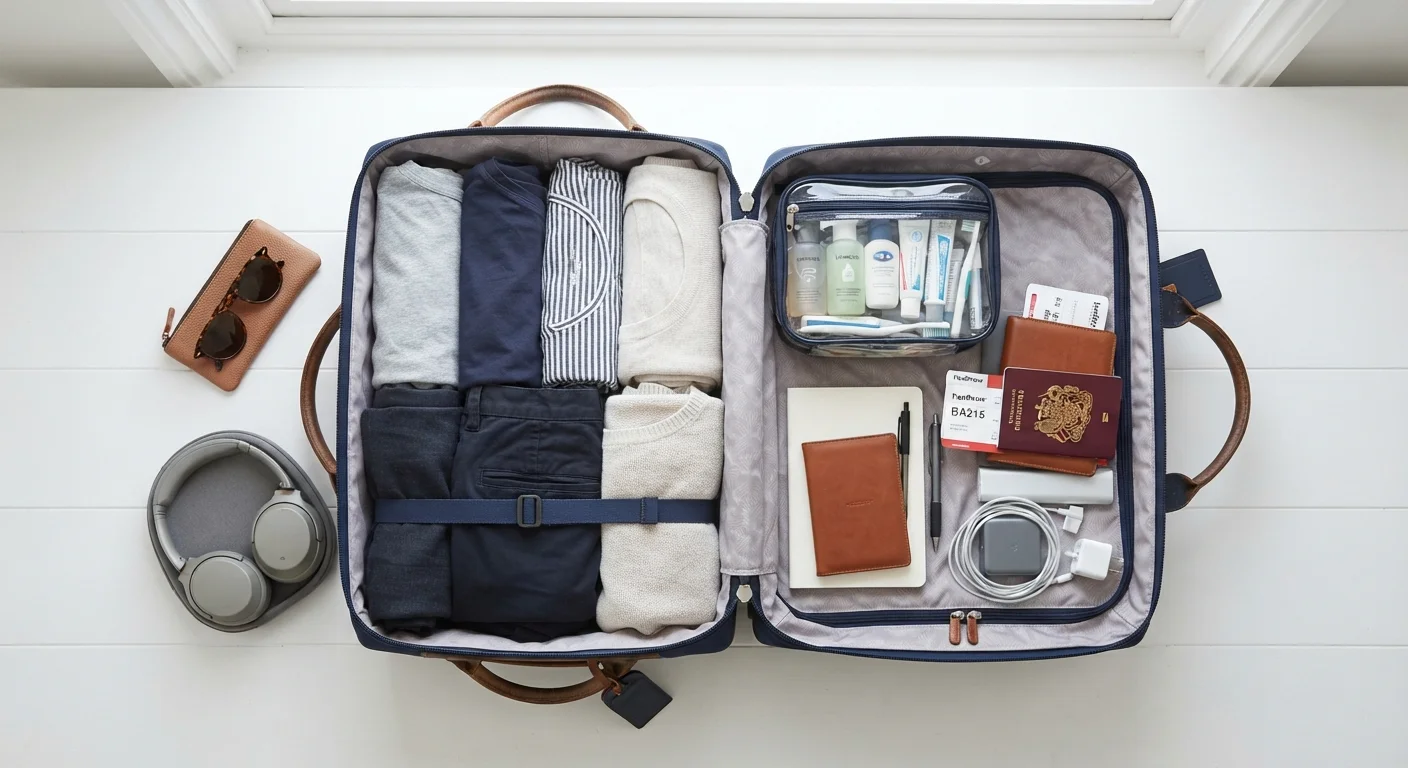
- Pre-stage your liquids bag in the very top of your carry-on so it comes out in one motion.
- Know what's in your bag. If you'd struggle to describe what's inside, so will the X-ray operator.
These aren't just efficiency tricks — they also protect your budget. Getting your bag flagged and items confiscated means replacing things you already own. Our article on how travelers blow their budget before arriving covers other quiet money drains worth knowing. And if packing in general is a recurring struggle, common packing assumptions that leave travelers scrambling is worth a read before your next trip.