Why Following Distance Matters More Than Most Drivers Realize
Rear-end collisions are among the most common crash types on American roads, and inadequate following distance is a central factor in most of them. The problem isn't that drivers don't know the 2-second rule - most do. The gap is in understanding why it exists and when it stops being sufficient.
When the vehicle ahead of you brakes, your response involves two distinct phases. First, your brain perceives the brake lights, processes the threat, and sends the signal to your foot. This is perception-reaction time, and for a typical, alert driver it averages around 1.5 seconds. Second, your brakes engage and physically slow the car - that's braking distance, which is not fixed. It grows with speed and shrinks with tire grip. Together, these form your total stopping distance, and it can add up fast. At 60 mph, a fully alert driver in a well-maintained car on dry pavement needs roughly 270 feet to stop - nearly the length of a football field.
~29%
Share of all U.S. crashes that are rear-end collisions
According to the National Highway Traffic Safety Administration (NHTSA), rear-end crashes are consistently one of the most common crash types on American roads.
~270 ft
Total stopping distance at 60 mph on dry pavement
This estimate, based on standard reaction time and braking calculations, illustrates how quickly distance requirements grow with speed.
1.5 sec
Average perception-reaction time for an alert driver
This figure is widely cited in traffic safety research and represents the time from hazard perception to brake application under normal conditions.
When 2 Seconds Falls Short
The 2-second rule was designed as a simple, memorable minimum - and it works reasonably well in light traffic at moderate city speeds. But several real-world factors push required stopping distances well beyond what 2 seconds provides.
- Speed: Braking distance increases with the square of your speed, not linearly. Going from 30 mph to 60 mph doesn't double your stopping distance - it roughly quadruples it. This is why the risks of higher speeds compound so quickly.
- Wet or icy roads: Reduced traction means your brakes have less grip to work with. On wet pavement, stopping distances can be 1.5 to 2 times longer than on dry roads. On ice or packed snow, the multiplier can reach four to ten times.
- Distraction or fatigue: Reaction time is not a fixed number. Tired or distracted drivers can take 2 to 3 seconds just to perceive and respond to a hazard - meaning a 2-second gap is consumed entirely before the brakes ever engage.
- Vehicle weight and load: Heavier vehicles carry more momentum and require proportionally greater braking force. A loaded pickup or SUV needs more distance than a compact sedan traveling at the same speed.
- Older or poorly maintained brakes and tires: Worn brake pads and low tire tread reduce braking efficiency meaningfully, extending stopping distances even on dry roads.
Road design and speed limits also play a role - a curving downhill road at 50 mph demands more buffer than a straight flat street at the same posted speed.
A Simple Upgrade to the 2-Second Rule
Instead of counting to two, count to three - it takes no extra effort and meaningfully increases your safety margin at any speed. In rain or on highways, extend your count to four. This small habit change costs you almost nothing in travel time but dramatically reduces your exposure to rear-end collisions.
Building a Smarter Following Distance Habit
The practical upgrade from the 2-second rule is simply to aim for 3 to 4 seconds under normal highway conditions, and to treat that as a floor rather than a target. In rain, increase to at least 4 seconds. In snow or ice, 8 to 10 seconds is not excessive. At night, when your vision of hazards is reduced, the same logic applies - you can explore more on that through our guide on night driving habits that reduce risk.
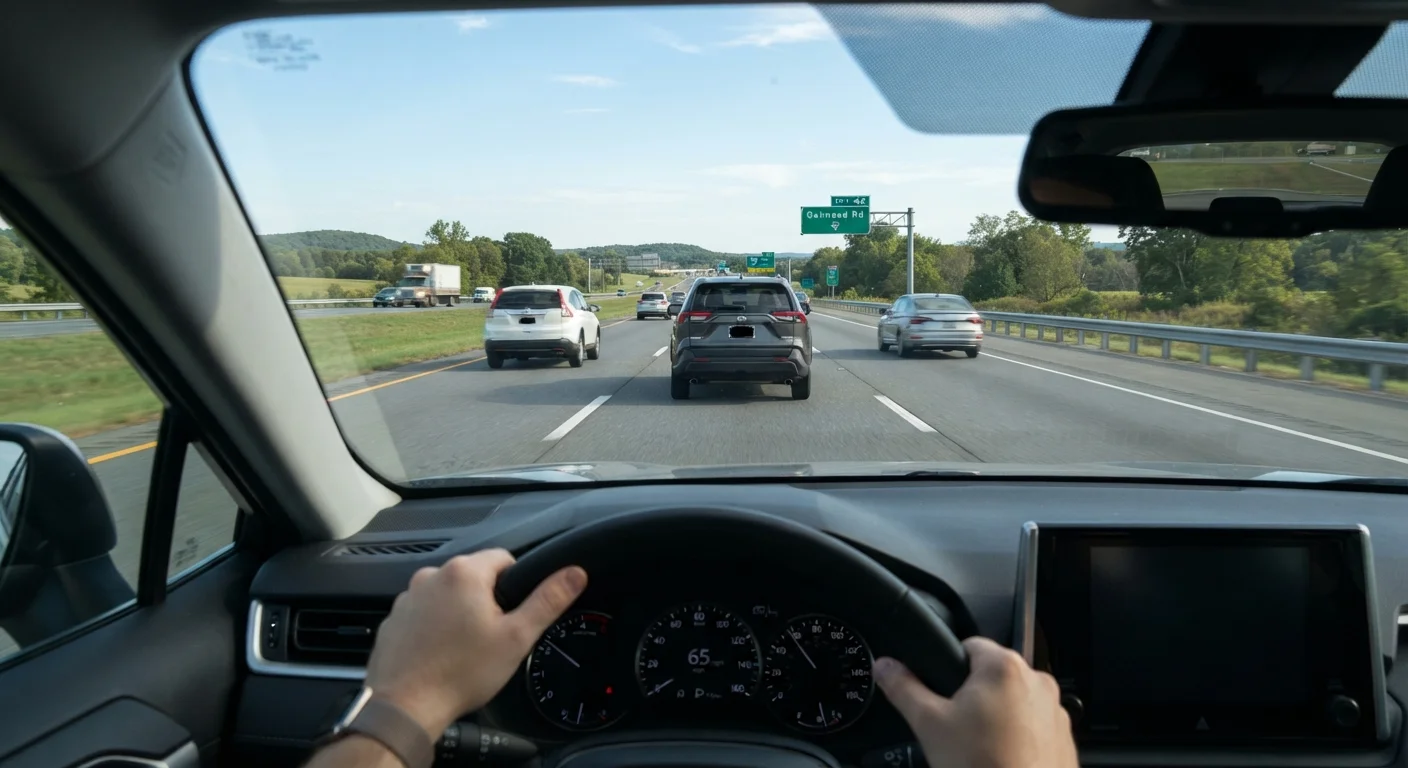
The time-based method remains the easiest tool available. As the vehicle ahead passes a fixed point - a sign, a shadow line, a crack in the pavement - begin counting. If you reach that point before your count ends, ease off the accelerator gently until the gap opens. You don't need to hit your brakes; just releasing the gas is usually enough to restore a safe cushion.
One useful reframe: following distance isn't just about stopping. It also gives you more time to see developing hazards further ahead, reduces your exposure to road debris kicked up by the lead vehicle, and lowers the stress of driving by removing the constant micro-adjustments that come with tailgating. A bigger gap is genuinely more comfortable - and that comfort is evidence the margin is working in your favor.