
What a Grain Is Made Of
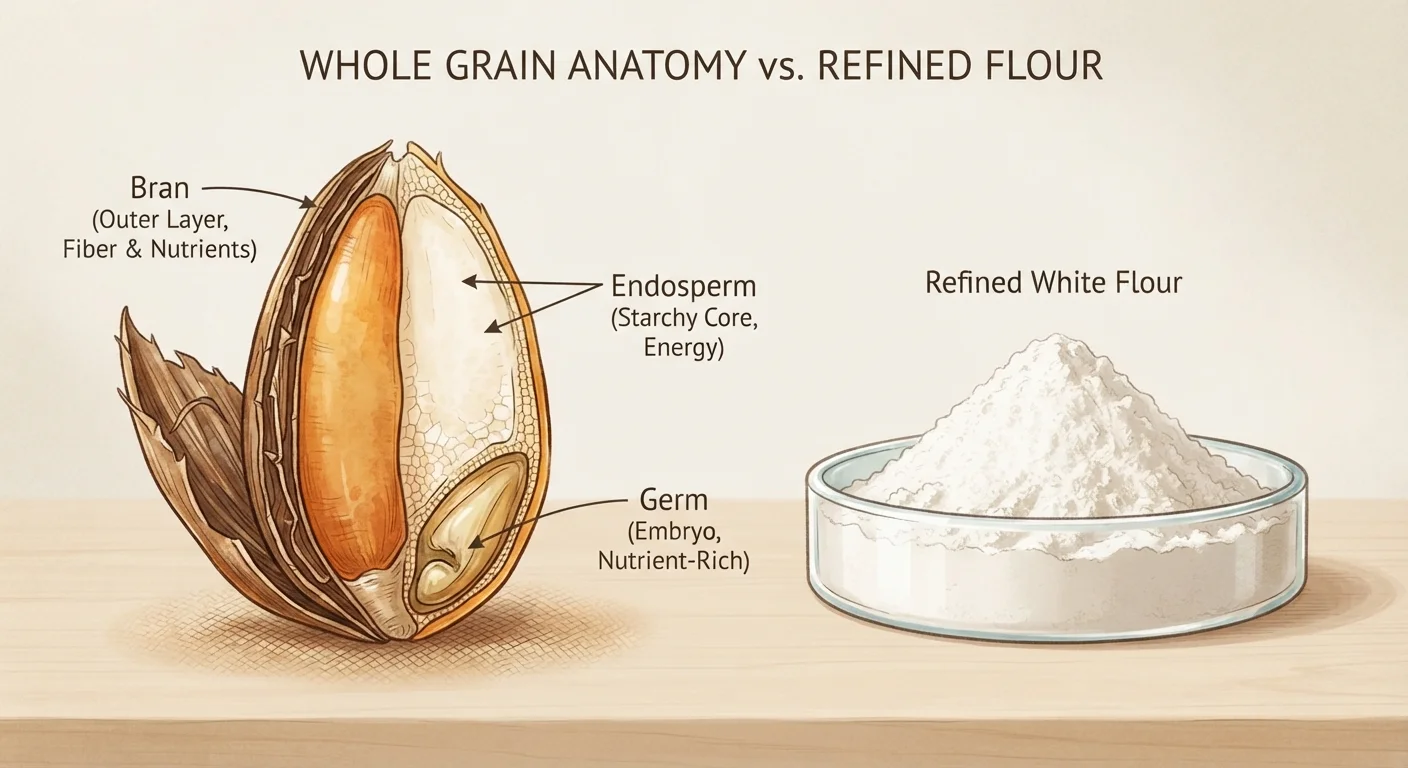
To understand what refining does, you first need to know how a grain is built. Every grain - wheat, oats, rice, corn, barley - has three distinct parts:
- Bran: The tough outer layer. It's packed with dietary fiber, B vitamins (like thiamine, niacin, and riboflavin), and minerals such as iron and magnesium.
- Germ: The small inner core that would sprout into a new plant. It contains healthy fats, vitamin E, B vitamins, and antioxidants.
- Endosperm: The largest part - mostly starch and some protein. This is what gives bread and pasta their structure and familiar texture.
A whole grain keeps all three parts intact. A refined grain has had the bran and germ milled away, leaving only the endosperm. That processing decision has significant nutritional consequences.
For a broader look at how nutrients function together, see our guide to macros and micros.
What the Refining Process Actually Removes
When the bran and germ are stripped away, several important nutrients leave with them:
| Criterion | Whole Grains | Refined Grains |
|---|---|---|
| Kernel parts retained | Bran, germ, endosperm | Endosperm only |
| Dietary fiber | High | Very low |
| B vitamins (natural) | Thiamine, niacin, folate, riboflavin | Mostly removed; some added back |
| Vitamin E | Present (from germ) | Largely absent |
| Glycemic impact | Lower (fiber slows digestion) | Higher (faster glucose release) |
| Shelf life | Shorter (germ fats can spoil) | Longer (fats removed) |
| Phytochemicals | Rich variety | Minimal |
- Dietary fiber: Primarily housed in the bran, fiber slows digestion, supports gut bacteria, and helps regulate blood sugar. Refined grains can contain a fraction of the fiber found in whole grains.
- B vitamins: Thiamine, riboflavin, niacin, and folate are concentrated in the bran and germ. These vitamins support energy metabolism and red blood cell production.
- Vitamin E: Found mainly in the germ, this fat-soluble antioxidant supports immune function and cell protection.
- Iron and magnesium: Both minerals are significantly reduced after milling.
- Phytochemicals: Plant compounds like lignans and phenolic acids - found predominantly in the bran - are largely absent in refined products.
Refining also removes the healthy fats in the germ. While this extends shelf life (fats can go rancid), it eliminates a source of essential fatty acids and fat-soluble vitamins.
~25%
Fiber remaining after milling
Research on wheat milling indicates refined white flour retains roughly 20-25% of the fiber found in whole wheat flour.
~60%
Calcium loss during refining
Studies on grain processing show significant mineral losses across multiple nutrients when bran and germ are removed.
Enrichment: What Gets Added Back - and What Doesn't
Most refined grain products sold in the U.S. are enriched, meaning manufacturers add back certain nutrients after processing. Typically, enrichment restores some thiamine, riboflavin, niacin, folic acid, and iron.
What "Enriched" Means on a Label
Federal regulations in the United States require that refined grain products labeled as enriched must contain specified amounts of thiamine, riboflavin, niacin, folic acid, and iron. These are added after milling to partially compensate for processing losses. However, the law does not require enrichment to restore fiber, vitamin E, magnesium, or the many phytochemicals lost during refining. Enrichment is a minimum standard, not a full nutritional restoration.
However, enrichment is selective. It does not replace:
- The dietary fiber lost from the bran
- Vitamin E and healthy fats from the germ
- Magnesium and zinc, which are only partially restored in some products
- The full spectrum of phytochemicals and antioxidants present in the whole kernel
In other words, enrichment is a partial fix, not a full restoration. A refined grain food labeled "enriched" is nutritionally better than an unenriched one, but it still doesn't match the complete nutritional profile of the whole grain it came from.
Blood Sugar, Satiety, and the Glycemic Difference
Because the bran and germ slow down digestion, whole grains generally have a lower glycemic index (GI) - a measure of how quickly a food raises blood glucose levels - compared to refined grains. Refined grain foods, lacking that fiber buffer, are digested more rapidly, which can lead to a quicker rise and fall in blood sugar.
This difference matters for satiety (the feeling of fullness). Fiber absorbs water, adds bulk, and slows the movement of food through the digestive tract, which helps most people feel satisfied longer after eating. Refined grain products tend to be less filling calorie-for-calorie.
It's worth noting that glycemic response varies based on many factors - food preparation method, what else you eat in a meal, and individual physiology all play a role. This is general nutritional science, not a personal health prescription.
Navigating Labels at the Grocery Store
Food labels use grain-related terms loosely, and the differences matter. Here's what to watch for:
- "100% Whole Grain" or "100% Whole Wheat": The most reliable claim - all grain ingredients should be whole.
- "Whole Grain": The product contains some whole grain, but may also contain refined grain. Check the ingredient list.
- "Multigrain": Simply means more than one type of grain was used. Those grains could all be refined. This term says nothing about whether the grains are whole.
- "Made with whole grain": Could mean a small fraction of the grain content is whole grain.
The most reliable check is the ingredient list: if a whole grain (e.g., "whole wheat flour," "whole oats," "brown rice") is listed first, it's the dominant ingredient. For a full walkthrough of how to read ingredient lists, see our ingredient list guide. And for help decoding everything else on the package, our food label explainer covers every row of the nutrition facts panel.
This article is for general informational and educational purposes only and is not a substitute for professional medical or dietary advice. Consult a qualified healthcare provider or registered dietitian for guidance specific to your health needs.