
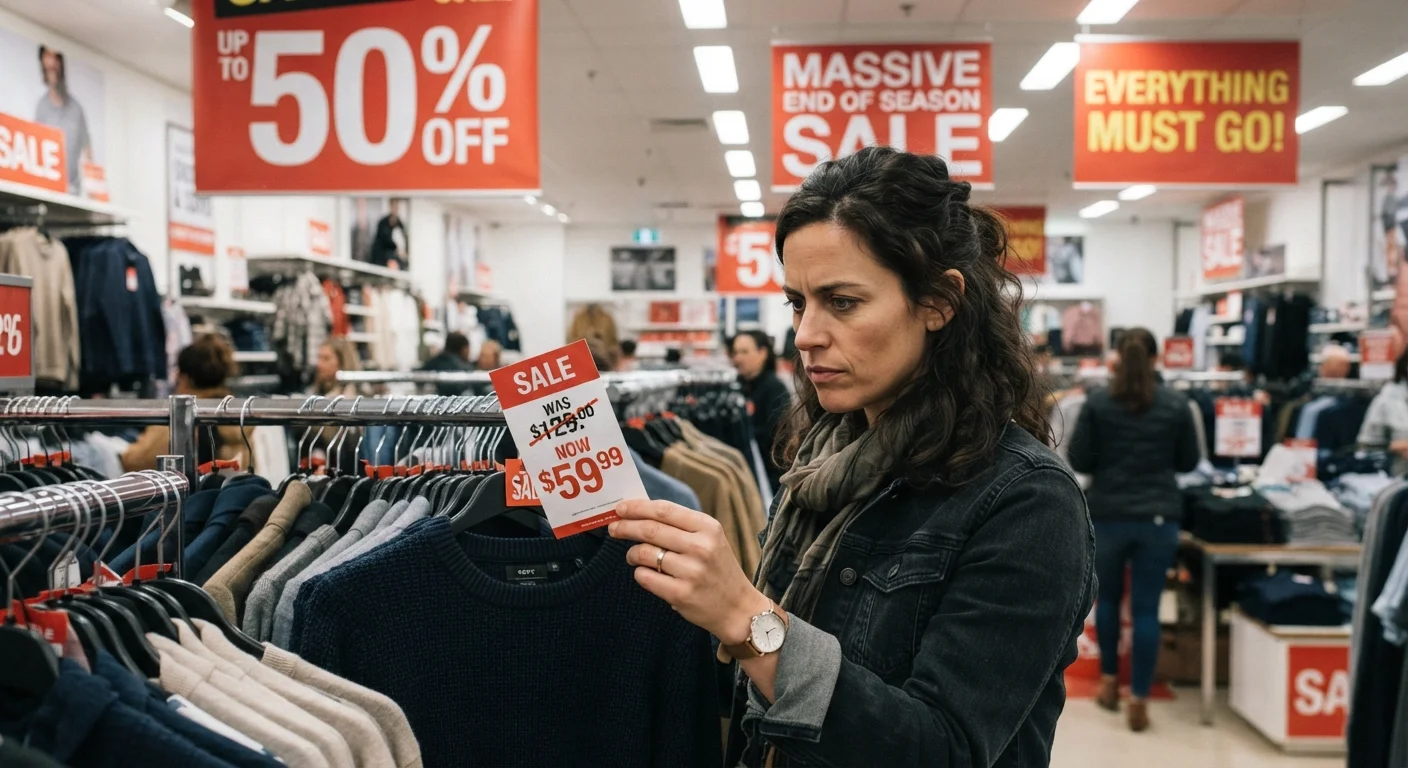
How Reference Prices Create the Illusion of a Deal
The number crossed out above the sale price — commonly called the reference price or was price — does most of the persuasive work in any retail markdown. It tells your brain what you're saving before you've confirmed whether that original figure was ever real.
In practice, retailers set reference prices in several ways. Some reflect a genuine selling price the item held for weeks or months. Others are the manufacturer's suggested retail price (MSRP), which may have little connection to what any store actually charged. A third category is the most problematic: a price the item was offered at briefly — sometimes for as little as one day — just to establish a legal "original" for future markdown advertising.
Most U.S. states have pricing regulations that require a reference price to reflect a bona fide prior offering, but enforcement is inconsistent and the definitions vary. The result is that consumers often see "original" prices that few, if any, shoppers ever paid. To understand how retailers use anchoring to shape your perception of value, see our article on why sale prices aren't always what they seem.
| Criterion | True Discount | Sale Price Theater |
|---|---|---|
| Reference price basis | Sustained prior selling price | MSRP or briefly-held price |
| Price history | Verifiably higher before the sale | Often flat or near "sale" price for months |
| Cross-retailer comparison | Sale price is lower than competitors | Sale price matches standard market price |
| Percentage vs. dollar value | Dollar savings are meaningful | High percentage, low absolute saving |
| Duration of "sale" | Time-limited, then price reverts | Ongoing or recurring with no reversion |
| Regulatory standing | Meets bona fide prior price standards | May exploit loose enforcement of pricing rules |
What a True Discount Actually Looks Like
A genuine price reduction has a traceable history. The item sold at price X consistently for a sustained period, and now it sells at price Y — verifiably lower. The key word is verifiably.
Several free tools allow you to pull up a product's price history across major online retailers. These tools display a chart showing every recorded price over weeks or months. If a product listed at "50% off" has actually hovered near the sale price for most of the past six months, the markdown is largely cosmetic. If the chart shows a genuine step-down from a stable, higher price, the discount is more credible.
~60%
Share of "sale" items not cheaper than before
An analysis by the consumer research organization Which? found that around 60% of items promoted during a major sale event were not cheaper than they had been in the preceding six months.
30 sec
Time to check an item's price history online
Browser-based price tracking extensions can display a product's full pricing chart in under a minute, requiring no account or subscription.
Dollar savings matter more than percentages. A 60% discount on a $10 item saves you $6. A 10% discount on a $400 item saves you $40. Retailers often lead with high percentages on low-cost items precisely because the percentage sounds impressive even when the absolute saving is modest. Our piece on the hidden language of pricing explains in detail how percentage framing influences purchase decisions.
It's also worth comparing the sale price against other retailers before assuming you've found value. A "sale" price at one store may simply match the standard price everywhere else.
Practical Steps to Separate Signal from Noise
You don't need to be a data analyst to verify a deal. A few habits applied consistently will serve you well.
- Check price history before purchasing — browser extensions and dedicated websites track historical prices for many online products. A 30-second check is often enough to reveal whether a "sale" is real.
- Compare across retailers — if the sale price matches the going rate elsewhere, the reference price was likely inflated, not the current price discounted.
- Convert percentages to dollars — focus on the actual dollar difference, not the percentage. It resets your frame of reference.
- Note how long the sale has been running — a perpetual sale is rarely a sale. If an item has been "on sale" every time you've visited a site, that sale price is effectively the real price.
- Be especially cautious during major promotional events — high-volume sale periods are when theatrical pricing is most common, because urgency reduces the likelihood that shoppers will pause to verify.
For a more complete walk-through, our guide on how to verify a deal is actually a deal covers each of these steps in detail. And if you're weighing whether to buy now or wait for a better price, paying full price vs. waiting for a sale walks through that trade-off honestly.
What U.S. Pricing Law Generally Requires
The Federal Trade Commission's guidelines on retail pricing require that a "former price" used in advertising reflect a price at which the item was actually offered to the public for a reasonably substantial period. However, "reasonably substantial" is not defined uniformly across states, and enforcement tends to be complaint-driven. This means consumers cannot assume a reference price is legitimate simply because it appears on a tag. Verifying independently remains the most reliable approach.