How Your Brain Reads a Price Tag
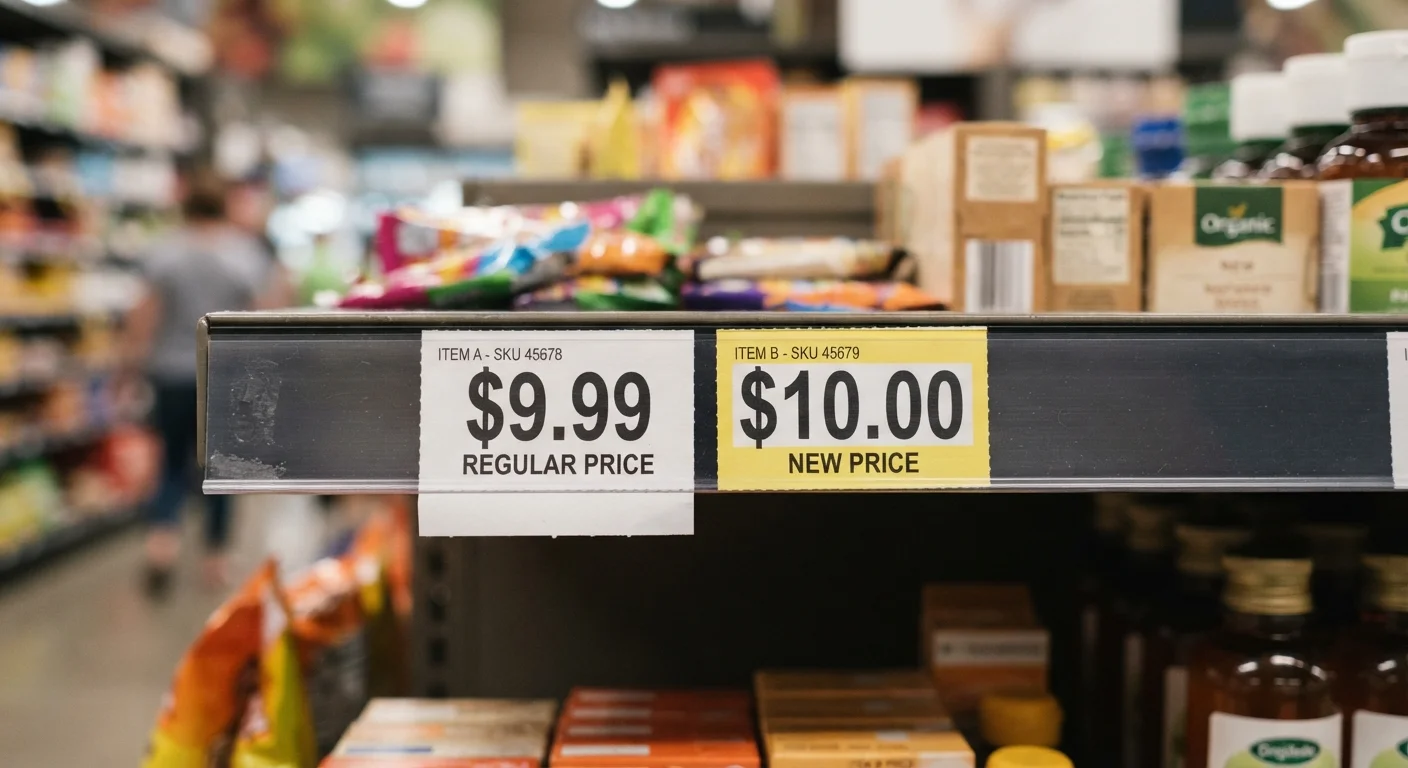
When you scan a price, your brain doesn't process it the way a calculator would. Instead, it reads left to right and anchors on the first digit it encounters. That's why $9.99 and $10.00 feel meaningfully different even though the actual gap is one cent.
This is called left-digit anchoring. Your brain categorizes $9.99 into the "nine dollar" range before it finishes reading the number. The two cents or one cent at the end barely register. Retailers engineered nothing here — they simply learned to take advantage of how human cognition already worked.
The effect is amplified under time pressure, distraction, or in high-stimulation retail environments — exactly the conditions most shopping happens in. When you're pushing a cart through a busy store or scrolling quickly on your phone, fast automatic thinking dominates over slower, deliberate calculation.
1¢
Actual difference between $9.99 and $10.00
Despite the trivial monetary gap, consumer behavior studies show this difference consistently influences purchase decisions.
~60%
Share of U.S. retail prices ending in 9
Academic surveys of retail price lists have found that prices ending in the digit 9 dominate across grocery, apparel, and general merchandise categories.
Left digit
Anchor point the brain uses first when reading prices
Research in numerical cognition shows that the leftmost digit disproportionately shapes perceived magnitude before the full number is processed.
The Specific Tactics Behind the Numbers
Charm pricing (.99, .95, .97) is the most widespread form, but it's not the only one. Here's a breakdown of the main techniques:
- Charm pricing: Ending prices just below a round number to trigger the left-digit effect. $19.99 instead of $20.
- Price anchoring: Displaying a higher "original" price next to a sale price to make the current price seem like a bargain — even if the original price was rarely, if ever, charged. See our breakdown of how retailers inflate reference prices for more on this.
- Prestige pricing: Using round numbers ($100, $500) to signal luxury or quality. The absence of .99 is itself a message: this item is above haggling.
- Bundle pricing: Combining items at a total price that obscures the individual cost of each, making the overall spend feel smaller.
These tactics are layered — a single checkout page might use charm pricing on the item, anchoring with a crossed-out price, and bundle pricing on accessories, all at once.
One Habit That Cuts Through Charm Pricing
Before you evaluate any price, round it up to the nearest whole dollar in your head. Then ask: at that round number, does this still feel like a good value? This single step eliminates the artificial gap charm pricing creates and forces you to judge the item on its actual cost.
Why Awareness Isn't Always Enough
Knowing about psychological pricing is genuinely useful, but research consistently shows that awareness doesn't fully neutralize the effect. The left-digit anchoring response is fast and automatic — it happens before conscious reasoning kicks in.
What does help is building deliberate habits that intercept that automatic response:
- Round up before comparing. Mentally convert $49.99 to $50 before evaluating it. This forces your brain to use the accurate number.
- Compare absolute dollar differences, not percentages. A 20% discount on a $15 item is $3. That framing is more concrete than "20% off."
- Pause on anchored prices. When you see a crossed-out "original" price, ask whether you ever would have paid that amount. If the answer is no, the anchor is irrelevant to your decision. Our guide on when markdowns are real versus theater walks through this in detail.
These habits won't make pricing tactics disappear, but they replace fast automatic thinking with a more accurate read of what you're actually spending.
Putting It Together: Reading Prices Like a Skeptic
Psychological pricing isn't deceptive in a legal sense — it's simply using knowledge of human cognition to shape perception. Understanding it gives you a more accurate picture of what's happening at the shelf or checkout screen.
The practical takeaway: treat every price as if it were rounded to the nearest dollar. Stop letting the cents column do emotional work on your budget. And when a deal feels irresistible, pause long enough to ask whether the item itself — at its true price — is something you actually need and were already planning to buy.
For a deeper look at how these tactics combine with broader retail strategies, see our end-to-end guide for evaluating deals. And if you want to understand where these pricing signals appear most aggressively, where shoppers consistently overpay maps out the highest-risk categories.