Why Tire Pressure Matters More Than Most Drivers Realize
Tire pressure is one of those maintenance items that is easy to overlook precisely because it changes gradually. There is no warning light, no strange noise, and no obvious symptom until a tire is noticeably flat. But the efficiency penalty starts well before anything visible happens.
When a tire loses air, its sidewalls flex more with each rotation. That extra flexing generates heat and increases the tire's rolling resistance - the friction-like force the drivetrain must overcome to keep the vehicle moving. More resistance means more fuel burned per mile, quietly draining efficiency every time you drive.
This connection between pressure and efficiency is well-documented. The U.S. Department of Energy has estimated that underinflated tires can reduce gas mileage by around 0.2% per PSI below the recommended level across all four tires. It may sound small in isolation, but a vehicle running 8-10 PSI low on all four tires could see a measurable and consistent reduction in fuel economy - the kind that compounds over thousands of miles.
~0.2%
Fuel economy lost per PSI of underinflation
According to the U.S. Department of Energy, each 1 PSI drop below recommended levels across all four tires reduces fuel economy by approximately 0.2%.
1 PSI
Pressure lost per 10°F temperature drop
A widely cited automotive rule of thumb supported by tire industry guidance on seasonal pressure changes.
25%
Below recommended PSI before TPMS alerts
Federal regulations require TPMS systems to warn drivers only after pressure falls at least 25% below the vehicle manufacturer's recommended level.
Reading the Right Number: Door Jamb vs. Tire Sidewall
One of the most common mistakes drivers make is inflating tires to the maximum PSI printed on the sidewall. That figure is the tire's structural ceiling - the highest pressure the tire is built to handle safely - not the pressure your vehicle is designed to run on.
Your vehicle's recommended PSI is printed on a sticker inside the driver's door jamb. This number was determined by your vehicle's engineers to balance ride comfort, handling, tread wear, and fuel economy for that specific car's weight and suspension setup. Some vehicles specify different pressures for the front and rear axles, so check both.
For the most authoritative source, your owner's manual also lists the manufacturer-recommended PSI and may include guidance on load-adjusted inflation for when you're carrying passengers or cargo.
Check Pressure When Tires Are Cold
Always measure tire pressure before driving or at least three hours after the vehicle has been parked. Driving heats the air inside tires and temporarily raises pressure readings, which can make underinflated tires appear normal. A cold reading gives you the accurate baseline you need.
How Temperature Quietly Changes Your Tire Pressure
Tire pressure is not static. Air expands when heated and contracts when cooled, which means your tire pressure fluctuates with ambient temperature even if the tires haven't lost a molecule of air to a slow leak.
The commonly cited rule of thumb is that tires gain or lose roughly 1 PSI for every 10°F change in temperature. That means a tire inflated to 35 PSI on a 70°F afternoon could read closer to 32 PSI on a 40°F morning - technically within the normal range, but trending toward the underinflated threshold if it was already at the lower end.
This is why monthly checks matter most heading into colder months. Always check pressure when the tires are cold - meaning the vehicle has been parked for at least three hours and driven fewer than a mile at low speed - because driving heats the air and temporarily inflates the reading, masking the true resting pressure.
The Tread Wear Connection: How Pressure Affects Tire Longevity
Beyond fuel economy, improper inflation accelerates tread wear in predictable, avoidable patterns. An underinflated tire wears faster on both outer edges because the sidewalls bow outward, putting disproportionate contact pressure on the shoulders of the tread. An overinflated tire does the opposite - the center of the tread bears excessive load and wears down prematurely.
Either pattern shortens tire life and may require replacement sooner than expected. Maintaining correct pressure is one of the simplest ways to get the full mileage out of a set of tires - a goal that complements regular tire rotation, balancing, and alignment.
Uneven wear also affects handling and braking. A tire with compromised tread depth has less grip, particularly on wet roads, which is a safety concern that goes well beyond fuel costs. Consistent pressure checks are a straightforward part of the long-term case for consistent vehicle upkeep.
Spare Tires Need Pressure Checks Too
Many drivers forget that a spare tire - particularly a compact 'donut' spare - also loses pressure over time. A spare that has been sitting for a year or more may not be safely usable when you actually need it. Include the spare in your monthly check routine and refer to your owner's manual for its recommended PSI.
Don't Rely Solely on Your TPMS
Most vehicles built after 2008 are equipped with a Tire Pressure Monitoring System (TPMS) - a sensor network that alerts you when pressure drops significantly. The catch is that the TPMS warning typically activates only when a tire is already 25% below the recommended PSI, which is well into underinflated territory. Tires can underperform for months without ever triggering that dashboard light.
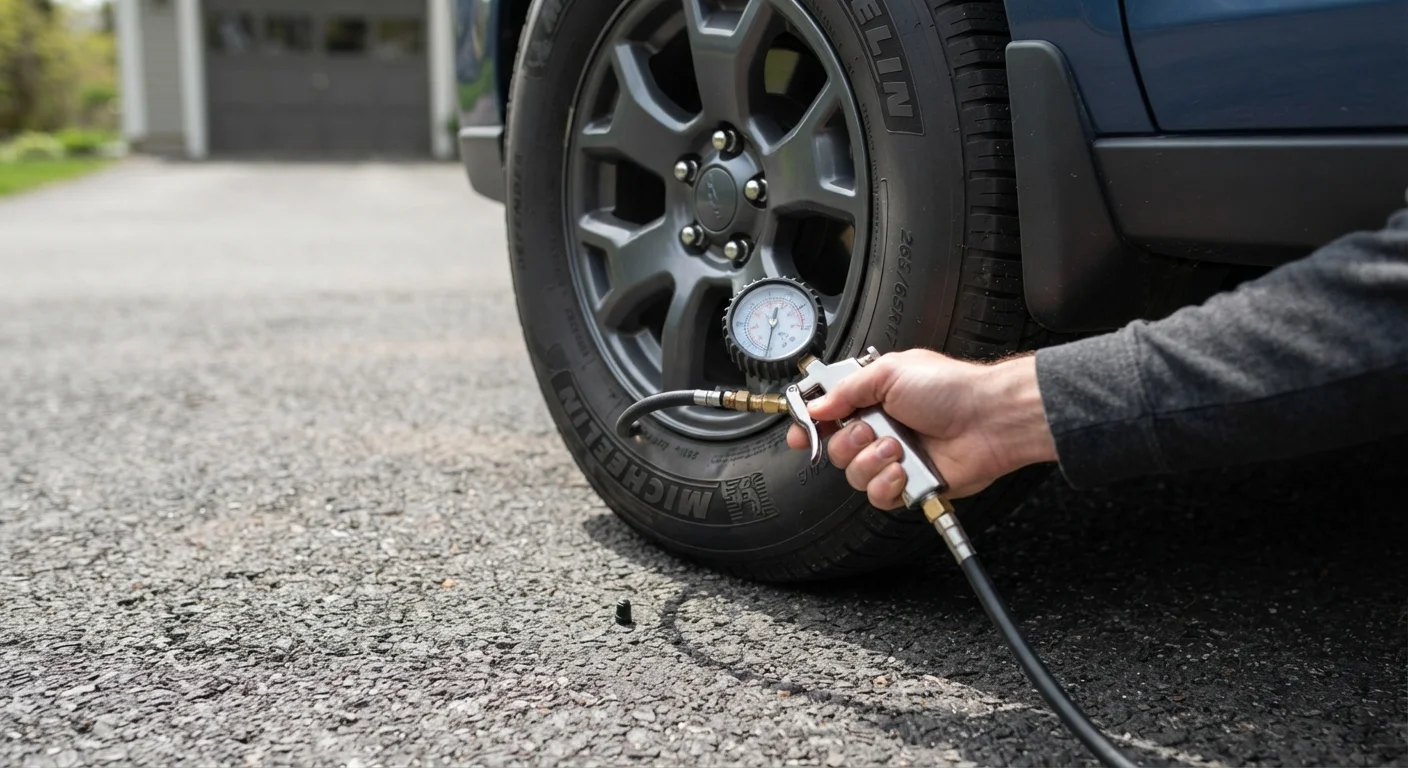
A quality analog or digital tire pressure gauge costs only a few dollars and provides an accurate reading in seconds. Checking each tire at the start of each month - and before any road trip - takes under two minutes and removes any guesswork. Avoid relying on visual inspections alone; a tire can look normal while carrying significantly less air than it should.
Drivers interested in avoiding other common maintenance misconceptions may want to review common car maintenance myths that could hurt your vehicle for a broader look at what conventional wisdom gets right - and wrong.