Why These Three Services Get Confused
Tire rotation, balancing, and alignment are often mentioned together - sometimes even bundled into a single service appointment - which makes it easy to assume they're variations of the same thing. They aren't. Each one targets a different problem, operates on different principles, and has its own recommended service interval. Treating them as interchangeable can lead drivers to skip one while assuming another has it covered.
Understanding what each service actually does helps you have more informed conversations with your mechanic, spot warning signs earlier, and make better decisions about when each service is genuinely needed. It also connects directly to tire longevity: done consistently and on schedule, all three contribute to getting the most life out of a set of tires. For a broader look at how these services fit into your overall vehicle upkeep, see the complete driver's maintenance reference.
Tire Rotation: Evening Out the Wear
Every tire on your vehicle does a slightly different job. Front tires on a front-wheel-drive car, for example, handle both steering and power delivery, so they tend to wear faster - especially on the outer edges. Rear tires on any vehicle carry a different load and experience different stresses. Left and right tires also wear differently depending on road crown and driving habits.
Rotation solves this by periodically moving tires to different positions - typically front to back, or in an X-pattern depending on the vehicle's drivetrain and whether the tires are directional. The goal is to spread wear as evenly as possible across all four tires so the entire set reaches the end of its useful life at roughly the same time rather than having one or two tires fail prematurely.
Most manufacturers recommend rotation every 5,000 to 7,500 miles. Your owner's manual will give you the interval specific to your vehicle - a resource most drivers underuse.
~$0.11/mile
Estimated cost of premature tire replacement
Industry estimates suggest that consistently skipping rotation can reduce tire life by 20% or more, effectively adding significant cost per mile driven.
5,000-7,500 mi
Typical tire rotation interval
This range reflects common manufacturer guidelines; the exact interval for your vehicle is found in the owner's manual.
~0.3°
Toe misalignment that causes rapid wear
According to alignment equipment manufacturers, even a fraction of a degree of toe misalignment can scrub significant tread life from a tire over tens of thousands of miles.
Balancing: Smoothing Out the Ride
A tire and wheel mounted together are rarely perfectly uniform in weight distribution. Even small differences - a few grams - can cause the assembly to wobble as it spins at highway speeds. The result is a vibration felt in the steering wheel or through the seat, and accelerated, uneven tread wear in the affected area.
Balancing addresses this by placing the tire-and-wheel assembly on a spin balancer, which identifies where the weight is uneven. A technician then attaches small counterweights to the wheel rim at precise locations to bring the assembly into balance. The process is quick and doesn't require any disassembly of the suspension.
Balancing is typically recommended when tires are first mounted, and again every time a rotation is performed. It's also the right response if you notice a new vibration after hitting a pothole - the impact can knock a wheel out of balance or even displace an existing counterweight.
Alignment: Pointing the Wheels Correctly
Wheel alignment is about the geometry of how your tires meet the road. Three angles matter most: camber (the inward or outward tilt of the tire when viewed from the front), toe (whether tires point slightly inward or outward when viewed from above), and caster (the angle of the steering axis, which affects stability and steering feel). When any of these are off, tires scrub against the road at a slight angle rather than rolling cleanly, which causes rapid and uneven wear.
Misalignment is often gradual - a hard pothole hit, a curb strike, or simply the cumulative effect of normal driving on imperfect roads. Common symptoms include the vehicle drifting to one side, a steering wheel that's off-center when driving straight, or tires that show heavy wear on one edge but not the other.
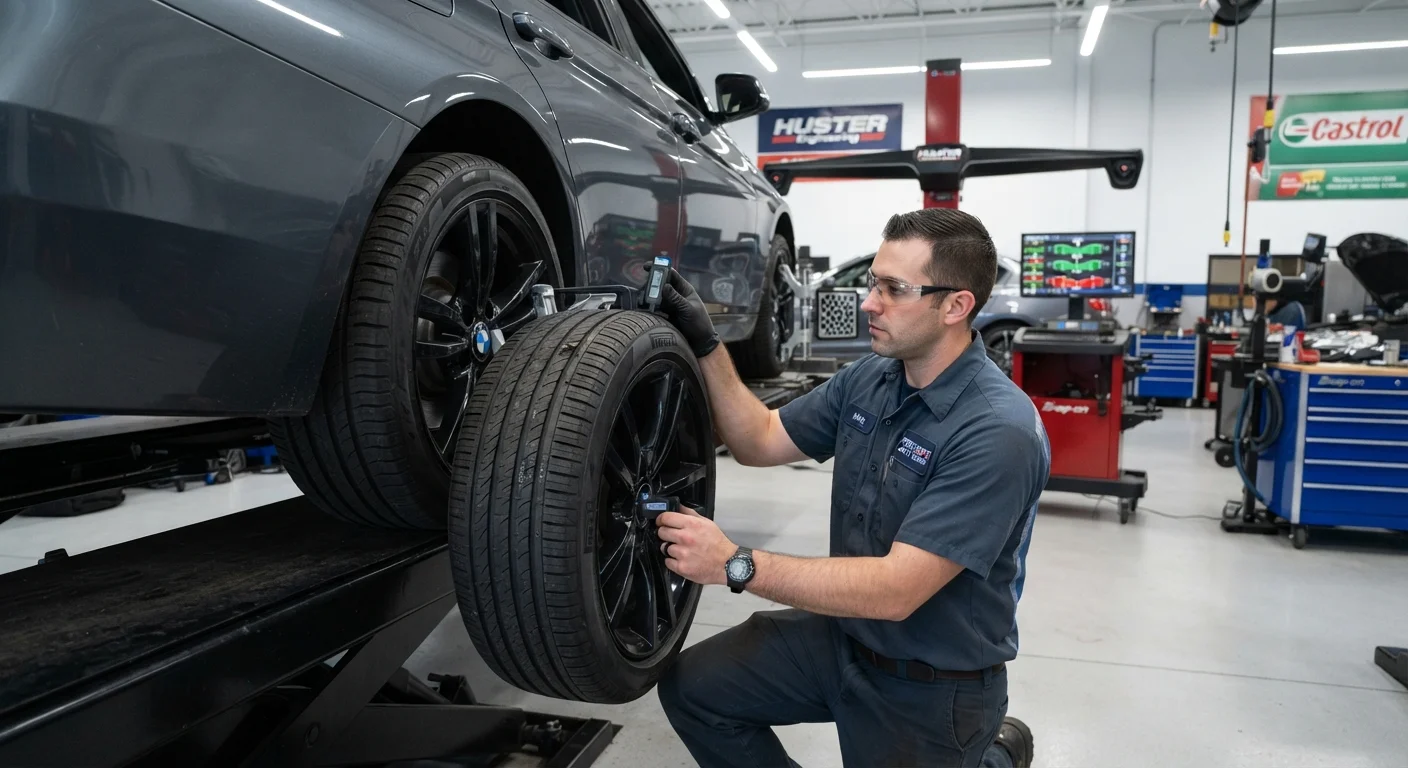
Unlike rotation and balancing, alignment requires specialized equipment to measure and correct. It should be checked any time you notice those warning signs, after any significant impact, and typically at least once a year or as your owner's manual specifies. Uneven tire wear from poor alignment also compounds the fuel economy effects discussed in the guide to tire pressure and fuel economy.
“Alignment is the one service drivers most often skip - and it's the one that most quietly destroys tires. By the time you can see the wear, you've already lost significant tread life.”
— ASE-Certified Master Technician, Automotive Service Excellence (ASE) credential holder, quoted in industry training materials
How All Three Work Together
None of these services fully substitutes for another. A vehicle with perfectly balanced tires can still have terrible alignment. Rotating tires on a car that's out of alignment just moves the uneven wear problem to a different set of positions. And balancing without rotation means some tires still accumulate wear faster than others.
Done together and on schedule, however, they form the core of tire maintenance. Consistent attention to all three is one of the most straightforward ways to extend tire life and maintain safe, predictable handling. If you're building a maintenance routine, these services belong in it alongside fluid checks and brake inspections - part of the long-term case for consistent vehicle upkeep.
When in doubt about whether a service is due, a qualified mechanic can inspect your tires and advise based on actual wear patterns - far more reliable than guessing based on mileage alone.