Why Right-of-Way Rules Matter
Right-of-way determines which driver proceeds first when paths cross. Getting it wrong isn't just a courtesy issue - it's a leading cause of intersection crashes. According to the Federal Highway Administration, intersections are the location of roughly 40% of all U.S. traffic crashes each year. Yet many drivers operate on habit and guesswork rather than a solid understanding of the rules.
This reference covers the three most commonly misunderstood intersection scenarios: roundabouts, four-way stops, and yield signs. Whether you're a new driver or someone refreshing their knowledge, knowing these rules cold makes you a measurably safer driver. For a broader look at how road design shapes your choices behind the wheel, see how speed limits and road design work together.
| Intersection crash share | ~40% of all U.S. traffic crashes (Federal Highway Administration) |
| Roundabout flow direction | Counterclockwise (U.S. standard) |
| Four-way stop tie-breaker | Yield to the driver on your right (Uniform Vehicle Code, adopted in most U.S. states) |
| Yield sign meaning | Slow and be prepared to stop - not an automatic stop |
| Roundabout injury crash reduction | Up to 75% vs. conventional intersections (Insurance Institute for Highway Safety (IIHS)) |
Roundabouts: Yield Before You Enter
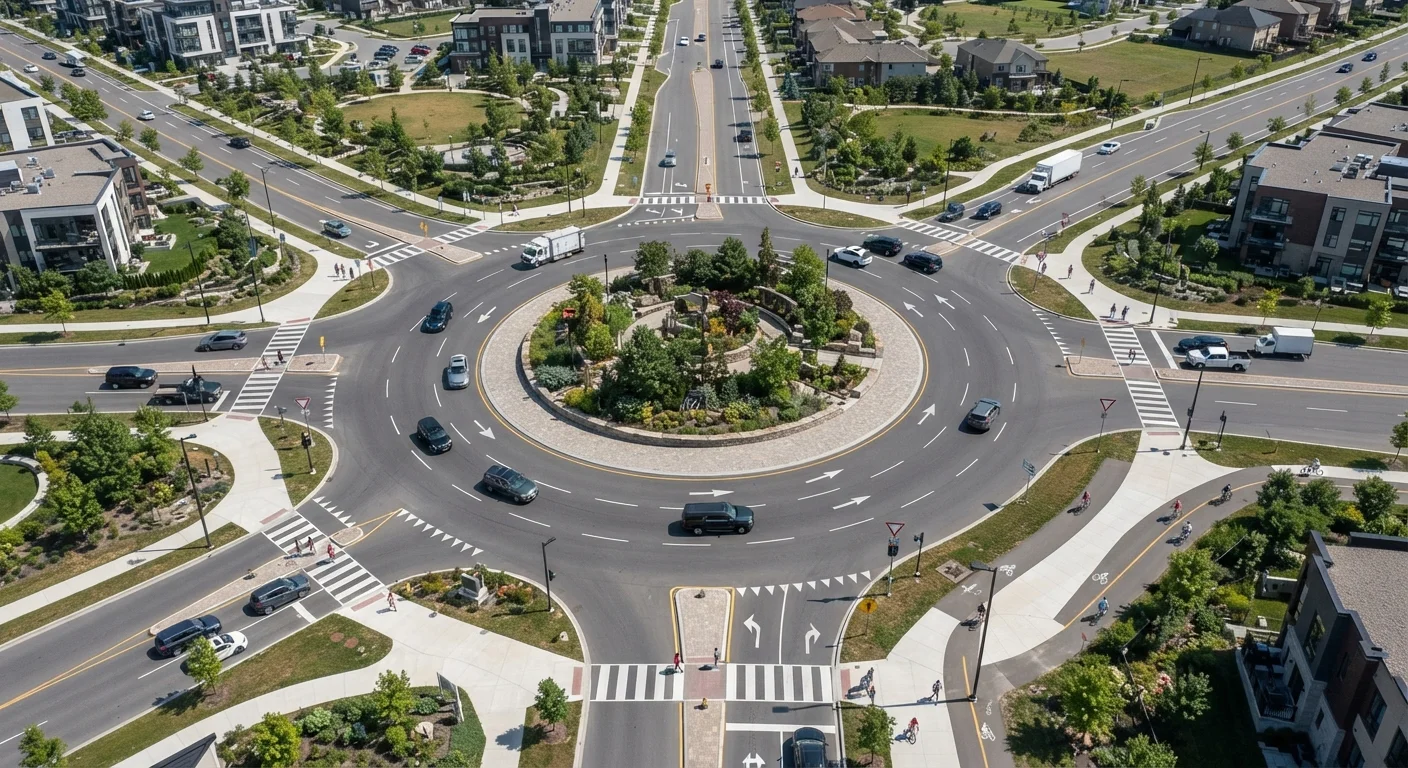
A roundabout is a circular intersection where traffic flows counterclockwise around a central island. The governing rule is simple: vehicles already inside the roundabout have the right-of-way. Drivers approaching must yield at the entry point - marked with a dashed yield line and typically a yield sign - and wait for a safe gap before merging in.
Common Roundabout Mistakes
- Stopping inside the circle: Once you've entered, keep moving at a steady, low speed. Stopping mid-roundabout blocks traffic and creates rear-end risk.
- Entering without yielding: Treat the entry like a merge, not a stop sign. Check for circulating vehicles before pulling in.
- Ignoring lane choice: In multi-lane roundabouts, choose your lane before entry. Right lane for right-turn exits; left lane for going past the halfway point.
Pedestrians at marked crosswalks outside the roundabout always have priority over both entering and exiting vehicles.
Right-of-way
The legal right of a driver, cyclist, or pedestrian to proceed first at an intersection or shared road space. It is granted by traffic laws and signs - not taken unilaterally.
Roundabout
A circular intersection where traffic moves counterclockwise around a central island. Entering vehicles must yield to those already circulating inside.
All-way stop
An intersection where every approach has a stop sign, requiring all vehicles to stop before taking turns based on arrival order.
Yield
A traffic instruction to slow down and give priority to other vehicles or pedestrians. A full stop is required only if a gap is not safely available.
Central island
The raised or painted circular area in the middle of a roundabout that guides counterclockwise traffic flow and is not to be driven over by standard vehicles.
Four-Way Stops: Order, Arrival, and the Tie-Breaker
A four-way stop (also called an all-way stop) requires every vehicle to come to a complete stop before proceeding. The right-of-way sequence follows a clear hierarchy:
- First to arrive, first to go. The vehicle that stopped first has the right-of-way.
- Simultaneous arrival: yield to the right. If two vehicles stop at the same time, the driver on the left yields to the driver on the right.
- Facing vehicles turning left: If you and an oncoming driver arrive together and you plan to turn left, the oncoming driver going straight has priority.
A complete stop means your vehicle's wheels must fully stop - rolling slowly through a stop sign is a traffic violation, not a legal yield. After stopping, scan all directions before moving. Traffic backed up from the original stop rotates through in arrival order.
Understanding these rules connects naturally to broader safe-driving skills. See our reference on merging and blind spot management for the next layer of intersection-adjacent hazards.
Yield Signs: When to Slow, When to Stop
A yield sign does not automatically mean stop - it means you must be prepared to stop if traffic requires it. Yield instructs you to slow down, assess the flow of cross or merging traffic, and give right-of-way to those vehicles before proceeding.
Where You'll See Yield Signs
- Roundabout entries (as covered above)
- Highway on-ramps and merge points - entering drivers yield to highway traffic
- T-intersections - the road ending (the top of the T) typically yields to the through road
- Pedestrian crossings - yield signs may accompany marked crosswalks mid-block
If traffic is clear, you can pass through a yield without stopping. If there's any doubt about whether you have a safe gap, stop and wait. Misjudging a yield gap is a frequent cause of angle collisions. For a complete guide to sign shapes and meanings, see what road signs are actually telling you.
Emergency Vehicles Always Have Priority
Regardless of the intersection type - roundabout, four-way stop, or yield - you must give way to approaching emergency vehicles with lights or sirens activated. Pull to the right and stop until the vehicle has passed. Re-enter the intersection only after it is safe and clear to do so.
Key Takeaways at a Glance
Intersection rules are consistent across U.S. states in their fundamentals, though some states add specific provisions. When in doubt, slow down, make eye contact with other drivers where possible, and be predictable - signal your intentions clearly and move decisively once you have the right-of-way.
- Roundabout: Circulating traffic has priority. Yield before entry.
- Four-way stop: First arrival goes first. Simultaneous arrivals yield to the right.
- Yield sign: Slow and assess. Stop only if traffic requires it.
Building these habits into your routine reduces hesitation at intersections - and hesitation is often more dangerous than a wrong decision made confidently. For everything else you need to know about driving safely at higher speeds, our complete highway safety guide covers on-ramps, passing lanes, and emergency procedures in full detail.