
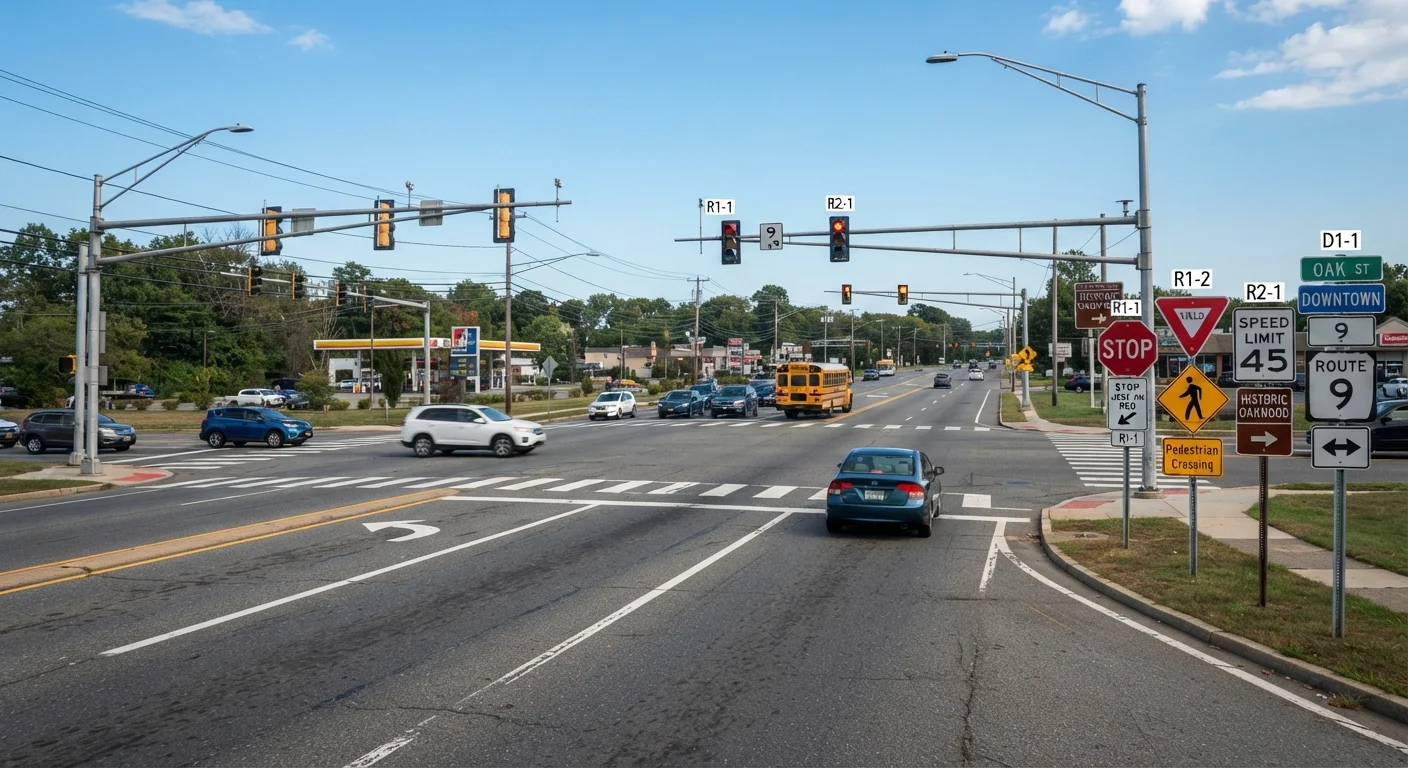
The System Behind the Signs
Every road sign in the United States is governed by a federal standard called the MUTCD - the Manual on Uniform Traffic Control Devices. This standardization means that whether you're driving through rural Montana or downtown Miami, sign shapes and colors follow the same rules. Understanding that system lets you read signs faster and more accurately than relying on memory alone.
Shape conveys meaning even before you can read the text. An octagon always means stop - no exceptions. A triangle pointing downward means yield. A diamond shape signals a warning. Pentagons mark school zones. Rectangles carry regulatory or guide information, with orientation (vertical vs. horizontal) hinting at the sign's purpose.
| Total sign shapes with standardized meanings | 9 distinct shapes (octagon, triangle, diamond, pentagon, rectangle, circle, pennant, crossbuck, trapezoid) (MUTCD, Federal Highway Administration) |
| Color reserved exclusively for stop/prohibition | Red (MUTCD color coding system) |
| Color used only for construction/work zones | Orange (MUTCD, Federal Highway Administration) |
| Shape always indicating a warning | Diamond (MUTCD, Federal Highway Administration) |
| Governing federal document for all U.S. road signs | Manual on Uniform Traffic Control Devices (MUTCD) (Federal Highway Administration) |
Color adds another layer. Rather than treating color as decoration, think of it as a priority filter. Red is reserved exclusively for regulatory commands - stop, do not enter, wrong way. Yellow signals caution. Orange is strictly for construction and work zones. Green guides you to destinations and distances. Blue indicates services such as hospitals, rest areas, and fuel. Brown marks cultural and recreational areas.
Signs Drivers Most Commonly Misread
Yield vs. Stop: A yield sign does not mean slow down and proceed regardless. It means give the right of way to conflicting traffic - which may require coming to a complete stop if traffic is present. Many drivers roll through yields without checking adequately, creating real collision risk. For a full breakdown of right-of-way scenarios, see how yield signs interact with roundabouts and four-way stops.
Speed limit signs on ramps: A posted speed on a curved ramp is an advisory maximum - the speed at which the curve was engineered to be safely navigated under normal conditions. Wet or icy roads, larger vehicles, or worn tires all reduce that margin. Treat advisory speeds as a ceiling, not a target.
"No Turn on Red" signs: These apply even when there is no cross traffic visible. They exist because pedestrian, bicycle, or sight-line factors have made right-on-red unsafe at that specific location. The sign is non-negotiable.
Flashing yellow vs. flashing red: A flashing red light functions identically to a stop sign - come to a full stop and yield before proceeding. A flashing yellow means proceed with caution; no stop is required, but you must be alert to crossing traffic.
Flashing Signals Are Not Suggestions
Many drivers treat flashing signals as optional caution cues. Under U.S. traffic law, a flashing red light requires a full stop and yield - identical to a stop sign. A flashing yellow requires cautious, alert passage. Treating either as a simple slowdown is a common and dangerous misreading.
Being aware of signage is especially critical at night, when reaction time to unexpected changes matters most. Our article on night driving habits that reduce risk covers how to stay alert on unfamiliar roads after dark.
Temporary and Supplemental Signs Worth Knowing
Orange construction zone signs carry the same legal weight as permanent signs. Speed reductions in active work zones are enforceable, and fines are frequently doubled in these areas under most state laws. Watch for dynamic message boards, which can change restrictions in real time based on conditions ahead.
Supplemental plaques - the smaller signs mounted below a primary sign - are frequently ignored. A plaque reading "When Children Are Present" beneath a school zone speed limit makes the speed conditional; it applies whenever children are visible near the roadway, regardless of time of day or whether school is in session. A plaque reading "Next 5 Miles" tells you exactly how long a restriction lasts.
Knowing your signs is one layer of a broader safe-driving foundation. If dashboard indicators are equally confusing, decoding your car's warning lights is a natural next step. And for drivers planning longer trips, highway driving fundamentals reinforces how signage fits into the larger picture of confident, informed driving.
This article provides general educational information about U.S. road signs. Always consult your state's official driver handbook for jurisdiction-specific rules and regulations.