How Each System Works
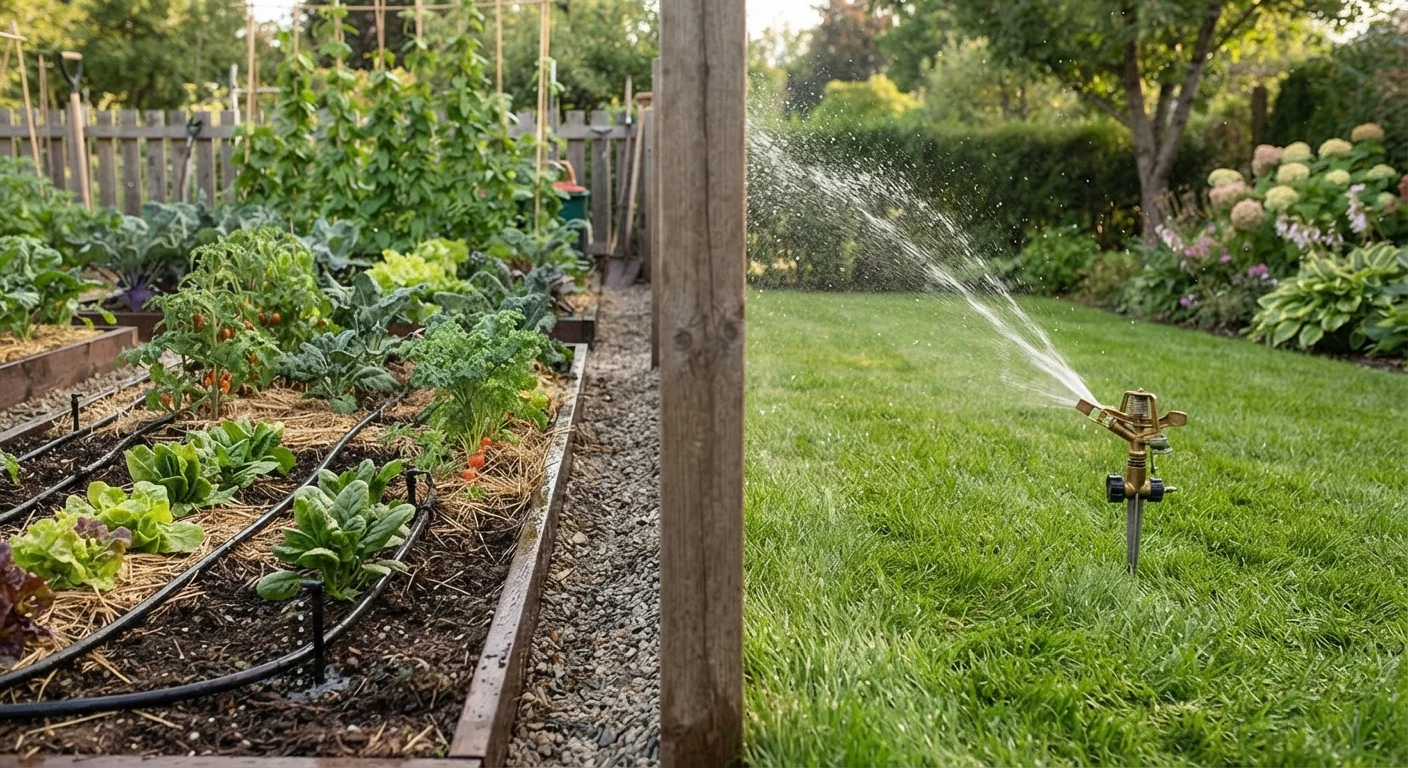
Understanding the mechanics of each system makes the choice much clearer. Drip irrigation uses a network of flexible tubing, emitters, and sometimes soaker hoses to deliver water slowly and directly at or just below soil level, right at the base of individual plants. Water seeps in gradually, keeping the root zone moist while leaving surrounding soil - and weed seeds - dry.
Sprinkler systems work by projecting water through the air over a designated area. Pop-up heads, rotary heads, and oscillating sprinklers all work on this principle: water is broadcast across the surface, mimicking rainfall. This makes sprinklers ideal for covering large, uniform spaces like a lawn but less precise for mixed garden beds.
The fundamental difference - targeted delivery versus broadcast coverage - determines nearly every other trade-off between the two methods. For a deeper look at why root-zone moisture matters, see our guide to deep, infrequent watering.
Water Efficiency and Plant Health
Water efficiency is one of the strongest arguments for drip irrigation. Because water goes directly to the root zone with minimal surface contact, evaporation losses are low - particularly important in hot climates or during summer months. Studies from university cooperative extension programs generally estimate drip systems operate at 90% or higher efficiency, compared to roughly 65-75% for conventional sprinklers, though actual results vary by design, soil type, and maintenance.
Keeping foliage dry also reduces the conditions that favor fungal diseases like powdery mildew. Sprinklers wet leaves routinely, which isn't always harmful - but for plants already prone to foliar disease, it can be a concern. Our article on common garden watering myths addresses the nuance around wet foliage in more detail.
~90%
Typical drip system water efficiency
University cooperative extension programs commonly cite drip irrigation efficiency at 90% or above when properly installed and maintained.
65-75%
Typical sprinkler system efficiency
Conventional overhead sprinkler systems lose a meaningful share of water to evaporation and wind drift, per general irrigation industry estimates.
For lawns, sprinklers remain the sensible choice: grass benefits from even coverage, and the overhead spray keeps the entire leaf blade and root zone hydrated uniformly - something drip tubing cannot replicate cost-effectively across turf.
Installation, Maintenance, and Cost
Drip systems require more planning upfront. You'll map emitter locations to match your plant layout, connect tubing to a water source (often via a backflow preventer and filter), and adjust emitter flow rates for different plants. Kits are available for DIY installation in smaller gardens, but larger or more complex layouts may benefit from professional design. Emitters can clog and need periodic flushing; tubing can shift or be damaged by garden tools.
Sprinkler systems - especially in-ground systems - involve trenching, pipe layout, and head placement, which is typically a job for a licensed irrigation professional for permanent installations. Portable above-ground sprinklers are the simplest option: connect a hose, set a timer, and you're done. Ongoing maintenance includes adjusting heads, checking for clogs or broken heads, and winterizing the system in freeze-prone regions.
| Drip Irrigation | Sprinklers | |
|---|---|---|
| Best suited for | Beds, borders, shrubs, vegetables | Lawns and large open areas |
| Water efficiency | High (delivers to root zone) | Moderate (some evaporation loss) |
| Foliage wetting | Minimal | Significant |
| Installation complexity | Moderate (planning required) | Low (portable) to High (in-ground) |
| Ongoing maintenance | Emitter flushing, tubing checks | Head adjustment, winterizing |
| Coverage pattern | Targeted, plant-by-plant | Broad, even area coverage |
| Weed suppression | Better (dry soil between plants) | Lower (wet soil encourages weeds) |
Upfront costs vary widely by yard size and complexity, but drip systems tend to have lower per-square-foot material costs for planted beds, while in-ground sprinkler systems carry higher installation costs due to labor and underground components.
Matching the System to Your Garden
The right system depends heavily on what you're growing and where. If your garden includes vegetable beds, perennials, shrubs, or young trees, drip irrigation is generally the more practical and resource-efficient fit. For a look at how your plant choices interact with watering needs, our comparison of perennials vs. annuals covers the differing water demands of each.
If you're establishing or maintaining a lawn, sprinklers are difficult to replace. Even coverage is what turf needs, and drip tubing simply isn't designed for that purpose. If you're deciding between grass seed and sod, watering method matters during establishment - our grass seed vs. sod guide walks through that decision.
Many gardeners find that zoning their yard - drip for beds and borders, sprinklers for turf - delivers the best overall results. Most modern irrigation controllers support multiple zones on a single timer, making a hybrid approach manageable even for beginners. If you're gardening in raised beds vs. in-ground plots, drip irrigation is especially well-suited to the contained, defined root zones raised beds create.